

Savings grace
Clergy often face uphill battle planning for retirement
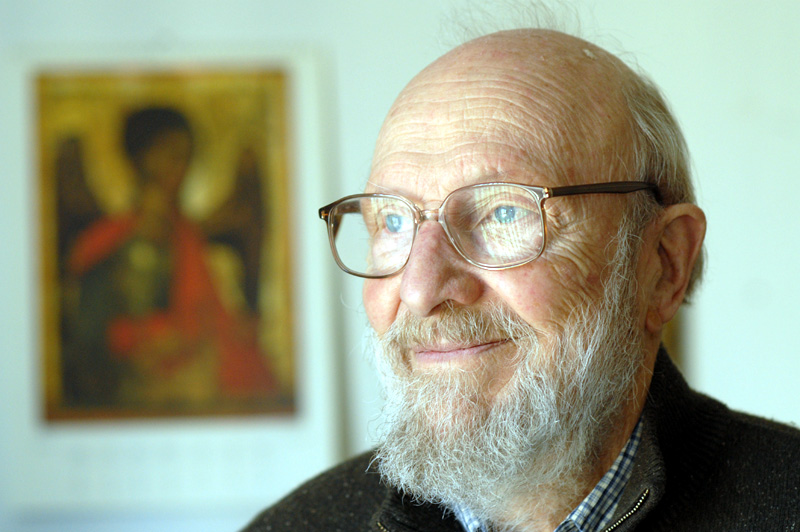
The Rev. Richard Wempe is a retired Catholic priest living on a fixed income in Lawrence. Several national organizations are working to provide better retirement plans for members of the clergy.
For 18 years, the Rev. Richard Wempe worked with the homeless in Kansas City, Mo., and didn’t take a salary.
Now that he’s retired, that means he can’t accept Social Security for those years. And even during the years he did earn a salary, he received only partial Social Security benefits.
Today, the retired Catholic priest says he lives well. He calls his apartment at Prairie Commons, 5121 Congressional Circle, the “classiest place I’ve ever lived.”
“My needs are less because I don’t have a family,” he says. “I’m 83. I was a Depression child. I know how to get $3 out of every dollar.”
But while some retired clergy members live well in retirement, some church denominations are concerned about how they’ll pay for their retirement benefits into the future.
That’s especially the case as baby boomer ministers reach retirement, and those who are retired continue to live longer.
“It’s a major problem,” says Sister Andree Fries, executive director of the National Religious Retirement Office of the Catholic Church.
She cites three reasons why her church is concerned about the future of retirement systems, including those for monks and nuns:
¢ Many religious staff once died before they retired. That’s not happening as often now.
¢ There are fewer younger priests to support the growing number of retirees.
¢ Health care costs are rising.
Fries says Social Security laws mean ministers receive about a third of the average benefits non-clergy members receive.
In the Catholic church, individual dioceses are responsible for their own retirement plans. Donna Harrity, director of group insurance and retirement for the Archdiocese of Kansas City, Kan., says a portion of a priest’s retirement is in a guaranteed payout for when they retire, and another portion is set aside for them to decide their own investments.
Fundraisers
The usual retirement age for priests is 70, though they can continue accruing retirement benefits through age 75.
“It’s a very good benefit,” Harrity says. “It certainly isn’t what an investment banker would make. But they’re getting better. We’re looking at those with an annual evaluation, to see if everything’s based the way it should be.”
To help raise funds for the retirement plan, the diocese has included retirement money in a capital campaign currently underway.
Similarly, Catholic churches have a once-a-year collection to benefit the National Religious Retirement Office.
Nuns and monks in particular, Fries says, have never been encouraged to save money.
“We’ve always been paid stipends, which are enough to live on,” she says. “If there was anything left over, it went to the schools or hospitals. We didn’t save anything at all.”
‘Very comfortable’
Other denominations are keeping a close watch on their pastoral retirement plans as well.
Carol Fusaro, who oversees the pension plan for the United Methodist Church for eastern Kansas, says each Methodist church in the United States pays into a national retirement plan. It’s similar to a 401(k) program.
“They’re vested from the very beginning, which is not always the case in the corporate world,” Fusaro says.
The plan changed this year. Now, the plan has two components, similar to the Catholic program.
“I think the benefit we have is an excellent benefit,” Fusaro says.
Don Miller, who retired at the end of 2005 from Immanuel Lutheran Church, 2104 Bob Billings Parkway, says he feels his church’s retirement plan is fair, as well. That plan, combined with Social Security, he says, is enough to live on.
“With those two together, it’s not like you’re out to pasture and there’s nothing for you,” Miller says. “I’m receiving a very comfortable income to live on. It’s not extravagant.”
A challenge for some pastors – especially those in smaller towns – is they live in parsonages and must find alternate living space when they retire.
That was the case when Wempe, the retired priest, moved here from Kansas City, where he had been serving. He likes living in Lawrence because of the variety of lectures and music events tied to Kansas University, and he doesn’t need much else.
“I tended to be a social activist much of the time, and I never had much money,” he says. “I didn’t have much for those 18 years, at the house for the homeless.”