

Israeli-Palestinian summit ends with few signs of progress
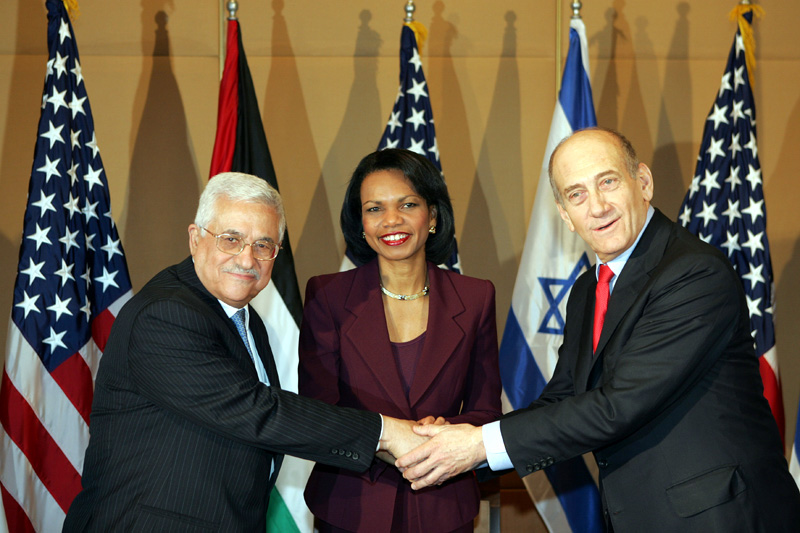
A mideast peace summit brings together, from left, Palestinian President Mahmoud Abbas, U.S. Secretary of State Condoleezza Rice and Israeli Prime Minister Ehud Olmert. Rice on Monday hosted talks between the Israeli and Palestinian leaders on ways to build an independent Palestinian state, but the summit appeared to yield little but a pledge to meet again.
Jerusalem ? A Mideast peace summit designed to open a new chapter for Israelis and Palestinians fed up with violence concluded Monday with no new agreements and a pledge to keep talking.
The United States, which had pushed for the session, said it was an accomplishment merely to have such a get together for the first time in six years. After two hours of talks with Israeli Prime Minister Ehud Olmert and Palestinian President Mahmoud Abbas, Secretary of State Condoleezza Rice stood alone in a bare-bones hotel function room to call the session “useful and productive.”
The prospect of any immediate success here essentially was hijacked by Abbas’ surprise announcement last week that he will govern hand-in-hand with the militant group Hamas. The United States and Israel list Hamas as a terrorist group and refuse all dealings with the group.
Speaking to reporters, Rice said the meeting was particularly valuable, however, in light of the lingering uncertainties about Abbas’ pact with Hamas.
“I think the real value here is that they sat down to talk with each other pretty early in this process,” Rice said.
“I could have made the decision that, well, I’ll just wait until this all sorts out,” Rice said, but she said that could have created new obstacles. “We thought it would be best to go ahead,” the secretary added.
Neither Rice nor other U.S. officials would describe the content of the session, although Israeli and Palestinian officials offered some details.
Olmert said he and Abbas agreed to maintain an open channel of communication, focused both on improving the lives of Palestinians and stopping terrorism.
“What we have heard today has nothing to do with a partnership,” said Mohammed Dahlan, an Abbas confidant.
“Abu Mazen is determined to go ahead with this national unity government. There is no backing down,” Dahlan said, using a nickname for Abbas.
Abbas has said that the deal brokered by Saudi Arabia is the best one he could get from Hamas, and that he would move ahead with forming a coalition. The power-sharing deal is seen as crucial to halting internal Palestinian fighting that has killed more than 130 since May.
Abbas and Olmert also discussed possibly extending a 3-month-old cease-fire covering the Gaza Strip to include the West Bank, said Palestinian negotiator Saeb Erekat.
Hamas spokesman Ismail Radwan called Monday’s summit a failure.
“Rice did not succeed in pressuring President Abbas to withdraw from the unity government. We call on the U.S. administration to respect the Palestinian people’s will and recognize the government and open a dialogue with the government,” he said.
A senior State Department official, speaking on condition of anonymity to describe the closed-door session, said it was an “an irreplaceable opportunity to clear the air.”