

Suspended memories
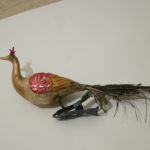
Carol Floersch's stork ornament
The ornaments that fill Christmas trees are full of history, memories and stories. We asked readers to share those stories. Here are some of them, all from Lawrence residents.
Lone survivor
Caleb Rosebaugh is so embarrassed by the ornament that when he helps decorate the tree, he always places the decoration at the back of the tree, next to the wall.
He’ll be so delighted that it’s in the newspaper.
It’s been about 25 years since Caleb, then a tooth-deprived kindergartner, made the ornament out of construction paper and pretzel rings attached with Elmer’s glue. Caleb’s photo is in the middle.
His brother, Josh, was 3 at the time. He got access to the Christmas ornaments and decided, well, they looked delicious.
“We had a lot of different homemade ornaments that were either made of food items or looked like food items, and he ate them,” says Cathy Rosebaugh, the boys’ mother. “One was made of Styrofoam. He ate it, too.”
The lone pretzel ornament remains.
Caleb’s wife loves the ornament, Cathy Rosebaugh says. Someday, she plans to give it to the couple.
That way, she figures, he can be embarrassed of his own tree.
Memories of mom
Bill Venner thinks of his mother every time he looks at his Christmas tree.
How could he not? Nearly every ornament on the tree was made by his mother between the early 1960s and late 1980s.
His mother, who lived in Richmond, Va., made ornaments year-round as a fundraiser for her church and to give to friends and family.
She started with Styrofoam balls, which she sculpted to whatever shape and size she wanted. Then, she decorated them with ribbon, costume jewelry and push pins, getting more elaborate as the years went on.
Now, Venner has dozens of them hanging on his tree.
“The main thing is my mother, and how dedicated she was do this and raising money for the church,” he says. “There was always some big project the church needed – steam cleaning, for example. And it might take them two or three years to raise money to do the project.”
Which is his favorite?
“I think all of them are her best work,” he says, “but I’m prejudiced.”
Cookie parties
The tree at Celia Smith’s home is partially bare, but the smell of gingerbread means it won’t be bare for long.
Ever since she was a child in Madrid, Smith has baked sugar cookie and gingerbread ornaments for her Christmas tree.
Back then, she only had a few cookie-cutter shapes. Now, she figures she has 250 to 300 – including a dinosaur, armadillo, airplane and George Washington.
Each year, she makes around 200 cookies and invites friends over to decorate them. Last year, 65 people came.
After the decoration process, a hook is inserted in a hole in the cookie so it can be hung. Smith decorates her own tree with the ornaments that guests don’t take home.
“When they’re iced and hung on the tree, they look beautiful,” she says. “Every year they are different. They let their imaginations run freely.”
Most years, Smith holds onto a few cookies in storage, but she admits the icing starts to look “sad” after a while.
That’s why, next year, she’ll fire up the oven and start her ornament-making process all over again.
Embattled decorations
Even after all these years, Carol Floersch can’t believe it.
Her great-grandmother came to the United States from Germany in 1863. She had four children and herself – five people in her party – but the boat only allowed four. So, the story goes, she smuggled in one of her children underneath her skirt.
Despite these circumstances, Floersch’s ancestor brought a whole collection of Christmas ornaments among her belongings. Best Floersch can figure, the ornaments are around 160 years old.
There are tiny candles that clip onto a tree, angels, a Santa Claus and bulbs. But Floersch’s favorite is a stork that has a child in a nest below it.
“It blows my mind,” Floersch says of the story. “If she was brave enough to bring all these with four children – one under her skirt – the least we can do is take care of them.”
Surviving the fire
The two ornaments – one cobalt blue, the other silver – could have gone unmentioned each year on Kim Kreicker’s family tree as she was growing up.
But that wasn’t going to happen. The story had to be told.
“I totally grew up in a family that was obsessed with this stuff,” she says.
That stuff, namely, is history.
The ornaments date to the mid-1860s and belonged to Kreicker’s great-great-great grandparents when they immigrated to the United States from Germany. They eventually settled in Chicago.
It might be special enough that the ornaments have hung from branches on her family’s tree since then. But it’s especially notable that the ornaments survived the 1871 fire that destroyed much of Chicago.
The fire did destroy Kreicker’s ancestors’ store – which sold “toys, notions and school supplies” – but not their house, where the ornaments presumably were kept.
“It’s been a long time,” she says. “And we’ve had them up every year.”
First Noel together
Even today, after 28 years of marriage, Joan Stone admits the plastic ornaments look a little tacky at first blush.
But once she tells the story behind them, people usually change their minds.
It was 1979, and she and her husband, Mark, were newlyweds living in the married student apartments at Iowa State University. They found a discarded Christmas tree by the Dumpster and claimed it for their own.
They didn’t have much money for ornaments, so they answered an ad in the paper from a woman with decorations for sale.
She was an older woman, and she answered the door with a cane and a German accent. She had tables full of old ornaments she was selling for a dime apiece, and she wanted to tell the story behind each of them as the Stones were making their way from room to room.
“She was the sweetest little old lady,” Joan Stone says. “It was like a Hallmark story on TV.”
They bought a lot of ornaments – $3 worth – but their favorites were round plastic ones that had a mechanism inside that spins when placed over the heat of a Christmas lightbulb.
“It’s not that we planned that,” Joan Stone says of the experience. “But I can’t help but think we picked up good feelings from her. You could help but pick up on those.”