

Donors’ conference exceeds goal for funding Palestinians
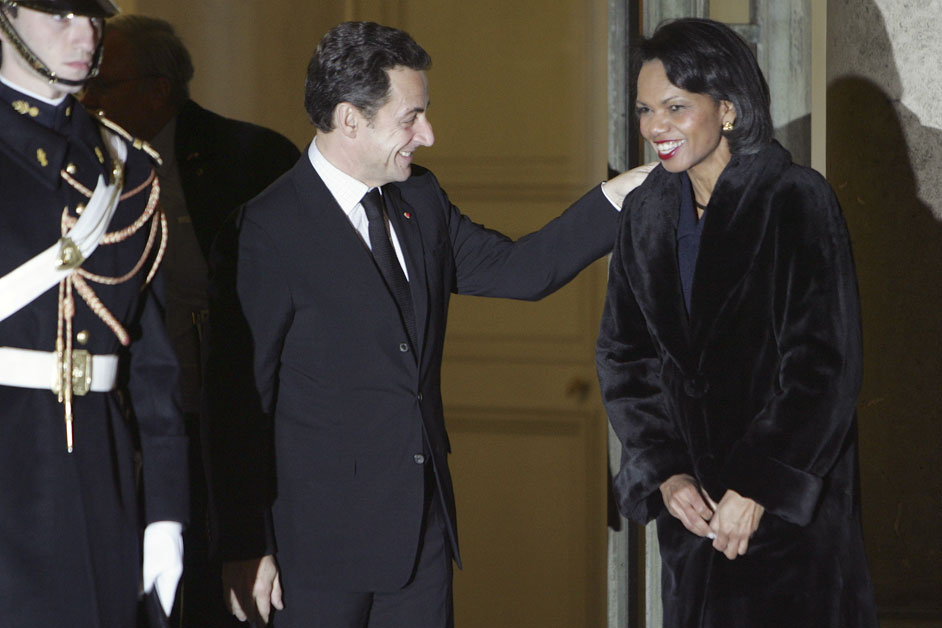
French President Nicolas Sarkozy, left, accompanies U.S. Secretary of State Condoleezza Rice after their meeting at the Elysee Palace in Paris. Rice urged generous international aid to the Palestinians on Monday, and the global community answered the call.
Paris ? Representatives from around the world collectively endorsed the latest U.S.-backed Middle East peace initiative Monday, pledging to support the crippled Palestinian economy at a crucial moment when its moderate leaders are engaged in peace talks with Israel. Ninety countries and international organizations shored up the Palestinians with pledges to donate $7.4 billion, almost $2 billion more than Palestinian President Mahmoud Abbas had originally sought to prepare the area for statehood over the next three years.
Europeans promised about half the money; Arab nations, with Saudia Arabia taking the lead, came through with 20 percent; the U.S. and Canada gave 11 percent and international organizations gave another 11 percent, with smaller regions making up the rest.
But even as they tendered their financial support to bolster the nascent peace process, nations such as France, Great Britain, and Germany, offered sharp rebukes to Israel for its settlement activities and for maintaining checkpoints that have made trade and economic recovery in the Palestinian territories nearly impossible.
After opening the conference Monday, French President Nicolas Sarkozy called on Israel to freeze its settlement activities and to ease checkpoint restrictions. German Foreign Minister Frank Walter Steinmeier told German TV that the Israelis had to stick to their promise to halt settlement building.
In a speech to the donors, however, Israeli Foreign Minister Tzipi Livini said that while Israel endorses Abbas’ reform plan, the checkpoints are needed for security. She said nothing about Israel’s announcement that 300 new homes would go up in a Jewish neighborhood in East Jerusalem, but restated Israel’s intent to live up to a 2003 commitment to end settlement activity.
“We want the obstacles to Palestinian economy and daily life to be removed,” she told the donors. “We have no desire to control Palestinian lives. … But we know that making every effort to improve quality of life, also means making every effort to end the threat to life posed by terror and violence.”
As if to punctuate the point, an Israeli air strike in Gaza City killed the commander of the Islamic Jihad’s military wing and his assistant. Several hours later, a separate attack south of Gaza City killed two additional Islamic Jihad members.
Abbas began the day by presenting an ambitious plan to donors that spelled out how money would be spent. Seventy percent, he said, would be earmarked to meet a payroll for 110,000 civil servants and other day-to-day needs, with the rest budgeted for capital projects and humanitarian aid.
Although the international community has coughed up almost $9 billion to support the Palestinians since 1993 through similar pledge-fests, less than half the amount of money promised actually materialized, according to a Palestinian who asked not to be named.