

Sharing the language
Storytime at Lawrence library helps bridge cultural gaps
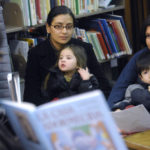
From left, Rupaleem Bhuyan and her 2-year-old daughter, Minaci Bhuyan, and Edith Paredes, and her 4-year-old son, Giovanni Paredes, all of Lawrence, listen to Karen Acosta read at the Lawrence Public Library. The bilingual reading program at the library is at 4:30 p.m. on Fridays.
Karen Acosta is sitting on a toddler-sized chair, and she’s using her best “I’m-talking-to-cute-little-kids” voice.
She’s reading to about a dozen people, children and their mothers, gathered at the Lawrence Public Library.
The story is about a child who is planning a party – or more specifically, a fiesta.
Acosta is helping the children learn to count the number of pieces of candy that will go in the piñata.
“One … two … three …”
She stops herself.
“Oh,” she says with a grin. “En español!”
This isn’t a typical story time, at least not as far as the Lawrence Public Library is concerned. This is the weekly Spanish/English Storytime, held at 4:30 each Friday afternoon.
The group is divided evenly between Spanish-speakers wanting to hear a story and learn English, and English speakers who want to learn a little Spanish.
“We have a diverse crowd,” says Acosta, a Kansas University graduate student from Paraguay who volunteers to lead the story time.
Spanish exposure
Joyce Steiner, youth services coordinator, says the library, at 707 Vt., has held story time in Spanish for about three years. At first, she says, it was a way to reach out to the Hispanic community in Lawrence.
But with an increased emphasis on early foreign language education – St. John Catholic School recently added Spanish classes at its elementary school – and with Spanish showing up more in popular culture – “Dora the Explorer” frequently incorporates Spanish phrases – Steiner says English speakers have begun coming to the story time, too.
“Kids don’t learn a lot of Spanish, but they do get exposed to it,” Steiner says. “It might want to make them want learn more.”
On this particular Friday, the offerings include two stories. In addition to the book about the child planning a fiesta, Acosta reads one about a flea that manages to wake up an entire house of sleeping people.
Acosta hands out a vocabulary sheet with words such as “abuela” (grandmother) and “raton” (mouse), which she reviews before reading each story. Then, she reads the stories in Spanish, frequently repeating herself in English to explain what’s happening.
Steiner says the library is continually adding to its collection of books in Spanish. Most of the children’s books available, she says, are English stories translated into Spanish, rather than stories that come from Hispanic cultures.
She says American libraries are constantly trying to work to get more Hispanic people into their doors. Often, Steiner says, these people are from countries where libraries are only for academicians or the elite.
“We’re trying to reach out to that group to let them know, yes, they’re welcome here,” Steiner says.
‘Little bit helps’
Edith Paredes knows that’s the case.
She’s originally from Paraguay, and she’s brought her two young boys to story time.
“We really focus on having our two children be bilingual,” Paredes says. “We want them to be exposed to both languages.”
At home, they speak only Spanish. The boys learn most of their English at preschool.
“Our relatives, most of them don’t speak English,” Paredes says. “And it’s also the culture. My husband is from Mexico, so we want them to experience not only the language but the culture.”
She says the story time is a positive way for her boys to be exposed to a bilingual situation.
Cheryl Hicklin, another Lawrence resident, also sees the benefits of the story time. Her 9-year-old daughter has been going for months.
Though her daughter, Jedzia, is learning some Spanish at St. John Catholic School, Hicklin says she’s hoping this will spark more interest.
“Sometimes you get discouraged, hearing you have to start teaching them when they’re babies,” Hicklin says. “But every little bit helps. Maybe this will help her want to study it in high school.”
And Hicklin, who spent a year living in Buenos Aires, Argentina, says Jedzia isn’t the only one benefiting from the children’s stories.
“I like to listen to Spanish, keep my Spanish skills up and introduce it to my daughter,” she says.