

Markets recoil on subprime fears
French bank's freeze on funds raises credit market worries
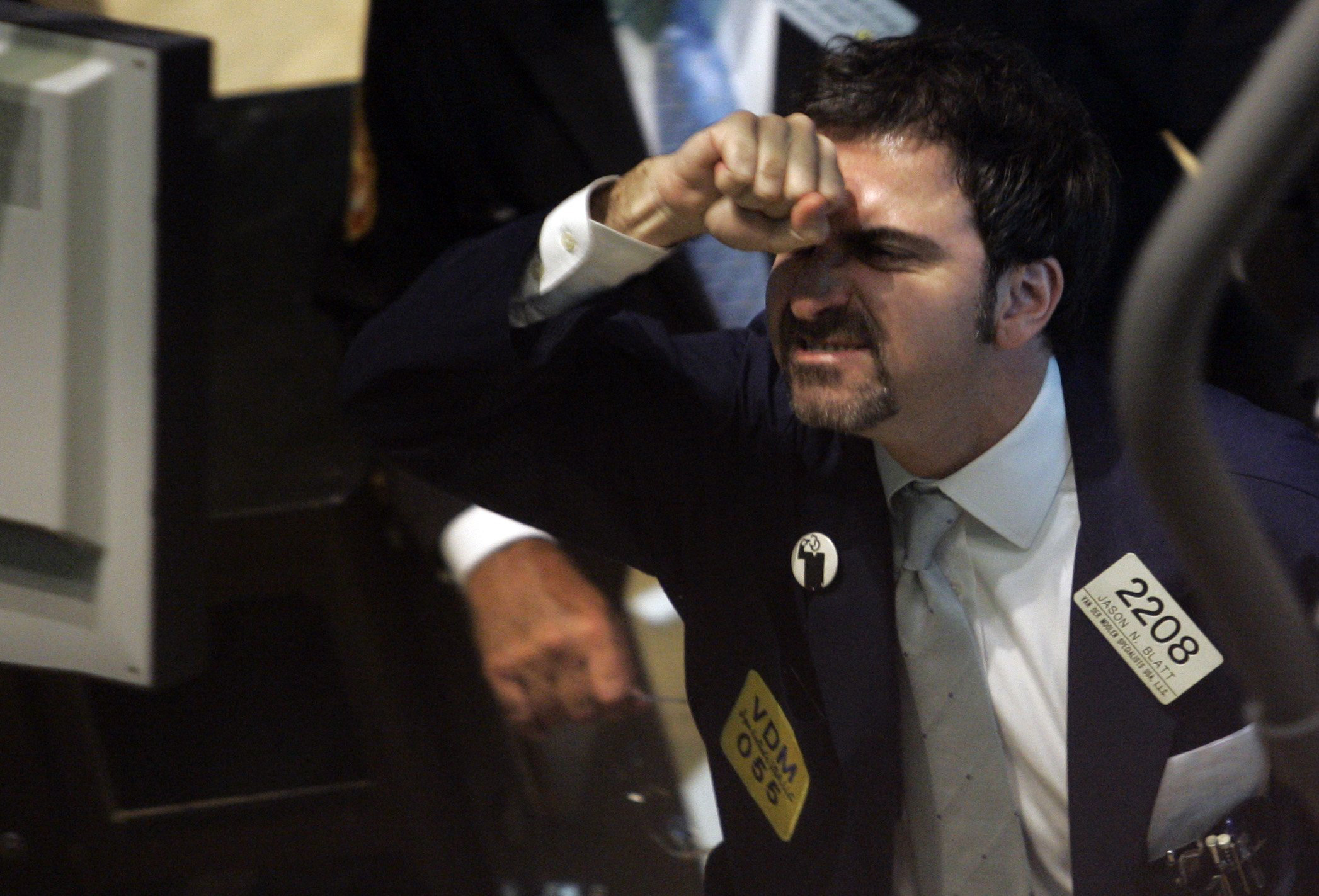
As Wall Street plunged more than 380 points Thursday, specialist Jason Blatt assessed the damage on the floor of the New York Stock Exchange. The drop occurred after a French bank said it was freezing three funds that invested in U.S. subprime mortgages because it was unable to properly value their assets.
Wall Street’s deepening fears about a spreading credit crunch sent stocks plunging again Thursday, with the Dow Jones industrials extending their series of triple-digit swings and falling more than 380 points.
The catalyst for the market’s latest skid: a French bank’s announcement that it was freezing three funds that invested in U.S. subprime mortgages, raising the specter of widening problems in the U.S. credit market.
“We’re seeing a lot of fallout from the subprime mortgage debacle that we’re in,” said Matt Neis, a financial consultant for A.G. Edwards in Lawrence, who spent much of Thursday updating, advising and counseling about 50 of his clients. “We’re actually seeing a lot of good news from corporate earnings reports – Target exceeded expectations – so we’re seeing a lot of good news out there, but it’s being overshadowed by the subprime mortgage worries.”
The idea that anyone – institutions, investors, companies, individuals – can’t always get money when they need it unnerved a stock market that has suffered through weeks of volatility triggered by concerns about tight credit and bad subprime mortgages, analysts said.
The broader Standard & Poor’s 500 index fell 44.40, or 2.96 percent, to close Thursday at 1,453.09.
Before Thursday, the S&P had its best three-day winning streak in nearly five years. But the latest pullback was the biggest point drop and percentage loss for the Dow and the S&P since a market decline Feb. 27.
The Nasdaq composite index fell 56.49, or 2.16 percent, to 2,556.49. On Wednesday, it had posted its biggest point gain in more than year. And while Thursday’s loss was sharp, Aug. 3’s was more severe.
A move Thursday by the European Central Bank to provide more cash to money markets intensified Wall Street’s angst. Although the bank’s loan of more than $130 billion in overnight funds to banks at a low rate of 4 percent was intended to calm investors, Wall Street saw it as confirmation of credit market problems. It was the ECB’s biggest injection ever.
The Federal Reserve added a larger-than-normal $24 billion in temporary reserves to the U.S. banking system.
The concerns that arose in Europe and spilled onto Wall Street underscored the potential worldwide ramifications of an implosion of some subprime loans and perhaps also weakened arguments that strength in the global economy could help keep profit growth going in the U.S. among large companies that do business overseas.
“We knew this was coming,” Neis said. “We don’t know how long it will last, but we don’t believe it will be two or three years. We think it’s a short-term fluctuation in the market. :
“Six months from now we’ll probably move on to some other problem to deal with.”
For now, he said, he’s advising his clients not to panic, and to take advantage of the opportunities that lower prices for stocks can afford.
“Short-term drops in the market are a long-term investor’s best friend,” Neis said.