

Planet has potential to be habitable
Washington ? For the first time astronomers have discovered a planet outside our solar system that is potentially habitable, with Earth-like temperatures between 32 and 104 degrees, a find researchers described Tuesday as a big step in the search for “life in the universe.”
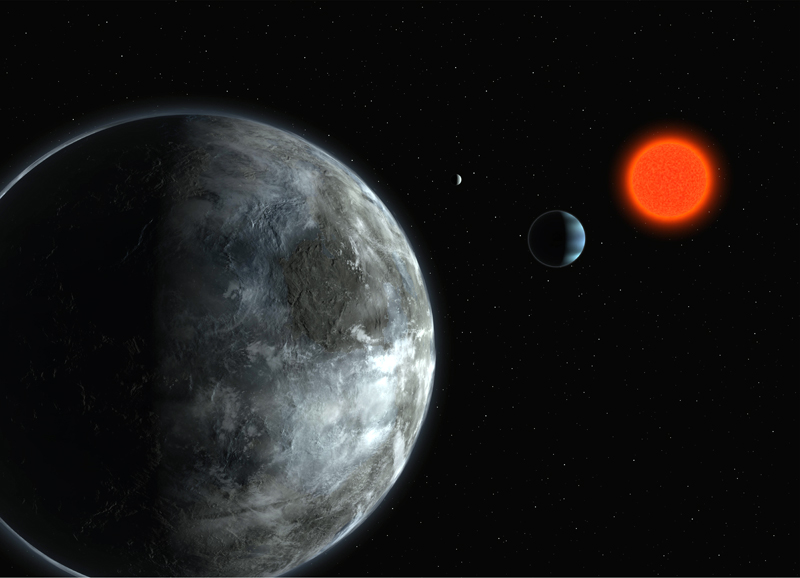
This illustration From the European Southern Observatory shows planets orbiting the red dwarf star Gliese 581 in the constellation Libra. Astronomers believe the newly discovered planet 581 c, left, is potentially habitable.
The planet is just the right size, might have water in liquid form, and in galactic terms is relatively nearby at 120 trillion miles – some 20.5 light years – away. But the star it closely orbits, known as a “red dwarf,” is much smaller, dimmer and cooler than our sun.
There’s still a lot that is unknown about the new planet, which could be deemed inhospitable to life once more is known about it. And it’s worth noting that scientists’ requirements for habitability count Mars in that category: a size relatively similar to Earth’s with temperatures that would permit liquid water. However, this is the first outside our solar system that meets those standards.
“It’s a significant step on the way to finding possible life in the universe,” said University of Geneva astronomer Michel Mayor, one of 11 European scientists on the team that found the planet. “It’s a nice discovery. We still have a lot of questions.”
The planet, discovered by the European Southern Observatory’s telescope in Chile, circles the red dwarf star Gliese 581. Red dwarfs are low-energy, tiny stars that give off dim red light and last longer than stars like our sun. Until a few years ago, astronomers didn’t consider these stars as possible hosts of planets that might sustain life.
The discovery of the new planet, named 581 c, is sure to fuel studies of planets circling similar dim stars. About 80 percent of the stars near Earth are red dwarfs.
National

Feds won’t seek death penalty in plea deal with man accused of killing top Minnesota Democrat

NASA unveils astronauts to test tech for future moon landing
Social Security’ fund faces shortfall one year earlier than expected
WASHINGTON (AP) — Social Security 's retirement trust fund is projected to face a funding shortfall in 2032, a ...

House passes $70B bill to fund immigration enforcement for 3 years

Texas teen convicted of murder for stabbing another athlete at track meet
Multiple people shot near a festival in Ohio, authorities say
Multiple people were shot Saturday near a community festival in Toledo, Ohio, and police said a search for the ...