

Just another day at the ballpark
Media didn't devote much attention to Robinson's big-league debut
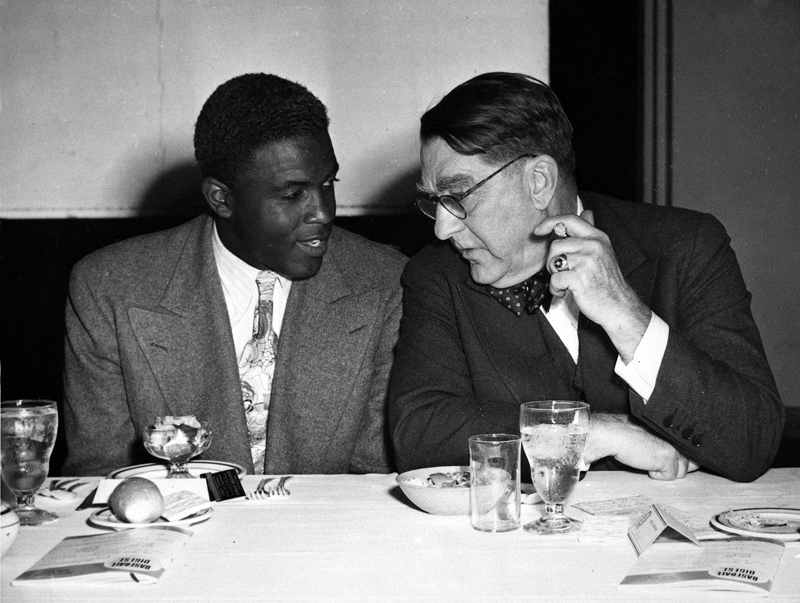
BROOKLYN DODGERS PRESIDENT BRANCH RICKEY, RIGHT, AND JACKIE ROBINSON confer at the Chicago Baseball Writers' Association annual dinner in Chicago in this Jan. 18, 1948 file photo.
EDITOR’S NOTE: Jim Becker covered sports and news for the AP for a quarter of a century. Now retired in Hawaii, he manages to see at least a dozen major-league games every year.
On a chilly, gray, early spring day, a black man in a sparkling white baseball uniform walked, alone, from the dugout onto the green grass of Brooklyn’s Ebbets Field.
It was April l5, l947, and Jackie Robinson was about to break the shameful color line in major league baseball, a feat that would have a lasting impact on sports and society.
There was a feel of history in the air overlaid, perhaps oddly, by a sense of somewhat calculated nonchalance.
I was standing by the batting cage along with a handful of other sports reporters when Robinson strode onto the field with that slightly pigeon-toed walk of the natural athlete.
About 10,000 of a crowd that would swell to almost 26,000 at the tidy old park, many of them black, had gathered well before game time. They made no special sound when Robinson appeared. No cameras flashed. Television was in its infancy, and there were no TV cameras on hand.
It was as if all of us – writers, fans and players on both teams, the Dodgers and the visiting Boston Braves – had come to an unspoken agreement to behave as though it was just another opening day at the ballpark. And, by the way, a black man played for the Dodgers.
It was a time in our country when in many places blacks couldn’t stay at the same hotel as whites, eat in the same restaurants, attend the same movie theaters or even drink from the same water fountains in the South. They rode in the back of the bus there.
It was into this atmosphere that the black man in the dazzling white uniform strode, alone, carrying for all of us the banner of decency and dignity and fair play that is the American promise.
There is no rooting in the press box, but many of us in it that day, like Robinson, had served in the Armed Forces and had just helped to defeat Hitler and thought it would be a good idea to defeat Hitlerism at home.
So those of us assigned to cover the game seemed to be of one mind that to turn this day of uncommon courage into a media circus would be both unseemly and unfair.
In the Dodger clubhouse before the game we talked to Robinson one at a time, and then only after interviewing a couple of veteran players first. Robinson said he was nervous, as he always was before a big game, but he was sure the feeling would wear off when the game started. He said he had been made to feel welcome by his new teammates, which may or may not have been true.
On the field Robinson was carrying, somewhat awkwardly, an unfamiliar first baseman’s mitt. A middle infielder by trade, he played first for the Dodgers that season.
Robinson glanced around for a few seconds, then picked up a baseball and began playing catch with a utility outfielder named Al Gionfriddo, who would make one of the most famous catches in World Series history that fall, and then disappear from the major leagues.
The PA announcer read the lineups in a matter-of-fact tone. This was before the hysterical homers took over the PA mikes, and the PA system at Ebbets Field never worked properly anyway.
Robinson, batting second, was thrown out by a whisker at first on his first time at bat. He went 0-for-3 with a sacrifice on the day. He reached base in the seventh on an error and scored on Pete Reiser’s two-run double.
The Dodgers won, 5-3.
After the game a half dozen or so writers combed the Dodger clubhouse, making a point to talk to several players. Robinson said he went hitless not because of the pressure, but “because Johnny Sain was pitching.” Sain was the Boston ace.
I gave the dressing room quotes to Joe Reichler, the AP’s baseball writer, who led his story with the result of the game. So did many others.
Some years ago I traded letters about Robinson’s first game with Jack Lang, longtime secretary of the Baseball Writers Association. He reminded me that there were nine mainstream daily newspapers in New York then, and not one of them led its game story with Robinson.
This approach persisted for some time. In late December I wrote the wrap-up of the sports year for AP. I relegated Robinson’s achievement to the 11th paragraph of a very long story, although when I got to him I pulled out all the stops. Robinson had been named Rookie of the Year, and the Dodgers had won the National League pennant, one of six they would win with Robinson.
Robinson had agreed with Rickey to hold his fiery temper and natural competitiveness in check, to endure the racial taunts from fans and opposing players. When the wraps came off and he was free to argue with the umpires and return with interest the foul bench jockeying, Robinson told me: “I can hardly wait for an umpire to throw me out of a game.” In other words, to treat him like everybody else.
But there was, there is, no way to treat Jackie Robinson like everybody else. His victory was his victory. Alone. His defeat would have been our defeat. All of us. He did not lose.