

Discarded devices pose security threat
New owners can retrieve sensitive information
Washington ? Don’t tell your cell phone any secrets. It might not keep them.
Secondhand phones purchased over the Internet surrendered credit card numbers, banking passwords, business secrets and even evidence of adultery.
One married man’s girlfriend sent a text message to his cell phone: His wife was getting suspicious. Perhaps they should cool it for a few days.
“So,” she wrote, “I’ll talk to u next week.”
“You want a break from me? Then fine,” he wrote back.
Later, the married man bought a new phone. He sold his old one on eBay for $290.
The guys who bought it now know his secret.
The married man had followed the directions in his phone’s manual to erase all his information, including lurid exchanges with his lover. But it wasn’t enough.
Selling your old phone once you upgrade to a fancier model can be like handing over your diaries. All sorts of sensitive information pile up inside our cell phones, and deleting it may be more difficult than you think.
Data not erased
A popular practice among sellers, resetting the phone, often means sensitive information appears to have been erased. But it can be resurrected using specialized yet inexpensive software found on the Internet.
A company, Trust Digital of McLean, Va., bought 10 different phones on eBay this summer to test phone-security tools it sells for businesses. The phones all were fairly sophisticated models capable of working with corporate e-mail systems.
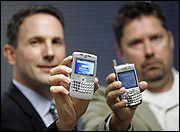
Nick Magliato, chief executive officer of Trust Digital, left, and Norm Laudermilch, chief technical officer, hold portable electronic devices. Their McLean, Va.-based company is working to make such devices more secure for people who store sensitive information on them.
Curious software experts at Trust Digital resurrected information on nearly all the used phones, including the racy exchanges between guarded lovers.
The other phones contained:
¢ One company’s plans to win a multimillion-dollar federal transportation contract.
¢ E-mails about another firm’s $50,000 payment for a software license.
¢ Bank accounts and passwords.
¢ Details of prescriptions and receipts for one worker’s utility payments.
The recovered information was equal to 27,000 pages – a stack of printouts 8 feet high.
“We found just a mountain of personal and corporate data,” said Nick Magliato, Trust Digital’s chief executive.
Many of the phones were owned personally by the sellers but crammed with sensitive corporate information, underscoring the blurring of work and home. “They don’t come with a warning label that says, ‘Be careful.’ The data on these phones is very important,” Magliato said.
Experts said giving away an old phone is commonplace. Consumers upgrade their cell phones on average about every 18 months.
Stored memory
The 10 phones Trust Digital studied represented popular models from leading manufacturers.
All the phones stored information on “flash” memory chips, the same technology found in digital cameras and some music players.
Flash memory is inexpensive and durable. But it is slow to erase information in ways that make it impossible to recover. So manufacturers compensate with methods that erase data less completely but don’t make a phone seem sluggish.
Phone manufacturers usually provide instructions for safely deleting a customer’s information, but it’s not always convenient or easy to find.
Research in Motion Ltd. has built into newer BlackBerry phones an easy-to-use wipe program.
Palm Inc., which makes the popular Treo phones, puts directions deep within its Web site for what it calls a “zero out reset.” It involves holding down three buttons simultaneously while pressing a fourth tiny button on the back of the phone.
But it’s so awkward to do that even Palm says it may take two people.
Trust Digital found no evidence that thieves or corporate spies are routinely buying used phones to mine them for secrets, Magliato said. “I don’t think the bad guys have figured this out yet.”
Peiter “Mudge” Zatko, a respected computer security expert, said phone owners should decide whether to auction their used equipment for a few hundred dollars – and risk revealing their secrets – or effectively toss their old phones under a large truck to dispose of them.
What about a case like the Lothario whose affair Trust Digital discovered?
“I’d run over the phone,” Zatko said. “Maybe give it an acid bath.”