

Lebanon braces for renewed conflict after assassination
Beirut, Lebanon ? Lebanon began three days of mourning Wednesday following the assassination of an up-and-coming anti-Syrian political leader whose death became a rallying cry for the country’s shaky pro-Western government.
As hundreds of anguished supporters carried Industry Minister Pierre Gemayel’s flag-draped coffin through his Christian hometown in the mountains above Beirut, Lebanon’s rival political factions braced for the fallout.
The government canceled Independence Day celebrations nationwide on Wednesday. In the Christian heartland north and northeast of Beirut, schools and shops were closed and traffic was light. But, underlining the political and sectarian divide, businesses were open as usual in Shiite areas in south Beirut where Hezbollah dominates.
Gemayel’s daylight assassination on Tuesday generated immediate international sympathy for Prime Minister Fuad Saniora as he tries to fend off an attempt by Hezbollah, the country’s powerful Shiite Muslim Islamic group, to topple his U.S.-backed coalition government.
It also complicated Hezbollah’s efforts to use its increased political stature following its 34-day war with Israel to boost its influence in the Lebanese government.
“The only winner in this is the Saniora government,” said Hilal Khashan, a political science professor at the American University of Beirut.
A Hezbollah success in toppling the Saniora government would be a major setback to American efforts to spread democracy in the Middle East, and it would further unnerve Saudi Arabia, Jordan and other Sunni nations worried about growing Shiite power in Iraq and Lebanon.
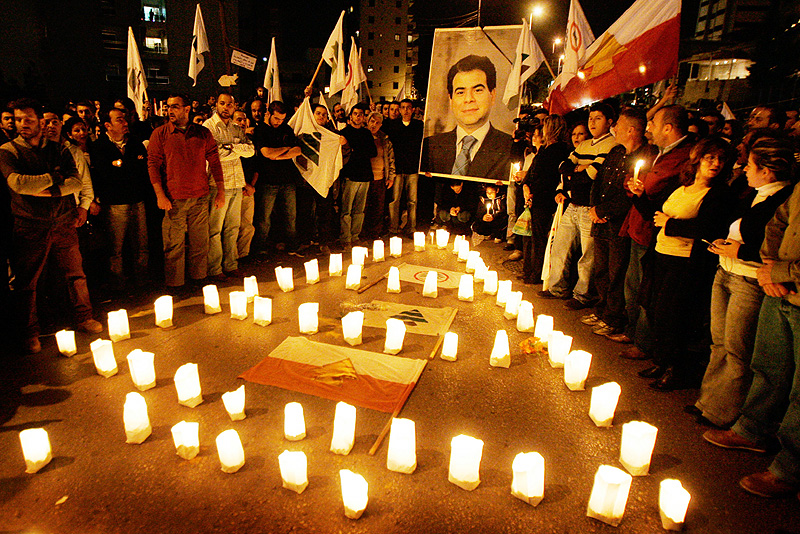
Mourners light candles placed in the shape of a cedar tree at a vigil in memory of assassinated Christian politician Pierre Gemayel. The gathering was Wednesday at the site where he was killed in Beirut, Lebanon.
Until Gemayel was shot to death while driving through a Christian neighborhood in Beirut, Lebanon had been preparing for a showdown between the government and Hezbollah supporters, who were expected to take their demands for more political power to the streets in protests as early as today.
But Hezbollah and its leader, Hassan Nasrallah, have been forced to postpone the demonstrations and rethink their strategy. While few believe that Hezbollah played a direct role in killing Gemayel, mourners turned their anger on the militia because of its close ties to Syria, which many suspect is behind a string of political assassinations stretching back to the February 2005 death of former Lebanese Prime Minister Rafik Hariri.
Hariri’s death sparked a peaceful uprising that drove Syrian forces from Lebanon after years of dominating the nation’s politics.
The rising anger makes it more difficult for Hezbollah to take its case to the streets.
While Nasrallah has cast the protests as an attempt to boost Shiite representation in the government, skeptics view the protests as an effort to derail an international tribunal capable of prosecuting those accused of involvement in Hariri’s assassination.
If the tribunal – endorsed by the U.N. Security Council and now awaiting government ratification – moves forward, it could implicate top Syrian officials and create more pressure on Lebanon’s neighbor to stop providing support for Hezbollah.