

Palestinians mark two-year anniversary of Arafat’s death
Ramallah, West Bank ? Tens of thousands of Palestinians converged on Yasser Arafat’s gravesite Saturday to mark the second anniversary of his death in a rally meant to reinvigorate his faltering Fatah Party.
Arafat’s successor, Palestinian President Mahmoud Abbas, told the crowd he expected to reach a long-delayed deal on forming a joint government with the militant Hamas group by the end of the month. Hamas officials also said a deal was close.
Abbas hopes the unity government will end crippling economic sanctions imposed by the United States and other Western countries for the Hamas-led government’s refusal to recognize Israel and renounce violence.
Fatah, whose January election loss to Hamas ended its four-decade domination of Palestinian politics, bused thousands of people to the West Bank city of Ramallah for the Arafat memorial.
Carrying Palestinian flags, Fatah banners and pictures of Arafat, the crowd marched to the muqaata, the compound that served as the late leader’s headquarters and where he spent the last years of his life.
Top Palestinian officials laid wreaths at the glass shrine atop Arafat’s grave inside the compound and read verses from the Quran, the Muslim holy book. The mass of people, many wearing the black and white scarf symbolic of Fatah, jostled for room inside the crowded courtyard. A massive picture of Arafat stood nearby.
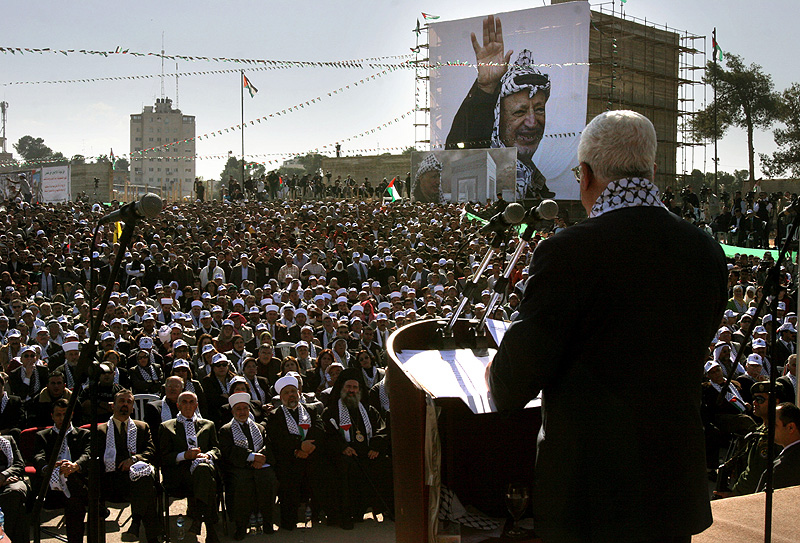
Palestinian President Mahmoud Abbas delivers a speech during a ceremony Saturday to mark the second anniversary of Yasser Arafat's death in the West Bank town of Ramallah. Arafat died Nov. 11, 2004, after leading the Palestinians for nearly four decades.
Abbas reiterated Palestinians’ demand for a state in the West Bank, Gaza Strip and east Jerusalem, pledging to “maintain Arafat’s will.”
Addressing the late leader, he said: “You inspired us by your long national roots, by your wise leadership, by your persistent, honest commitment. That’s what fills us with determination to go ahead and fulfill our national goals, the national goals that you worked for.”
As a leader, Arafat inspired great emotions in both his supporters and detractors. Israel saw him as a terrorist, and some of his people viewed him as deeply corrupt. But many Palestinians saw him as their best hope for achieving an independent state,
Arafat, who dominated Palestinian politics for nearly four decades, died on Nov. 11, 2004, after a sudden, rapid decline in his health.
More than a year after his death, his Fatah Party lost a parliamentary election to Hamas, a militant Islamic group that calls for Israel to be replaced with an Islamic state.