

Into the pool
Getting kids excited about testing the waters can be whale of a challenge
Claire Campbell inches toward the water, hands arched above her head in her best Superman pose.
Almost in slow motion, she eases head-first toward instructor Kenzi Lemos’ hand, which is outstretched as a target several feet from Claire in the water.
The dive is deliberate, but the painful “smack!” is unmistakable.
Claire resurfaces and dog-shakes the foul-tasting chlorine water from her face before opening her mouth to a wide grin.
“What was THAT?” Lemos asks.
“A belly-flop,” Claire responds, then lets out a wild giggle.
Claire is only 6, but she’s already an honorary fish when it comes to being in the swimming pool. She’s been in the pool since she was younger than a year old, and it’s clear she’s nearly fearless when it comes to being in water.
Not every child is that way. Those who teach swimming lessons in Lawrence say they deal with plenty of children – and even adults – who would prefer to avoid the water.
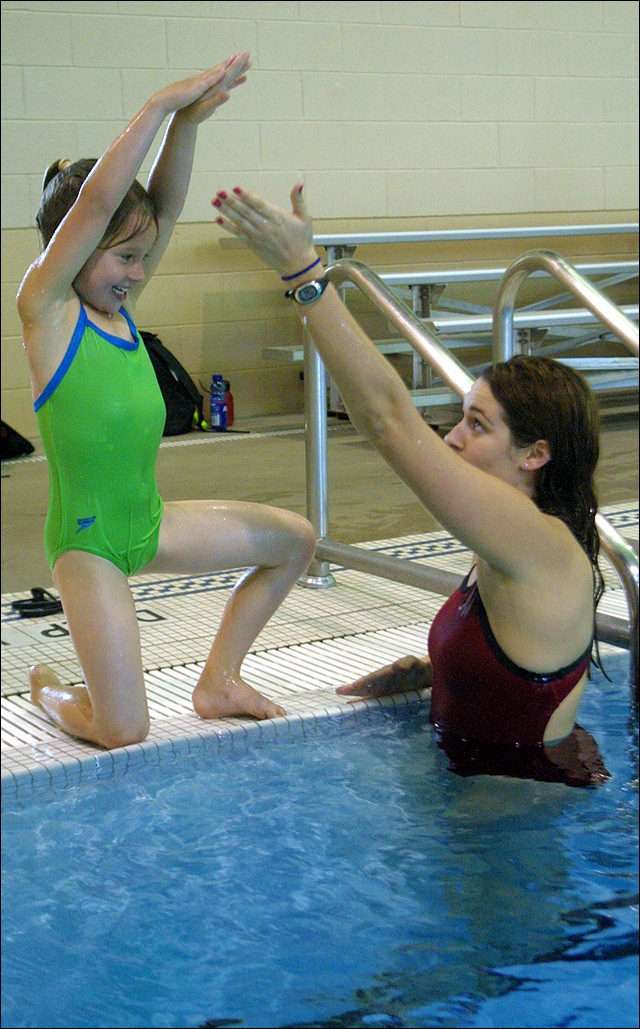
Claire Campbell, 6, prepares to dive with the help of her swimming instructor, Kenzie Lemos. Campbell takes private lessons once a week at the Indoor Aquatic Center, 4706 Overland Drive.
“There’s often a hesitation from both kids and their parents,” says Jimmy Gibbs, aquatics manager for Lawrence Parks & Recreation. “There’s usually a long history – a significant incident that happened early in their life so they don’t feel comfortable around the water. And if parents are uncomfortable around the water for some reason, that fear and hesitation impresses upon the kids.”
Wendy Leedy, health and safety programs director for the Douglas County chapter of the American Red Cross, says she thinks children’s fears often come from the admonishments of adults.
“You don’t want them to be fearful; you want them to be cautious,” Leedy says. “You don’t want them to think they can be careless and not pay attention to regulations and not be aware of water hazards. But parents and guardians can scare them by focusing too much on the negative.”
Start young
Both Gibbs and Leedy suggest acclimating children to water at a young age to avoid fear later in life.
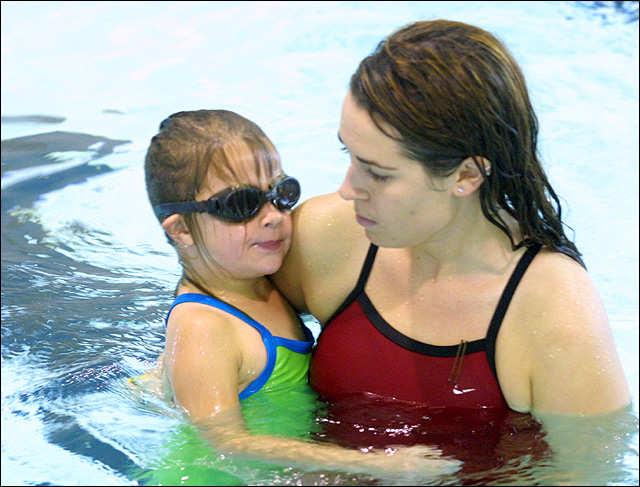
Campbell does water work with Lemos.
Gibbs says that could even mean blowing bubbles or sticking your face in the water while taking a bath with your infant son or daughter.
He says he suggests parents enroll in water classes with their children when they’re about 6 months old. The classes generally involve just being in the water and using games to learn skills such as breath control and opening their eyes under water.
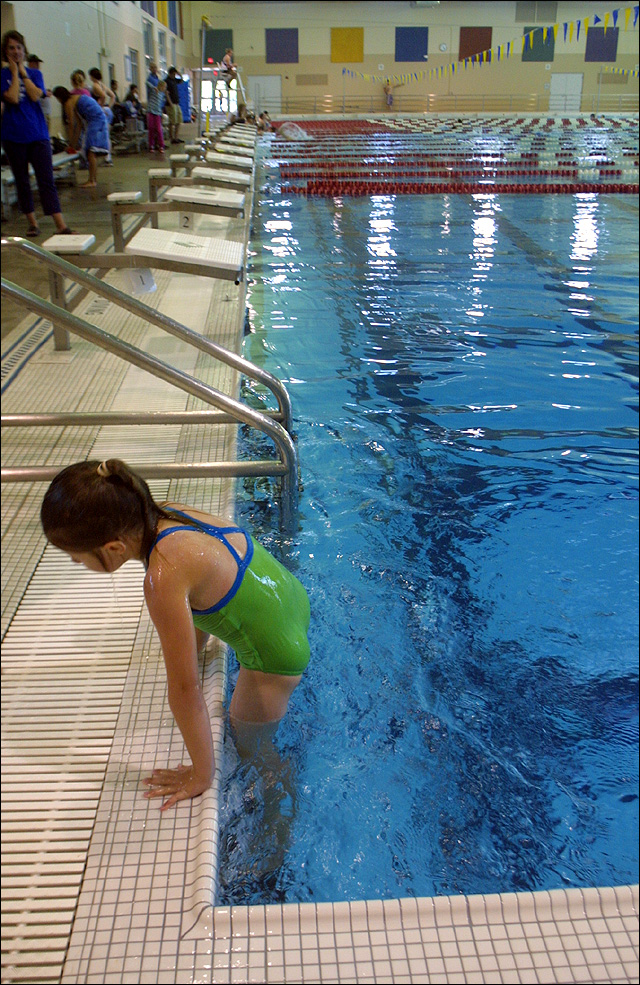
Claire Campbell, 6, exits the lap pool at the Lawrence Indoor Aquatic Center following a half-hour private lesson. Campbell has been in the water since she was 1 and has been taking swimming lessons since she was 3.
“The sooner you can get your kids in the water, the sooner they can learn how to use their body for buoyancy and stay safe in the water,” Gibbs says.
He says flotation devices approved by the U.S. Coast Guard can help introduce children to water, but they also can be dangerous, since parents are more likely to leave their children unsupervised with flotation devices.
Leedy also suggests parents be careful with their own actions around the water. Splashing, dunking children, pretending like a parent is drowning or forcing a child into the deep end of the pool might frighten them.
Lessons
Gibbs says Lawrence children typically start basic lessons at age 4 or 5. Lawrence Parks & Recreation typically gives 2,000 lessons a year, both during the summer at the Outdoor Aquatic Center, 727 Ky., and year-round at the Indoor Aquatic Center, 4706 Overland Drive.
That often is the first time children are in the pool without their parents nearby and offers another opportunity for nervousness.
“There’s a false sense of security with your parents,” he says.
Sign up
Swimming lessons for all levels, ranging from parent-child introduction sessions to advanced instruction, begin June 3 at the Lawrence Indoor Aquatic Center and June 5 at the Outdoor Aquatic Center.
Lawrence Parks and Recreation offers various options for days, times and session lengths.
For more information, visit www.lprd.org or call 832-7946.
For children who have been through lessons in the past, re-enrolling in a swimming-lesson course that’s already been completed is one way of re-acclimating them to the water for the summer.
For 6-year-old Claire Campbell, swimming lessons are a year-round event. Her father is Clark Campbell, women’s swimming coach at Kansas University.
Claire started lessons at age 3, and never had much fear “because we were always around water and had her in the pool with us,” says her mother, Cassandra Campbell. “We went to the pool to see dad. It was very familiar.”
Cassandra Campbell says she thinks spending time around water is the best way to calm fears. Introducing children early also gives them an advantage if they fall in water accidentally, without parental supervision.
“Some kids,” she says, “just sink to the bottom because they don’t know what to do.”