

School attacker gets life sentence
Victims' families accuse Russian government of cover-up
Vladikavkaz, Russia ? The Beslan school siege trial ended Friday much as it began, with grief-crazed mothers venting their anger at the sole known surviving attacker and at a government they say lied about the tragedy.
The regional Supreme Court convicted Nur-Pashi Kulayev in the deaths of 331 people – more than half of them children – and sentenced him to life in prison. Prosecutors had demanded the death penalty for his role in the 2004 hostage-taking, but Russia abandoned capital punishment when it joined the Council of Europe a decade ago.
“Kulayev deserves the death penalty but is sentenced to life in prison because a moratorium is in place,” Judge Tamerlan Aguzarov said.
Asked whether he understood the verdict, Kulayev, a Chechen, nodded his freshly shaved head. His lawyer said he plans to appeal.
As the judge read the verdict, some victims’ mothers threw themselves on the glass-and-metal cage where Kulayev stood during the yearlong trial. Police struggled to restrain them.
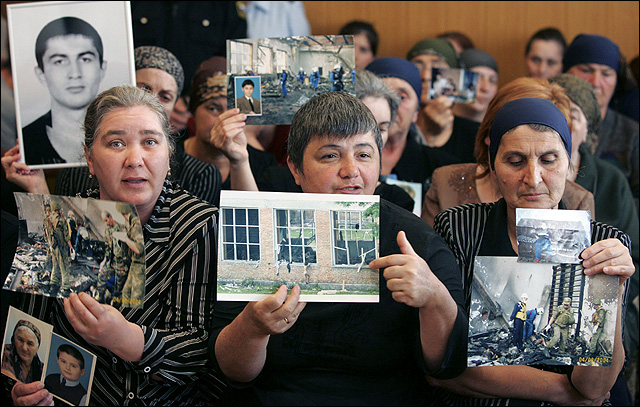
Relatives of victims of the Beslan school siege speak to the media after hearing the verdict on the sole surviving Beslan school attacker Nur-Pashi Kylayev in Vladikavkaz, Russia. Many of the relatives held photos of their dead children and scenes from the attack. A southern Russian court on Friday said the sole surviving Beslan school attacker deserved the death penalty, but sentenced him to life in prison because of the country's moratorium on capital punishment.
The women had crowded the courtroom to hear the sentence. Some held banners, illustrated with pictures of tanks and dead children, that blamed authorities for letting the siege happen.
Militants attacked School No. 1 in the southern Russian town on Sept. 1, 2004 – the first day of classes – taking more than 1,100 children, parents and staff hostage and herding them into a gymnasium, which they rigged with explosives.
Of the 331 victims, 186 were children. Most people died when the explosives tore through the school and Russian security forces stormed the building. Thirty-one suspected militants and 11 elite special forces soldiers also were killed.
Survivors and victims’ relatives claim many deaths occurred because troops fired at the school from tanks and flame-throwers, setting off a fire that caused the roof to collapse.
Many victims’ relatives have accused the government of a cover-up. They say officials helped the militants cross heavily policed territory to reach Beslan, and that many victims died needlessly in a botched rescue.
The North Ossetian Supreme Court found Kulayev guilty on all eight charges, saying he shot children as they tried to escape and detonated a bomb. He had said he participated in the raid but did not kill anyone.
Deputy Prosecutor-General Nikolai Shepel, who led the government’s case, said he was satisfied with the verdict. But victims’ relatives were deeply critical of the trial.
The Mothers of Beslan activist group accused prosecutors of carrying out a “superficial and one-sided investigation … meant only to establish the terrorists’ and Kulayev’s guilt.”
The group said investigators neglected to probe a chain of alleged government errors, including failure to take security measures despite a heightened danger of terrorist attacks; refusal to negotiate with the hostage-takers; an underestimation of the number of hostages; Russian forces’ lack of preparation for storming the school; and the “uncontrolled use of tanks, flame-throwers, grenade-launchers and other weapons.”
Relatives demand to know who bears the most responsibility: Kulayev and his 31 fellow militants or Russian officials whose negligence or even alleged complicity allowed the hostage-taking to happen.
“I did not go to court to become convinced of Kulayev’s guilt, but to reconstruct all the circumstances of the terrorist attack and find the truth,” said Aneta Gadiyeva, whose daughter was killed. “But I did not learn anything new and did not get any answers.”
The Beslan crisis stunned Russia and prompted President Vladimir Putin to push through sweeping political changes that many critics say have dealt democracy a major setback.