

Telecommuting suits lifestyles
More employees opt to work from home
Imagine being on a Hawaii vacation and stepping onto the hotel balcony to watch the sun rise over the Pacific.
Then the phone rings. It’s a co-worker from the mainland. Ready for the conference call?
It happened to Darlene Frudakis, president of PetAg Inc., a Hampshire, Ill.-based pet food maker. Even more surprising was Frudakis’s reaction.
“It was just a fabulous feeling,” said Frudakis, a full-time telecommuter who is very comfortable blurring the line between work and play. She relishes the “freedom and creativity … to think outside the box” that comes with being physically detached from her company’s headquarters – whether that is at home in Novato, Calif., or on vacation – and says that makes her more productive.
More than 30 years after the lifestyle began inching into mainstream corporate culture, and in spite of the potential pitfalls, there were almost 14 million Americans telecommuting at least part time in 2004, and an additional 7 million running businesses from home, according to the most recent Labor Department data.
In 2005, 44 percent of U.S. companies offered at least some telecommuting options, according to a survey of 1,043 large employers by Mercer Human Resources Consulting. That is up from 32 percent in 2001.
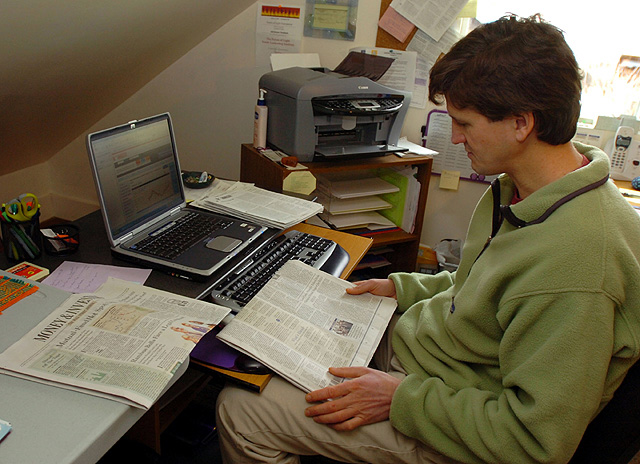
Bill Rocco, a mutual fund analyst for Chicago-based Morningstar, works in his home office in Ashland, Ore. He is among 14 million Americans who telecommute. Rocco, who has been telecommuting for nine years, said he chose the lifestyle because he could more easily indulge in the outdoors.
In the post-9-11 era, corporate America views a work force that can function remotely as a strategic advantage, experts said.
“The reason I think it’s gaining momentum is because of natural-disaster preparedness,” said Ellen Galinsky, president of the New York-based Families and Work Institute, a nonprofit that researches work force trends for corporations. Galinsky said it was the less centralized companies that were up and running fastest in the days following the Sept. 11 terrorist attacks.
Maryella Gockel, who oversees flexible work scheduling at Ernst & Young in New York, believes it is still the employees who are driving the trend. At first the telecommuting bandwagon was led by new mothers who wanted to have more time with their children, she said. Then dads sought similar arrangements. And, finally, employees without children began requesting the same kind of scheduling options their co-workers were receiving – they wanted to devote more time to a hobby or just spend less time in traffic.
Bill Rocco, a mutual fund analyst for Chicago-based Morningstar, has been telecommuting for about nine years, initially from Corvallis, Ore., and now from Ashland, Ore. – a lifestyle he chose so that he could more easily indulge his love of the outdoors.
Unlike Frudakis, Rocco said “it is really important to draw that boundary” between work and leisure, something he does by turning off the phone at the end of the day and before weekends. “Otherwise it would be too easy to work all the time,” he said.