

Tens of thousands attend funeral for Milosevic
Pozarevac, Serbia-Montenegro ? Slobodan Milosevic was laid to rest Saturday beneath a tree at the family estate in his hometown, a quiet end for a man blamed for ethnic wars that killed 250,000 people in one of the turbulent Balkans’ bloodiest chapters.
The late Serbian leader’s burial, a week after his death while on U.N. trial charged with genocide and crimes against humanity, followed an emotional farewell in Belgrade that drew at least 80,000 Serb nationalists and another in his birthplace attended by up to 20,000 admirers.
As a cold drizzle fell, his flag-draped coffin was lowered into a double grave with a place for his widow, Mirjana Markovic, who reportedly wants to join him when she dies.
The grave, marked with a simple marble slab inscribed with both of their names in Cyrillic letters and the dates 1941-2006, was dug beneath a favorite linden tree where the couple first kissed as high school sweethearts.
No immediate members of Milosevic’s family attended.
But in a letter read at graveside, Markovic, who lives in self-imposed exile in Moscow because she faces Serbian charges of abuse of power during her husband’s 13-year reign, said: “You lost your life while fighting for noble causes. You were killed by villains. But I know you will live forever for all who wish to live like human beings.”
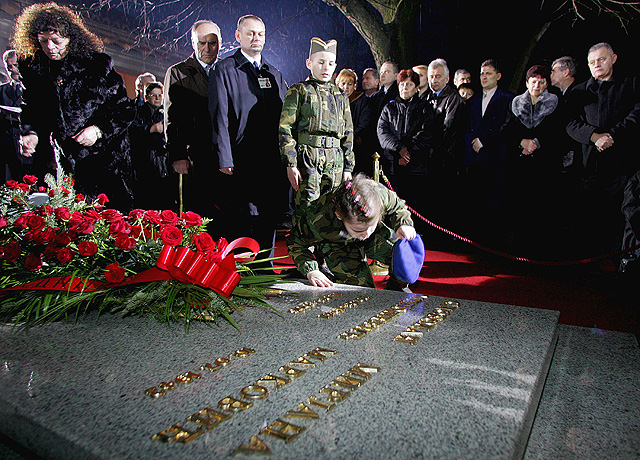
Sympathizers pass by the grave of former Serbian leader Slobodan Milosevic in his hometown of Pozarevac, some 30 miles southeast of Belgrade, capital of the former Yugoslavia. Milosevic was buried at dusk Saturday in the backyard of his family's estate after farewell ceremonies drew tens of thousands of nationalist supporters.
A letter from the couple’s son, Marko Milosevic, expressed hope that the late president’s death would “sober up the humiliated Serb people.”
“To die for one’s country means to live forever,” his letter said.
No priest officiated at the burial because Milosevic was an avowed atheist.
After the burial, residents of the gritty industrial town 30 miles south of the capital waited in a long line to view the grave, which was framed by a crimson carpet and brass stands holding red velvet ropes.
People had lined the town’s main street to welcome the arrival of Milosevic’s remains, cheering and waving as a brass band played a funeral march. Many threw red roses, the symbol of the Socialist Party.
Earlier in Belgrade, Milosevic supporters packed a square in front of the federal parliament to pay their respects. Many were bused in by his Socialist Party from Serb areas in Bosnia, Croatia and Kosovo, where Milosevic started wars during the splintering of Yugoslavia in the 1990s.
People wept and chanted “Slobo! Slobo!” at the sight of the flag-draped coffin on a bier atop a red-carpeted stage. Some clutched photographs of Milosevic or the U.N. court’s two most-wanted fugitives: Bosnian Serb leader Radovan Karadzic and his wartime military chief, Gen. Ratko Mladic.
Ramsey Clark, a former U.S. attorney general and longtime Milosevic supporter who is now on Saddam Hussein’s defense team, drew cheers by telling the crowd: “History will prove that Slobodan Milosevic was right.”
Milosevic died March 11 in his room at a U.N. detention center near the tribunal, which was trying him on 66 counts of war crimes, including genocide. He was the first head of state to be extradited by his country for trial by a U.N. court.