

Give a thought to scale when shopping online
Think about size if you plan to buy over the Internet or at any auction or sale you do not attend in person. For example, confusion often arises concerning doll furniture, dollhouse furniture and children’s furniture, especially if a table or bed is being sold from a catalog or Web site. The seat of an adult’s chair is about 16 inches from the floor; the back is about 3 feet tall. A child’s chair is large enough for an average 3-year-old to sit on. The seat is 13 inches from the floor, and the back is 16 inches tall. A dollhouse chair is usually made in the scale used to make the dollhouse. By the 1870s, the most common scale was 1 inch to 1 foot. There were some made to smaller scales, perhaps 1/8 or 2/5 of an inch to the foot. So a dollhouse chair would be just 3 inches high. Doll furniture came in sizes that fit various dolls. Larger chairs, sometimes large enough for a child, were made for 24-inch dolls. Small chairs were made for Barbie and other dolls about 12 inches tall. Period furniture for children, dolls and dollhouses all sell for high prices. But be careful — there are reproductions of all of these.
Q: What can you tell me about my antique bowl? A floral scroll mark printed on the bottom contains the words “Asiatic Pheasants, J.F.W., Foley Potteries.”
A: Your bowl is more than 100 years old. “Asiatic Pheasants” is a well-known 19th-century pattern used by several potteries in the Staffordshire district of England. The central design of the pattern — which has been found in pale blue, flow blue, black, pink and green — is a bouquet of flowers and a pair of flying pheasants. Your bowl was made at Foley Potteries of Fenton, Longton, England, sometime between 1869 and 1892. At the time, Foley Potteries was owned by James F. Wileman (the initials “J.F.W.” in the mark).
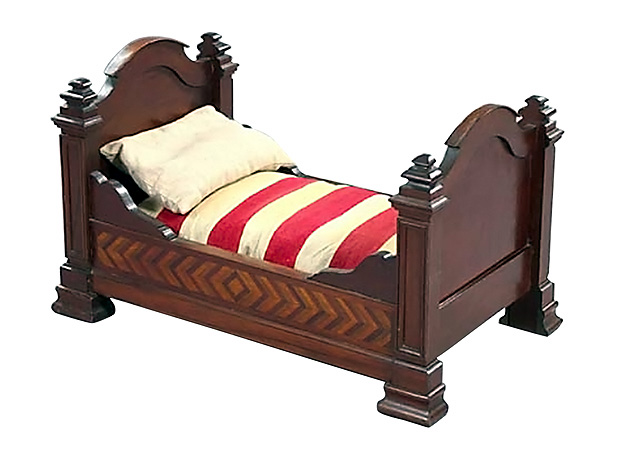
This is a mid-19th-century doll's bed, made to hold a 24-inch doll on the 30-inch-long mattress. It is well-made of mahogany, with inlaid rails. It sold for the adult-sized price of ,292 at New Orleans Auction Galleries.
Q: We inherited an old family photograph still in its original daguerreotype case. The case appears to be ebony with a carved design of a hanging flower basket. It’s lined with embossed velvet. The inscription behind the picture is: “Littlefield, Parsons & Co., Manufacturers of Daguerreotype Cases. L., P. & Co. are the sole proprietors and only legal manufacturers of Union Cases with the embracing riveted hinge, patented Oct. 14, 1856, and April 21, 1857.” We know you can’t help us identify our ancestors in the photo, but we’re hoping you can tell us something about the case.
A: Littlefield, Parsons & Co. was in business in New York City from 1857 to 1866, which dates your case and probably your picture. The case is not ebony. It’s a compound of gutta-percha (a natural rubbery substance) and shellac invented in the early 1850s by Alfred Critchlow. He called his cases “Union cases” and molded them in many designs. In 1853 he went into partnership with Samuel Hill and Isaac Parsons to manufacture the cases, then sold his interest in the company in 1857, when it became Littlefield, Parsons & Co. Union cases sell for about $200 to $250 if they’re in very good condition. An expert can tell you if your picture is a daguerreotype (an image made on a light-sensitive, silver-coated metallic plate) or an ambrotype (a negative image on glass backed by a dark surface).
Q: Can you tell me the origin of a fragile woven-silk souvenir ribbon I inherited from my grandmother? The wording at the top reads “Souvenir of the Independence of America.” Below that there’s a picture of a statue of George Washington on a horse and the words “George Washington, First President of the United States 1789.” Under that is a scene of the signing of the Declaration of Independence and the title “Signing of the Declaration of Independence, July 4th, 1776, Victory.” At the bottom, which is shaped into a point, there’s an American eagle. All of this fits on the ribbon, which is only 8 1/2 inches long by 2 1/2 inches wide.
A: Your souvenir is called a Stevengraph because it was made by Thomas Stevens of Coventry, England. In approximately 1860, Stevens (1828-1888) adapted a jacquard loom to create small, multicolored silk pictures to commemorate holidays and historical events, celebrate birthdays and honor poets or royals. Stevengraphs were produced until 1940. Yours probably dates from 1876, the year the United States turned 100, and may have been woven at the Philadelphia Centennial Exhibition held that year. Souvenir ribbons were often woven onsite at expositions and fairs. Your Stevengraph would sell for $25 to $100, depending on its condition.
Q: I have a collection of 60 Armstrong Cork Co. flooring catalogs dating from 1921 to 1982. They are in good to excellent condition. Any idea what they might be worth?
A: Armstrong Cork Co. became Armstrong World Industries about 25 years ago. Its corporate headquarters are in Lancaster, Pa. The company itself may be interested in your collection if its own is not complete. Or you could consider donating the catalogs to a historical society in Lancaster. If you sell your catalogs, you should get more for the whole collection than you would for single issues. Try selling through an online auction, or place an ad in an advertising collectibles publication or a Lancaster newspaper.
Tip: Clean the inside of a graniteware pot by filling it with water and boiling peeled potatoes in it.
Current prices
Current prices are recorded from antiques shows, flea markets, sales and auctions throughout the United States. Prices vary in different locations because of local economic conditions.
Brick mason’s tool, carries 6 to 10 bricks at a time, wooden handle, marked “Fuler Brikarrier by Goldblatt,” 1887, $40.
Gilbert Microscope Set No. 8, original tissue paper and cardboard inserts, $180.
Mary Gregory glass tumble-up water set, cobalt blue, girl holding bird, 6 3/4 inches, $225.
Charles and Ray Eames contour swivel chair, for Herman Miller, red molded-plastic shell on 4-prong base, 1958, 34 1/2 inches, $470.
Fraktur, brown-ink design, tulip center, stylized tree and potted fern, “Susannah Deeter was born July the 28th, 1817, by me, John R. Deihi,” 8 x 6 inches, $520.
Cast-iron squirrel nutcracker, wooden base, patented May 20, 1878, 10 x 3 1/2 x 9 inches, $750.
“Klondike Cough Nuggets 5 Cents” sign, cardboard, cowgirl holding product, red ground, yellow letters, 7 x 10 inches, $825.
Lenci doll, The Detective, pressed felt, blond hair, chubby face, painted features, diamond-pattern coat, 23 inches, $1,430.
Staffordshire platter, North Carolina State arms, octagonal, dark blue, floral border, impressed mark, 11 x 14 inches, $1,955.
Folk art folding campstool, various hardwoods, verses, hunter and deer, woman under tree, birds, signed and dated “Hosea Hayden, Sunday, June 19th 1892,” 18 1/2 x 26 inches, $4,715.