

Items that fit in multiple collections add value
In 1927, the first solo airplane trip across the Atlantic Ocean was flown by Charles Lindbergh. It was an event that was as unbelievable as the first man landing on the moon in 1969. Souvenirs of the Lindbergh flight were best sellers, and companies made plates, cups, scarves, figurines and even drapery fabric. His plane was named “Spirit of St. Louis,” so, as might be expected, a designer with a sense of humor created a dispenser for whiskey – spirits – that was shaped like the airplane. Several manufacturers made shakers and dispensers that included Lindbergh’s name, pictures of the plane, or were shaped like a plane. Today these are known as “crossover collectibles,” and they are sought by both those who collect Lindbergh memorabilia and those interested in liquor and its use.
Q: I have a toy wood-burning heating stove embossed “T. Southard, Peekskill, 1850.” It’s made of iron and is 18 inches tall by 27 inches wide. A flat plate at the top holds four filigreed sides in place above the base, which has an ash-box drawer on one side. Is it valuable?
A: Toy stoves like yours can be valuable. A T. Southard cast-iron toy cook stove auctioned for $600 a few years ago. The 1850 may refer to the year your stove was made. That’s about the time toy stoves were first sold by U.S. stove manufacturers. It had been thought that small model stoves from the 19th and early 20th centuries were salesman samples, but we now know that most of them were made as toys. T. Southard of Peekskill, N.Y., became Southard, Robertson & Co. in 1876.
Q: Is my Shirley Temple blue-glass breakfast set a collectible? I have a bowl and a small milk pitcher. There’s a white picture of Shirley at the bottom of the bowl and on the side of the pitcher.
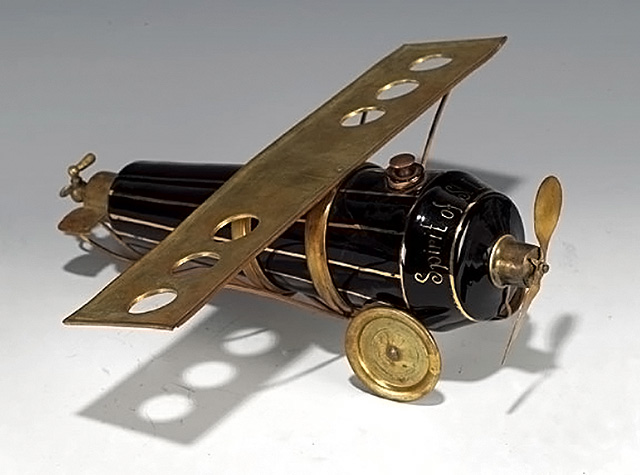
The Spirit
A: Blue-glass dishes with a white enamel picture of Shirley Temple were made from 1934 to 1942 by Hazel Atlas Glass Co. of Wheeling, W.Va., and U.S. Glass Co. of Pittsburgh. The dishes were used as product premiums by Wheaties and Bisquick. Today your dishes would sell for about $30 to $50 each. However, both the bowl and pitcher have been reproduced since the 1980s.
Q: My parents gave me a cast-iron dog bank with a survival pack on the dog’s back. It’s about 8 inches long and 5 inches high. The strap holding the pack is cast with the phrase “I hear a call.” Cast into the dog’s legs are the words “Copyright July 20th, 1900.” Any information?
A: A.C. Williams Co. of Ravenna, Ohio, started out as a manufacturer of stoves and tools, but in the early 1900s became the world’s largest producer of toys and still banks (the kind without moving parts). The company made still banks in many different shapes – including animals, buildings, clocks and cannons – until World War II. You have the company’s Water Spaniel with Pack bank, produced in fairly small numbers in the early 1900s. It sells today for $100 to $200.
Q: My aunt gave me a set of Japanese luncheon dishes she had owned for years. The dishes are decorated with a pastel scenic pattern in the background with flowers and a bird in the foreground. They are marked on the bottom with Japanese letters. When you hold the bottoms of the cups up to a light, an image of a geisha girl appears. Can you give us any information?
A: The geisha girl that appears in the cup bottoms is called a “lithopane” or “lithophane.” The picture is formed by varying the thickness of the porcelain base. The process was patented in 1827 in Paris and used by English potteries during the mid-19th century. Lithopanes were popular among Japanese ceramicists from the early 1900s through the mid-1950s. But the description of your dishes leads us to think they date from just after World War II. They must have been made in Japan for sale there, because dishes made for export were marked “Made in Japan” or “Made in Occupied Japan.”
Current prices
Current prices are recorded from antiques shows, flea markets, sales and auctions throughout the United States. Prices vary in different locations because of local economic conditions.
¢ Wrigley’s gum blotter, Sweet Laurel brand chewing gum, black ground, red wrapper, “Keeps Teeth Sparkling,” 2 x 5 inches, $55.
¢ Fenton-glass Hobnail pitcher set, iridescent yellow, eight matching tumblers, $265.
¢ The Little Colonel movie window card, starring Shirley Temple, Fox Film, 1935, 22 x 28 inches, $305.
¢ Mahogany cradle, tapered and hooded head, beveled, dovetailed pine rockers, 1830, 33 x 25 x 43 inches, $310.
¢ French Hansi character dolls, Yerri and Gretel, celluloid composition, painted features, smiling, jointed, velvet outfits, 1917, 8 inches, pair, $355.
¢ Cast-iron penguin doorstop, made by Creations Company, 1930, 3 x 3 3/4 inches, $560.
¢ Bullwinkle Pez dispenser, yellow stem, two orange candy packs, sealed, 1960s, $695.