

Out & about
Lawrence couple build gardens around gems that outshine standard sheds
I’ve been searching for inspiration for a little structure to build or buy for my own property, something to store items like bikes, the mower and gardening equipment. The pre-built garden sheds at hardware stores and big-box retailers make me cringe. Why toil away to make the domicile attractive just to erect a tin box next to a lush flower bed?
So I biked by Carol Huettner and David Baird’s garden one sunny afternoon on a hot tip from a friend who said this was a yard I needed to see. The most immediate aspect of this sprawling North Lawrence outdoor space to catch my eye was the intricately detailed and pristinely coddled “out structures.” Two gorgeous buildings independent of the home sat tall and proud as if they, too, had grown out of the fertile Kaw Valley.
When David, a gallery owner, bought this stately 1920s Victorian-style home 21 years ago, it was in disrepair. The large red barn was dilapidated, with cardboard for walls, a hole-filled roof and a gas stove in the center. It also housed goats. Now it’s a showplace, and much of the labor and creativity are products of Carol and David themselves.
This fantastic space houses ancient artifacts from North Africa and the Middle East, which David collected during his many globe-trotting treks. The barn entry has metal lanterns and light fixtures hanging from the rafters in the glass greenhouse atrium, and it boasts a room devoted to rugs and old hand-carved and hand-painted doors.
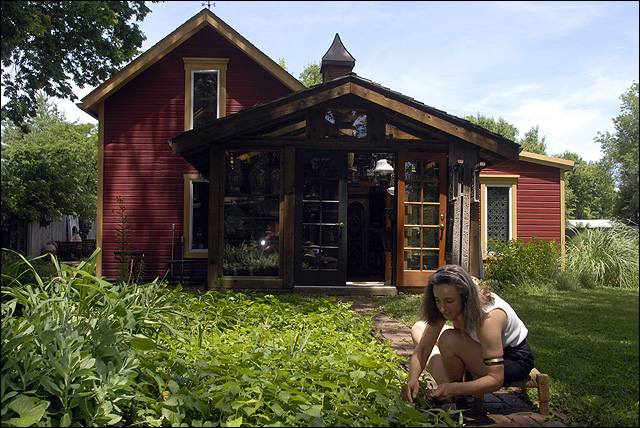
Lawrence gardener Carol Huettner picks through flowers, weeding one of several beds that surround some of the outbuildings where she and David Baird live in North Lawrence. Huettner and Baird use the buildings, which exceed the architectural standards of most run-of-the-mill garden sheds, to store tools, as well as items brought back from travels in North Africa and the Middle East.
There are drums, a balafon (African xylophone), masks, foot stools, textiles and colorful prints. It smells of a trip back in time to a small storefront tucked away off a busy road in Marrakech. Where the goats used to reside is now a polished sauna for David and Carol to relieve aches and pains from working too hard in the garden and on the house.
Off of the red barn is an inviting patio area where a mosaic table in the round is actively used for dining; above, there’s a thick wooden-beamed arbor with chunky wisteria vines clinging and wrapping around overhead.
“I wanted a grape arbor, which is quite common in Africa, but instead I got wisteria,” David says. “Part of the philosophy of North African architecture is the play of the indoor to the outdoor space and how they blend and mold effortlessly together. I try to keep that in the back of my mind and let it influence me.”
Turn the corner around the patio, and leaning against a smaller “out structure” are ornate moucharabi (wooden interlacing dowel work found in Arab windows and used as outdoor trellises). They are tilted effortlessly, casting shadows of mazelike designs across the stone work. The little vaulted windows have moucharabis fitted snuggly to allow for a breeze, and the tall walls, cathedral ceilings and narrow girth all make for a unique “house.”
Swing open the structure’s hand-carved Moroccan miniature double doors, and there are the lawn mower, bikes and gardening tools.
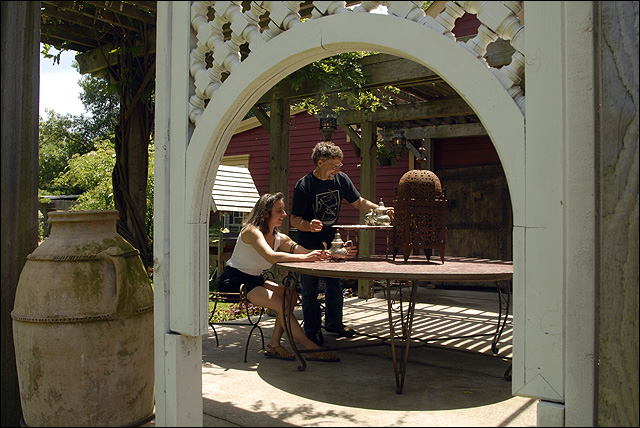
Carol Huettner and David Baird sit in the courtyard-type setting they've created in their backyard. North African architecture is the inspiration behind the design of their home and out
“I love this house; the slates along the ceilings are perfect for me to dry my flowers, and with the cross breeze of the windows it functions beautifully for that,” Carol says. “This structure really reminds me of an old tobacco drying barn or a ‘claim cabin’ from this country’s early settlers.”
David and Carol also have a rabbit hutch that is fit for the king of bunnydom, with a shingled roof and arched window facades.
The structures are magnificent pieces of architectural genius, throwing out conventional tool sheds and aiming toward aesthetically pleasing structures to place among Carol’s flourishing garden. She sells some of her heirloom flowers, which she has collected mostly from the East Coast, at the Lawrence Farmers Market, as well as fresh and dried herbs and flowers, and her pottery.
“I’m living the good life,” Carol says. “My sister might be jealous – she’s a lawyer.”
David and Carol are spanning the globe, collecting treasures along the way, whether it is Carol digging up an heirloom plant to lug home or David discovering an ancient door to incorporate into his designs. If they keep it up, they might not ever want to leave – because there truly will be “no place like home.”