

T-ball tests patience, promotes fun
Jay Garvin had the unenviable task of lining up about 11 5- and 6-year-olds for pictures at 5:45 p.m. on Thursday. If the children weren’t paying more attention to the spectators than Garvin, they were playing with each other in the dirt at Youth Sports Inc. Of course, once everyone was in place, a late arrival forced the process to be repeated.
Finally, Garvin settled the children down long enough for the photographer to snap a quick picture before 6 p.m. However, Garvin’s evening was far from over – he still had a T-ball game to coach.
Garvin coaches the Flaming Baseballs of the Parks and Recreation Intro T-Ball League.
“Flip a coin there, I don’t know,” said Garvin, when asked if it was more difficult to get his players to listen to him during pictures or games. “Their attention span is about that long on everything, so I’d flip a coin there. They’re both tough.”
While being a T-ball coach can appear stressful on the surface, Garvin genuinely enjoys it and, although the games last only 60 minutes, T-ball provides a breath of fresh air from the usual winning-driven sports leagues of today.
The biggest difference between T-ball and most sports is that the final score is irrelevant. By the end of the game, neither players nor coaches are aware of the final score and they couldn’t care less. Besides, in T-ball, both teams are allowed to bat around each inning, regardless of how many runs or outs they record. So an abacus would likely be necessary to track the plethora of runs each team collects.
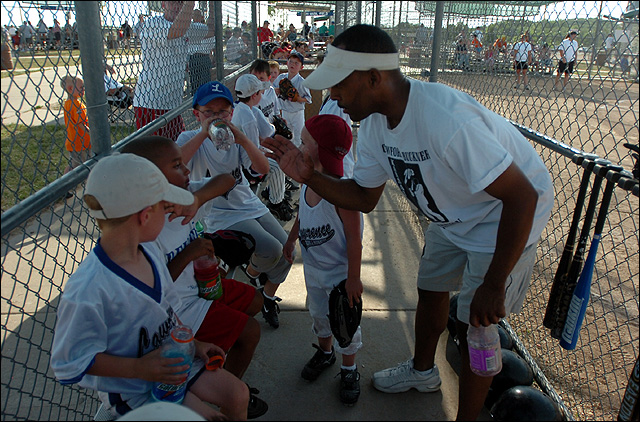
Flaming BAseballs' Coach Marvin Wesley fires up his team in the dugout Thursday when the Flaming Baseballs played Team 1 at Youth Sports Inc.
Another unique aspect of T-ball is that players must be cycled into games, so everyone plays. Unlike most sports, though, Garvin said there aren’t any battles for playing time. To keep parents from complaining about how much playing time their child gets, Garvin tells all the parents at the beginning of the season that playing time will be based on how many practices players go to. The only way players can get less playing time than everyone else is if they miss practices. As for the players, Garvin said he rarely hears complaints from them about playing time.
“You’ll get a few that say, ‘Why am I not playing?’ but you get more that say, ‘Hey, I want out. I’m tired,’ so they come sit down and get their Gatorade,” Garvin said.
Nevertheless, coaching at the T-ball level comes with its share of difficulties. Making sure a dozen children playing baseball for the first time all know what they’re supposed to be doing can take its toll.
An assistant coach for Team 1, Flaming Baseball’s opponent on Thursday, jokingly said, “Now I can finally relax,” when her team finally took the field after a few minutes of explaining where everyone needed to go.
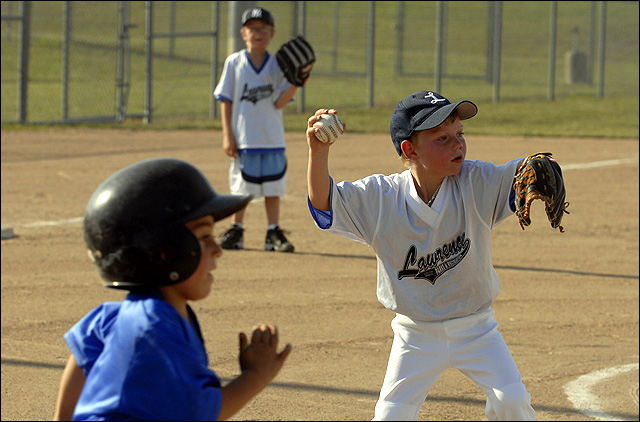
Flaming Baseballs' Pitcher Mason Phelps turns to first for a throw durirg his team's game against Team 1 on Thursday at Youth Sports Inc. The two teams play in the Parks and Rec Intro T-ball league.
After the game, Garvin gathered his team outside the dugout and as they munched post-game snacks, he kept them only long enough to remind them when the next practice was.
“The difficulties are the attention spans and just remembering what you tell them,” Garvin said.
Luckily for Garvin, he’s coached at the T-ball level before when his daughter played and he is a Parks and Recreation director, so he said he’s aware of the challenges that come with the job.
But for Garvin, the many positives easily outweigh the difficulties.
“Obviously, the positives are that they’re all out here to have fun and they’re having fun,” Garvin said. “This is the best level for enjoyment. They’re just out here to play. They don’t care if they win or lose.”