

What’s pumping them up?
The science behind those high gasoline prices that have your parents grumbling at the pump
Gasoline prices have been soaring lately. You probably hear your parents grumbling every time they fill up the car or minivan. But why is this happening? Here are some answers.
It’s all about demand …
Prices go up when a lot of people want to buy something (that’s called demand) and there’s not that much being sold (called supply). Worldwide demand for oil products, including gasoline, went up 7.6 percent from 2001 to 2005, to a total of 83.6 million barrels a day. (Crude oil is measured in barrels; each barrel equals 42 gallons. That means oil consumption is equal to 3.5 billion of those big gallon milk cartons – a day!)
Who’s using all that oil? China’s consumption is growing fastest, but the United States is by far the biggest guzzler of oil. We use a quarter of the world’s oil. Mostly we use it for cars, and the average car on the road in the United States gets the same mileage it did 21 years ago, despite all the advances in technology during that time.
… and supply
Oil is a hydrocarbon, made from plant life that died millions of years ago and has been cooked under high pressure beneath Earth’s surface. Oil is found in underground reservoirs. With the shifting of tectonic plates and the passage of time, these reservoirs can be found all over the world.
Running on empty?
For years, Texas had enough oil to supply the whole world. Now, most of the world’s discovered oil lies in the Middle East, particularly beneath the sands of Saudi Arabia. Political instability in the region means that it’s hard to be sure that a steady stream of oil will continue.
Just how much oil is still underground waiting to be tapped is a matter of great debate. People have written books saying that Saudi oil is starting to run out. However, the Saudi oil minister recently said the kingdom could increase production for many years to come.
New technology also is helping people discover new oil. Drilling companies have come up with ways to deal with shifting ice and deep waters. Sometimes they drill sideways to make it easier to get to the oil.
The fear factor
Not long ago, the world had much more oil than it used. Now supplies from the world’s oil-producing countries are just barely more than demand. That makes people nervous because a fairly small world incident could upset that balance.
For example, groups of Nigerians unhappy with the government of that African nation have blown up pipelines, making it impossible to get at much of that country’s oil.
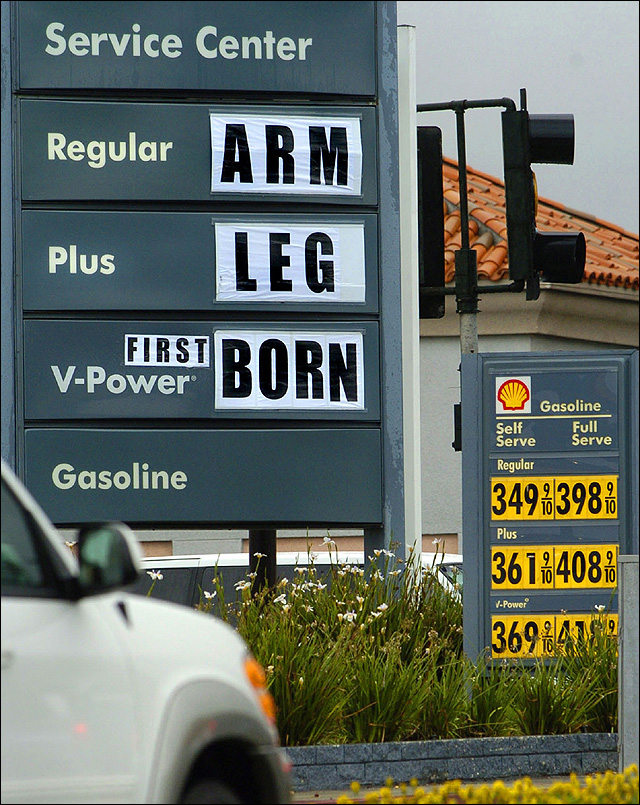
A sign outside a gasoline station expresses the high cost of gasoline in flesh-and-blood terms in Manhattan Beach, Calif.
Meanwhile, the United States and Europe are worried about Iran’s nuclear program, which the United States says could be used for nuclear weapons. What would happen if Iran refused to continue to sell 2.5 million barrels of oil a day?
Fears about the future lead to higher prices today, even if there is no real shortage at the moment.
A hurricane’s havoc
Last year, Katrina hit hard in the Gulf of Mexico, home of a large portion of U.S. oil and natural gas production as well as the nation’s biggest refineries, which get rid of the impurities in crude oil. (It’s called crude for a reason; you can’t just pour it from the ground into your gas tank.)
At first, Katrina knocked out nearly 60 percent of the Gulf’s oil production and nearly 40 percent of its natural gas output; several refineries were damaged, too. That’s part of the reason gas prices hit record highs after the August hurricane. Nearly all the facilities have been fixed now – in time for the new hurricane season, which started June 1.