

Where East meets West
Inspired by travels, Lawrence couple create Japanese garden
It all began with an innocent-looking bamboo plant.
Master Gardener Jane Kuwana planted a little pot of bamboo that she’d picked up at a farmers market to screen her front door. It worked out beautifully … for a while.
“Each winter I would lug this pot that kept getting bigger and heavier into the greenhouse,” she recalls. “Finally I just couldn’t carry it anymore. That bamboo started to crack the driveway, the home’s foundation, and it was everywhere!
“Still to this day, I am meticulously picking little volunteers of bamboo out of the garden.”
Jane and her husband, Ted, a retired Kansas University chemistry professor, conquered the bamboo beast and lived to tell the tale. In fact, their battle with the invasive plant didn’t discourage them from creating the Japanese garden of their dreams.
The Kuwanas have gathered inspiration for their home and landscape during more than 10 trips to Japan – they’ve scheduled another for later this year – and four to China. But even less-traveled green thumbs can incorporate the less-is-more Asian aesthetic into their yards by designing with simple lines, incorporating natural elements or simply dropping a stone Buddha statue into a flower bed.
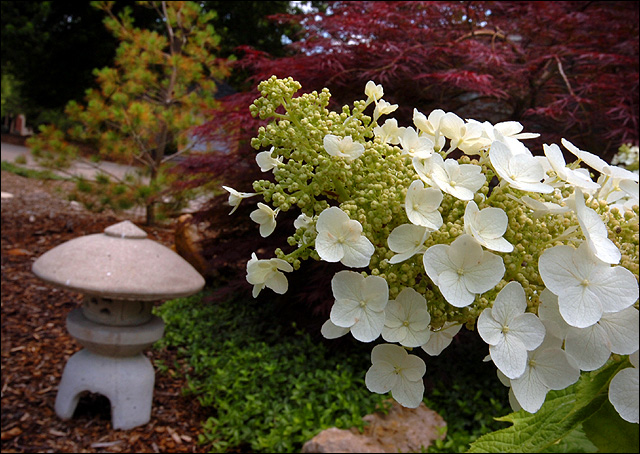
Among the plants and items in Lawrence couple Jane and Ted Kuwana's Japanese-inspired garden is this oak leaf hydrangea, front right, and a Japanese lantern.
Calming effect
The Kuwanas have fully embraced the style.
Their home is full of artwork, sculptures, rugs, furnishings, knickknacks and vases with arrangements of cut ginkgo and Japanese maple draped heavily to one side.
Most everything has an Asian sensibility. Even the black standard poodle named Tomodachi, meaning “good friend or playmate,” has a Far East stamp of approval. Tomo, for short, slides on the slick wooden floors with his claws grasping for something to stop his momentum. Past the vast expanse of windows that cover an entire wall of the home, he skids and scampers before running into a rug to stop his joyride.
The windows look out onto Jane’s giant dogwood tree, which droops down the steep incline of her yard like a waterfall of petite white flowers falling to terra firma. Jane is explaining her favorite garden in Tokyo while we sip some refreshing raspberry tea.
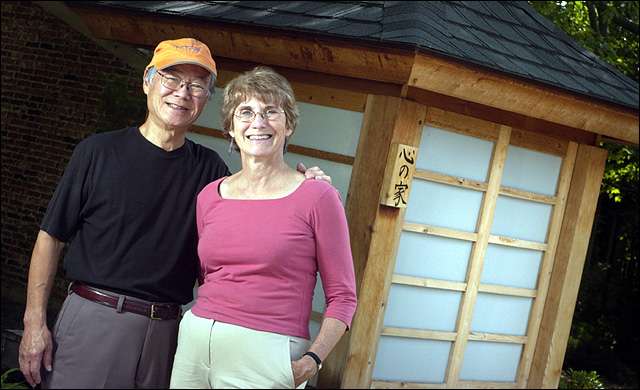
The Kuwanas, pictured before a Japanese playhouse in their front yard, have designed a garden inspired by multiple trips to Japan and China.
“The garden is San Kai-en, and it is this sweet little garden in Tokyo where you knock on a tiny pagoda door and a man peeks his head out and you say, ‘garden,’ like it is a secret password,” she says. “The doors open magically, and they allow you in.
“Possibly the greatest aspect to that garden is that right outside the walls is the busiest part of Tokyo, but you would never know when you are in the garden what madness lies behind the walls.”
Tea time
Another plant that thrives in the Kuwanas’ yard is most unexpected: a curly willow tree.
Jane elaborates, “Ted bought me a bouquet of roses about 10 years ago, and in it were a couple of sticks of curly willow. I decided to plant one of the stems, and now we have this 50-foot-tall curly willow tree that is taking over the neighborhood.”
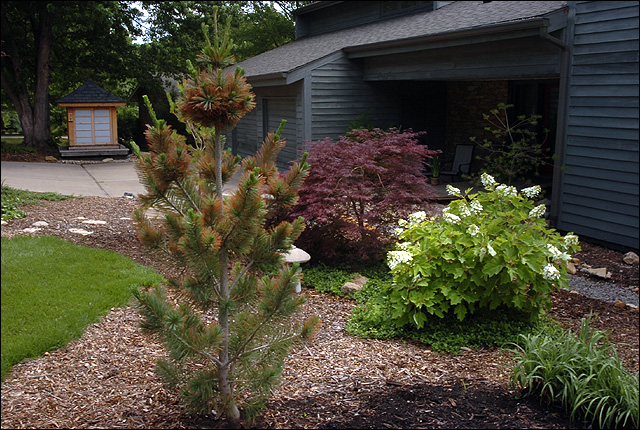
Jane and Ted Kuwana have incorporated Asian elements into their home and yard, inspired by visits to Japan and China. Minimalism plays a role in the look, as do water and stone.
The tree provides much of the canopy for Jane’s gorgeous shade garden that has giant ferns, broad, glossy hostas, columbine, a bed of crape myrtle and toad lilies everywhere. Tucked amid these shade lovers is an old stone Japanese lantern statue that the Kuwanas found at an antique shop.
A dose of serendipity led to yet another feature that looks like it was made for the Kuwanas’ garden.
Several years ago, the couple won the annual CASA raffle drawing and received a stunning little Japanese tea house-style children’s playhouse that’s now situated snuggly in their landscape. The inscription near the door says “Kokoro,” meaning, “touch the heart.” Jane has stocked it with a miniature tea set, perfect for little hands, and toys for the couple’s four granddaughters – although Jane admits she and her friends often sit on the playhouse floor and enjoy tea themselves.
Asian elements
The Kuwanas are gearing up for their next trip to Japan, where they’ll visit two gardens and are sure to gather more inspiration for their own.
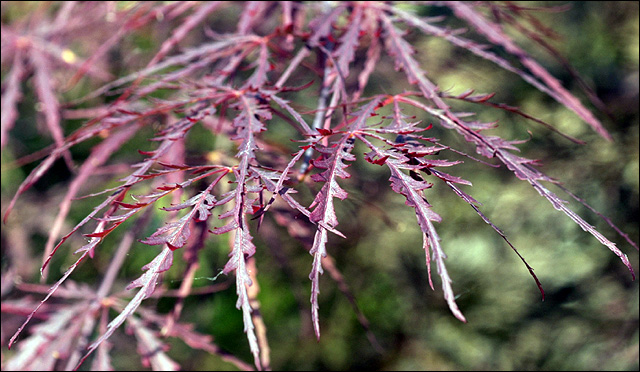
The leaves of a Japanese maple exemplify the simple, graceful Asian elements in the Kuwanas' yard.
But even if you can’t make it to the Far East, you can incorporate elements of Asian design – and the peaceful, sensory experiences that accompany them – into your garden with the use of plants like bamboo, or features like simple wooden bridges and dry creeks.
Few random acts occur in this style of gardening. Structure and permanence are established through natural elements like water, stone, wood, gravel, sand, moss and carefully chosen flora. When placing these elements, every idiosyncrasy is considered, such as the grain of the wood and the pores in a stone.
It all has meaning, and it all matters. (Refer to the reference list on this page for more guidance).
If you seek a dose of serenity or simplicity, try incorporating some Asian flair in your landscape. Just beware the bamboo beast.
Elements of Asian garden design
¢ Water: This is the most important consideration in Asian gardens for many reasons, one being the sound of water, which often is used to disguise undesirable noise. This can lend a feeling of solitude, peace, introspection and personal reflection in the garden.
¢ Stone: This material is used liberally in Japanese gardening to bring a significant sense of scale and structure. They are often placed in odd-numbered groupings, many times in a triangular fashion to impart the representation of mountains. Japanese legend says that stones are actual beings with spirits and should be treated with reverence. They often symbolize cranes, tortoises and fish.
¢ Pebbles/sand: These are immensely popular among Asian cultures as a material for paths and walkways. Patches of sand are raked for meditative purposes.
¢ Color: Color is quite minimal in true Japanese gardens, and green is generally the prevalent hue, although the red of the Japanese maple is a popular way to create interest. Asian gardens often are most colorful at their entrances, where the gardeners feel it’s most suitable to have color as a focal point.
¢ Common flora: Azaleas, camellias, tree peonies, Japanese maples, Gingko trees, rhododendrons, hydrangeas, hostas, ferns, chrysanthemums, bamboo, weeping Norwegian spruce, conifers and deciduous color from sugar maples and firebushes.
Sources: hgtv.com, gardenvisit.com, helpfulgardener.com