

U.S. relief mission begins in radical heartland
Sewon, Indonesia ? The U.S. military began its latest emergency relief mission in the Muslim world on Wednesday, treating earthquake survivors in an Indonesian region that has spawned some of Southeast Asia’s most deadly militants.
Dozens of Marines set up a field hospital on a soccer field in Sewon, a town in the district hardest hit by Saturday’s powerful temblor, which killed more than 6,200 people and injured at least 30,000.
The hospital was scheduled to be fully operational by today, but doctors began treating a handful of patients who trickled in Wednesday.
The operation comes as Washington strives to improve its image in Indonesia, the world’s most populous Muslim nation, and erode support for the nation’s small but growing radical fringe.
It follows far larger emergency missions in western Indonesia after the 2004 tsunami and last year’s quake in Pakistan, both of which saved many lives and won praise in nations where many see the U.S. war on terror as an attack on Islam.
Despite the tragic circumstances, one U.S. officer in Sewon said, the current relief effort could serve as a cultural bridge. “When you help people, you become friends.,” said 1st Lt. Eric Tausch, from a U.S. Marine division based in Okinawa, Japan.
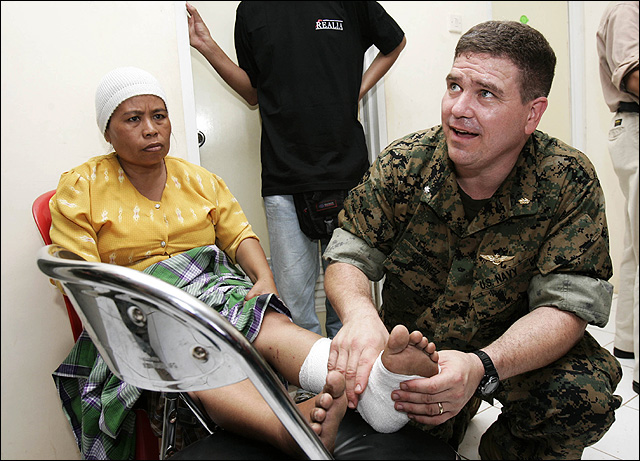
Earthquake survivor Arwiyah, left, gets medical treatment from U.S. Navy Lt. Cmdr. Carlos Gurdines, from Texas, at a U.S. Marine field hospital in Bantul, Indonesia. International rescue workers rushed Wednesday to get medical care, water and shelter to some 650,000 people displaced by Indonesia's earthquake.
Though a terrorist attack on foreigners here is not seen as likely, many members of the al Qaida-linked Jemaah Islamiyah terror group came from or were arrested in central Java, where the quake hit.
The group is accused in a string of bombings of Western targets in Southeast Asia, mostly in Indonesia, including two attacks on the tourist island of Bali that killed more than 220 people, mostly foreigners.
The infamous Ngruki boarding school founded by the movement’s alleged spiritual leader, imprisoned cleric Abu Bakar Bashir, and attended by many convicted terrorists, is just over an hour’s drive from the quake zone.
The 100-strong team of U.S. Navy medical staff and Marines in Sewon is being welcomed by locals, but a close aide of Bashir said they should go home.
“It is propaganda to win the sympathies of the Indonesian public,” Fauzan Al-Ansauri said. “The money they are spending is a fraction of what U.S. companies make each year from Indonesia’s natural resources, but they win massive media coverage through this.”