

Israel: 26 militants killed from Hezbollah rocket attack
Tyre, Lebanon ? Hezbollah launched a new kind of rocket Friday that made the deepest strike into Israel yet, rattling Israelis as their warplanes and artillery targeted guerrillas in attacks on apartment buildings and roads.
Lebanese officials said about 12 civilians died in the day’s fighting; Israel said it killed 26 militants, raising to about 230 the total number killed in the campaign.
Hezbollah’s launching of the new weapon unnerved Israelis, 500,000 of whom are already living in northern shelters because of rocket bombardments. The rocket firing was also likely to escalate a conflict now in its 18th day, with Secretary of State Condoleezza Rice heading back to the Middle East this weekend to make a second attempt to resolve the crisis.
The guerrillas said they used the Khaibar-1 – named after the site of a historic battle between Islam’s Prophet Muhammad and Jewish tribes in the Arabian peninsula – to strike the Israeli town of Afula.
“With this, the Islamic Resistance begins a new stage of fighting, challenge and confrontation with a strong determination and full belief in God’s victory,” Hezbollah said in a statement.
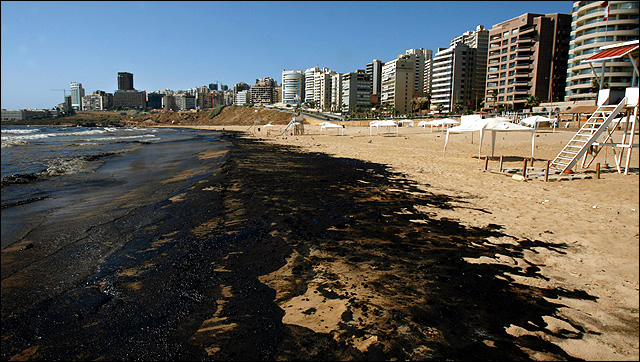
A layer of crude oil covers the Ramlet el-Beida public beach Friday in Beirut, Lebanon. Much of Lebanon's coastline is now awash with crude oil believed to originate from the Jiyeh power plant, some 12 miles south of the Lebanese capital, which has been ablaze since it was targeted by Israeli airstrikes and is said to have leaked about 15,000 tons of oil into the Mediterranean sea, according to local environmental organizations.
Five of the rockets crashed into empty fields outside Afula, causing no injuries. Still, Israel deployed a Patriot interceptor missile battery north of Tel Aviv, believing the area could be in range of Hezbollah’s barrages.
Israel said the Khaibar-1 rockets were renamed, Iranian-made Fajr-5s. They have four times the power and range of Katyusha rockets, making them able to hit Tel Aviv’s northern outskirts.
Hundreds of Katyushas have hit northern Israel in the current fighting, including 96 on Friday, one of which hit a hospital. The Afula strike came two days after Hezbollah leader Sheik Hassan Nasrallah vowed his guerrillas would fire rockets beyond Haifa, Israel’s third-largest city, which has been hit repeatedly in the conflict.
A top U.N. peacekeeping official said he thought the war could continue until the end of August and voiced fears Israel would flatten Lebanon’s southern villages and destroy the port of Tyre “neighborhood by neighborhood” if Hezbollah rockets keep slamming into the Jewish state.
Rice’s second trip to the region comes as diplomatic efforts are solidifying into two sharply divided camps. Most agree on the idea of bringing international forces into the south to end Hezbollah’s decade-long free rein here – but still unresolved is how and when.