

Former Peru president sworn in for second term
Lima, Peru ? Alan Garcia, reviled and driven into exile 16 years ago, was sworn in Friday as president of Peru, seeking redemption for his disastrous earlier term that left the country in economic and political ruin.
Garcia, who fled the country in disgrace after his turbulent 1985-90 presidency ended in hyperinflation and a raging guerrilla war, has pledged to fight corruption, cut the salaries of the country’s bloated political class and seek better deals from mining and gas companies that are enjoying record profits.
“We have fallen into the vicious circle of more exports and more misery,” Garcia said in a sober inauguration speech before Congress and eight heads of state, including the presidents of Brazil, Bolivia and Chile. “It’s time to leave this vicious circle.”
He called reducing Peru’s 50 percent-plus poverty rate an urgent task, vowed to improve the long-ignored infrastructure and emphasized responsibility and austerity – a clear attempt to transcend his 1980s image, when his behavior earned him the nickname “Caballo Loco,” or Crazy Horse.
“The state has become an obstacle for the people,” Garcia said, reading from a prepared text, which flattened his normally colorful speaking style.
His speech alternated between populist, high-spending themes and assurance of fiscal controls. He quoted Karl Marx and said that he planned to seek greater revenues from mining concerns, but he added that he was wary of scaring off foreign investment.
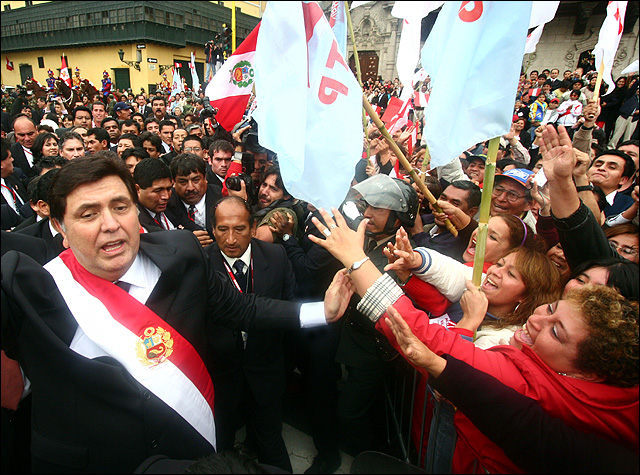
Peru's new President Alan Garcia, left, waves to supporters Friday outside the Govern-ment Palace in Lima, Peru, after being sworn in. Garcia, who left the presidency in disgrace 16 years ago after driving Peru's economy into ruin amid a guerrilla war, will have a chance at redemption now that he is president again.
Garcia’s improbable comeback, the latest in a series of leadership shifts in Latin America, marks the return of one of the continent’s most colorful and unpredictable political personalities. Garcia, 57, can be a spellbinding orator, ruminating extemporaneously on global political and economic trends, but his calamitous first term left many deeply skeptical that he was capable of running a government.
Many Peruvians recall the hourslong lines for bread, cooking oil, sugar and other necessities that marred Garcia’s 1980s administration, which racked up a cumulative inflation rate estimated at more than 2 million percent. The social unrest helped the cause of leftist guerrillas, who set off bombs in the capital, downed power lines and exerted widespread control in the countryside and in universities.
It was left to his successor, Alberto Fujimori, once an obscure professor of agronomy, to tame the Shining Path guerrilla threat and guide the country back to some measure of fiscal responsibility. But Fujimori ended up dissolving Congress and becoming increasingly authoritarian, and finally had to flee the country.