

Bush, Blair urge sending forces to help Lebanon
Washington ? President Bush and British Prime Minister Tony Blair declared Friday that a multinational force should be dispatched quickly to help Lebanon regain control of the southern part of its country from the Hezbollah militia.
However, the two leaders again stopped short of supporting an immediate cease-fire in the fighting between Hezbollah and Israel that Arab and European leaders have been urging.
As Middle East violence raged for a 17th day, Bush and Blair said at a White House news conference that the makeup of the multinational force would be discussed at a U.N. meeting Monday called by Secretary-General Kofi Annan. The force would both lead to stability and help speed the safe delivery of humanitarian aid, they said.
Bush said he was sending Secretary of State Condoleezza Rice back to the Mideast this weekend to help negotiate terms for such a force with both Lebanese and Israeli leaders.
“This is a moment of intense conflict in the Middle East,” Bush said, standing alongside Blair in the East Room. “Yet, our aim is to turn it into a moment of opportunity and a chance for broader change in the region.”
“We agree that a multinational force must be dispatched to Lebanon quickly to augment a Lebanese army as it moves to the south of that country,” Bush said.
Larger than Lebanon
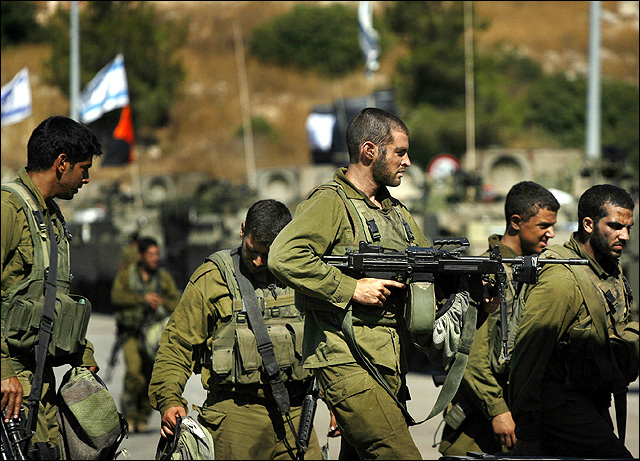
Israeli soldiers return to a military staging point Friday on a highway along the border with Lebanon. Israel said its aircraft hit 130 targets Thursday and early Friday in Lebanon, including a Hezbollah base in the Bekaa Valley.
Israel’s punishing campaign of airstrikes, artillery shelling and clashes, which began after Hezbollah crossed the border and captured two Israeli soldiers, has killed an estimated 600 Lebanese. More than 50 Israelis have died, most of them soldiers.
Even so, “the stakes are larger than just Lebanon,” Bush said.
Blair called the fighting “a complete tragedy for Lebanon, for Israel and for the wider region.”
The president said his and Blair’s goal was a U.N. resolution “setting out a clear framework for cessation of hostilities on an urgent basis, and mandating the multinational force.”
But many issues surrounding the makeup of such a force and its mandate remained to be defined. And Blair indicated its authority would clearly be limited.
International forces could go in only after a suitable cease-fire and not have “to fight their way in,” Blair said.
“This can only work,” he said, if Hezbollah is “prepared to allow it to work.”
Both leaders said the force would work in conjunction with the Lebanese army.
“The purpose of it, obviously, is to help stabilize the situation,” Blair said. “But it’s also to allow the government of Lebanon’s true armed forces to come down from the north and occupy the south themselves.”
Other proposals
A U.S. official, speaking on condition of anonymity because of the sensitive nature of the discussions, said other possible elements of a proposal for the ending the conflict included:
¢ Disarming Hezbollah and integrating the guerrilla force into the Lebanese army.
¢ Urging Hezbollah to return Israeli prisoners.
¢ A commitment to resolve the status of Chebaa Farms, a small piece of land held by Israel and claimed by Lebanon.
¢ Setting up a “no-go” buffer zone in southern Lebanon.
¢ An international reconstruction plan for Lebanon.
Under pressure
At the White House, neither Bush nor Blair advocated the immediate cease-fire that many European and Middle Eastern leaders want.
“We’ve got to resolve the immediate situation,” Blair said. “But we shouldn’t be in any doubt at all – that will be a temporary respite unless we put in place the longer-term framework.”
Blair is under growing pressure at home for Britain to distance itself from its longtime ally and call for an immediate end to violence between Israeli troops and Hezbollah guerrillas based in southern Lebanon. If Blair did that in his private meeting with Bush in the Oval Office and lunch, there was no indication of it in his news conference remarks.
Bush and Blair were asked what message they had for Iran and Syria – both sponsors of Hezbollah. The Bush administration has refused to negotiate directly with either Iran or Syria.
Bush said Iran should abandon all nuclear aspirations. He added, “My message to Syria is: Become an active participant in the neighborhood for peace.”
Blair said his message was “that you have a choice. Iran and Syria have a choice. And they may think that they can avoid this choice. In fact, they can’t.”
U.S. officials say European troops would probably dominate a multinational force.
“I don’t anticipate American combat power, combat forces, being used in this force,” Rice told reporters while traveling to Malaysia for an Asian regional conference. She was there when she got the word that Bush wanted her back in the Middle East.
Blair has also ruled out contributing British forces, citing Britain’s former role as a colonial power in the region.