

U.S. military confirms rise in Baghdad attacks
Baghdad ? Bombings and shootings soared by 40 percent in the Baghdad area in the past week, the U.S. military said Thursday. An American general said extremists were preparing “an all-out assault” on the capital in a decisive battle for the future of Iraq.
Iraq’s most influential Shiite cleric issued his strongest call yet for an end to Shiite-Sunni bloodletting, urging all Iraqis to wake up to the “danger threatening the future of the country” and stand “side-by-side against it.”
U.S. military spokesman Maj. Gen. William Caldwell said there had been an average of 34 attacks a day involving U.S. and Iraqi forces in and around the capital in the last week – up sharply from the daily average of 24 registered between June 14 and July 13.
“We have not witnessed the reduction in violence one would have hoped for in a perfect world,” Caldwell said. “The only way we’re going to be successful in Baghdad is to get the weapons off the streets.”
Caldwell said insurgents were streaming into the capital for “an all-out assault against the Baghdad area.”
“Clearly the death squad elements, the terrorist elements know that Baghdad is a must-win for them,” he said. “Whoever wins the Baghdad area, whoever is able to bring peace and security to that area, is going to set the conditions to stabilize this country.”
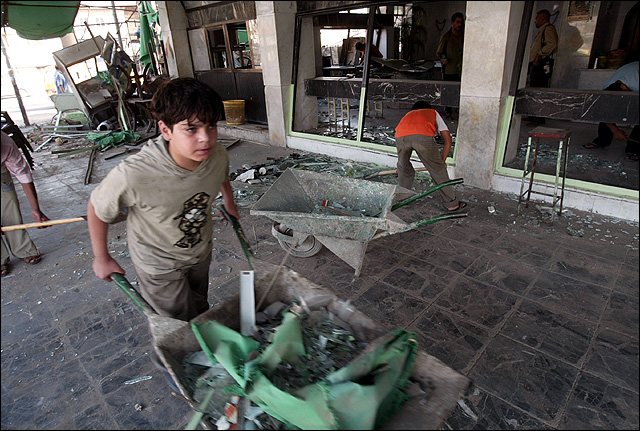
Restaurant employees clean up the damage left by a grenade attack followed by gunfire in Baghdad, Iraq. Thursday's attack was aimed at dining Iraqi police officers, killing one and wounding 12 others, authorities and witnesses said.
But much of the bloodshed has been carried out by Shiite militias seeking retribution for attacks by Sunnis – including organized insurgents, religious extremists and Sunnis not affiliated with resistance groups but fearful of Shiite gunmen.
The result is a pattern of tit-for-tat vendetta killings that is difficult to stop by military action or political overtures to Sunni insurgent leaders.
With thousands fleeing areas where their sect is in the minority, Iraqis fear Baghdad is being transformed into a Sunni west and a Shiite and Christian east – divided by the Tigris River that flows through the center of the city.
Alarmed by the crisis, Grand Ayatollah Ali Al-Sistani issued a rare statement, saying the time has come for “all those who value the unity and future of this country” to “exert maximum efforts to stop the bloodletting.”
Caldwell’s comments were among the most frank by a senior American military official about the grave crisis facing Prime Minister Nouri al-Maliki’s 2-month-old national unity government.
With the stakes high, al-Maliki last month unveiled a much-heralded security plan for Baghdad, including up to 50,000 police and soldiers on the streets, more checkpoints and raids in neighborhoods where violence is high.
But with surging attacks in the capital – including the kidnappings of Iraqi officials – leading politicians from Shiite and Sunni parties have declared the plan a failure. The United Nations said this week that about 6,000 civilians were killed in May and June, many of them in sectarian violence.