

Humanitarian disaster looming in Lebanon
Beirut, Lebanon ? Fears mounted Thursday that a humanitarian catastrophe is unfolding in southern Lebanon as Israel sustained its intense bombardment of the area and U.S. Marines landed on the beaches near Beirut to help speed the evacuation of Americans from the war zone.
Thousands of Lebanese were trying to flee the south after Israeli warplanes dropped leaflets warning people to leave, stirring fears that an Israeli ground invasion was imminent. But hundreds of thousands more remain stranded in villages and towns, unable to leave their homes because of the intensity of the Israeli bombing campaign.
United Nations and Lebanese officials warned of an impending humanitarian disaster unless food and medical supplies are allowed to reach the stricken area and called on Israel to establish a “humanitarian corridor” to allow aid to get through.
More than 300 people now have been killed and more than 1,000 wounded, most of them in southern Lebanon, since Israel began its assault in response to the abduction of two Israeli soldiers by Hezbollah guerrillas.
Hospitals in the south are overflowing with injured people, and ambulances are unable to reach victims in remote villages, leaving many to die unattended, said Lebanon’s social affairs minister, Nayla Muawad.
“We are living a humanitarian disaster. People are in a desperate situation. They have no milk and medicines,” she said. “Supplies are unable to reach the people.”
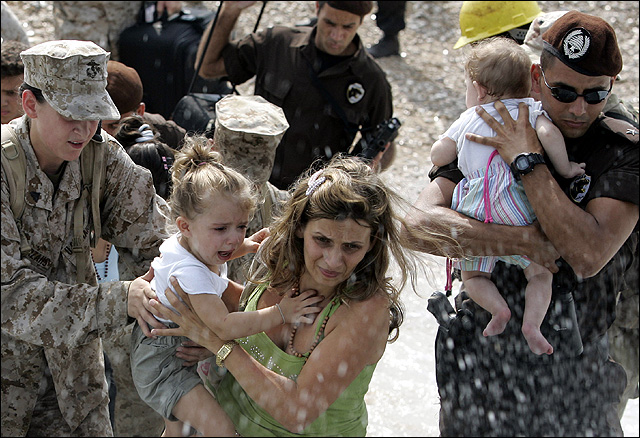
U.S. Marines help evacuees leave from a beach in Beirut, Lebanon. About 1,200 Americans fleeing fighting boarded the USS Nashville on Thursday and were transported to Cyprus.
In the once teeming southern Beirut neighborhood of Haret Hreik, where Hezbollah had headquarters and where Hezbollah leader Hassan Nasrallah lived, the massive scale of Israel’s nine-day-old bombing campaign was chillingly evident.
Entire apartment buildings have been crushed, their contents spilled onto cratered, debris-strewn streets. The blackened stump of one pulverized building – struck the night before – still smoldered.
Most of Haret Hreik’s residents, aware that the presence of Hezbollah’s offices made the neighborhood a target, also fled to safer parts of the city as soon as the first Israeli warplanes flew overhead more than a week ago.
But those living in southern Lebanon could not get out so easily because the main roads, bridges and highways linking the south to the north were an immediate target of the Israeli warplanes.
The U.S.-based aid agency Catholic Relief Services said it had received numerous reports of civilian vehicles being targeted as they attempted to flee the south.
At least 100,000 people have sought refuge in centers established for displaced people, the Lebanese government said, and altogether 500,000 Lebanese – an eighth of the population – have been forced to flee their homes, according to the U.N.
With no sign that either party to the conflict is preparing to back down, the exodus of foreign nationals from Lebanon accelerated. Another 1,200 Americans were ferried to safety in Cyprus, escorted by U.S. Marines who landed on a Beirut beach to help with the two-day-old effort to evacuate Americans stranded in Lebanon.