

Technology enhances colonial experience
Williamsburg, Va. ? Thomas Jefferson isn’t about to start listening to an iPod, with telltale earbud wires dangling from beneath his three-cornered hat as he walks the streets of Colonial Williamsburg.
But people far from the restored 18th-century capital of Virginia can use their portable audio players to hear costumed interpreter Bill Barker talk about portraying Jefferson or, in honor of the Fourth of July holiday, read the Declaration of Independence.
The world’s largest living history museum long has used modern media to share its stories with audiences far beyond its 301-acre Historic Area, dating back to before World War II when it produced an educational film for schools.
Today, it has an extensive Web site with photo slideshows, online exhibits and interactive tours, and it offers “electronic field trips” for schools using live television broadcasts and the Internet.
It’s also using something that didn’t even exist a couple years ago: podcasts.
Colonial Williamsburg is creating free weekly audio programs people can listen to on computers as well as portable players to find out more about those who work there, plying old trades and playing historical figures. The idea is to educate people and, hopefully, inspire them to visit.
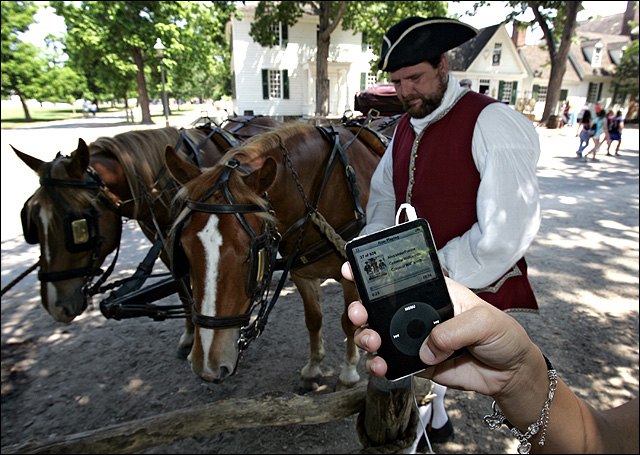
An iPod plays an audio podcast as historical interpreter Dan Hand hitches Captain, left, and Ranger, to a hitching post in Colonial Williamsburg, Va. Colonial Williamsburg is creating weekly radiolike programs that people can listen to on computers and portable MP3 players to find out more about those who cook in the taverns, create holiday decorations and portray residents of Virginia's colonial capital, from slaves to Thomas Jefferson.
“It’s just another way to get the message out from Colonial Williamsburg,” said Colin G. Campbell, president of the private, nonprofit Colonial Williamsburg Foundation, which operates the museum.
Robyn Eoff, Colonial Williamsburg’s Internet director, came up with the idea for the podcasts as a new way to reach audiences.
“History may be old, but its presentation doesn’t have to be,” Eoff said.
The podcasts may not immediately bring people to Colonial Williamsburg, she said, “but if they educate them about what happened in Williamsburg and about what Colonial Williamsburg offers now, then we hope that in the future they’ll make a visit.”
While Colonial Williamsburg has been concentrating on the podcasts, a couple months ago it also began offering audio tours, Eoff said. They can’t be downloaded ahead of time – visitors rent machines to listen on site.
Other historic sites and museums, such as the Smithsonian Institution, also have podcasts, although Colonial Williamsburg, which has been posting its podcasts for more than a year, may have been among the first, Eoff said.
Among sites related to America’s independence, Monticello, Jefferson’s home in Charlottesville, has a collection of podcasts available on its Web site, ranging from talks about restoration efforts there to the former president’s own words, such as his “rough draft” of the Declaration of Independence.
The Web site boston.com, part of the Internet division of The New York Times Co., has a podcast audio tour of 14 sites along Boston’s Freedom Trail, including Paul Revere’s house and the Bunker Hill Memorial.