

First train from China completes trip to Tibet
Lhasa, China ? The first train from Beijing to Tibet finished an arduous journey along the world’s highest railway Monday, opening direct service to the Himalayan region that China has been trying for decades to tame.
Pens spit ink and packaged foods burst in the low pressure as the “Sky Train” climbed the 16,640-foot Tanggula Pass. Laptop computers and digital music players failed, the tiny air bags that cushion their moving parts broken at high altitude.
Some passengers threw up. Others took Tibetan herbs or breathed oxygen from tubes. Outside, Tibetan antelope and wild donkeys grazed beneath snowcapped mountains and deep-blue skies.
Despite Beijing’s public commitments to preserving the fragile Tibetan plateau crossed by the train, plastic bags, bottles and cardboard boxes were scattered along the tracks. Large sections of the permanently frozen earth were grassless and scarred by vehicle tracks.
Many Tibetans loyal to their exiled spiritual leader, the Dalai Lama, say the railway is part of a campaign to crush Tibetan culture, and a still-simmering separatist movement, by encouraging a huge influx of majority Han Chinese migrants.
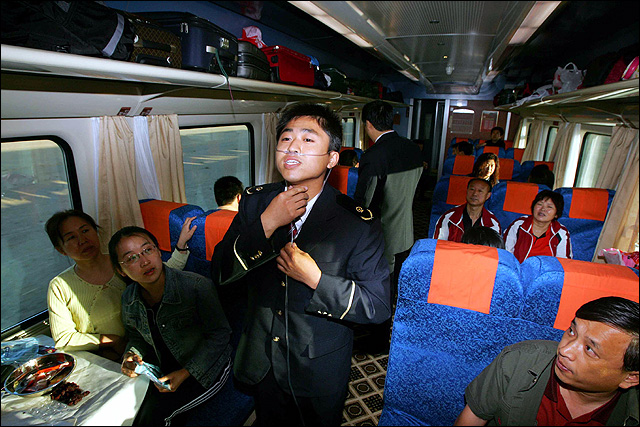
A train official shows passengers how to use the oxygen supply aboard the Beijing-Lhasa express in China. China's train to Tibet reached its destination Monday, rising to over 4,000 meters, beneath stunning vistas of snow-capped mountains and deep blue skies. Some passengers donned oxygen masks to combat dizziness and other symptoms of altitude sickness.
One Tibetan passenger asked a Western reporter what the Dalai Lama, the exiled Tibetan spiritual leader, thought of the train. The man, who asked not to be identified by name, said that with China’s Internet monitoring, it was too dangerous for him to search news Web sites for the information himself.
The Dalai Lama has said that the railway is neither good nor bad, but that it remains to be seen how it will be used, and whether it will bring real benefit to Tibetans.
China says the newly opened 710-mile stretch of rail, linking the ancient Tibetan capital of Lhasa to a station that had been a final stop on China’s vast rail network, is an unparalleled engineering marvel.
The $4.2 billion project was built in four years on delicate permafrost, marshy ground easily damaged by human encroachment. Engineers used sunshades and high-tech cooling columns plunged into embankments to help ensure the ground stays frozen. China has earmarked $190 million for environmental protection along the railway.
The government acknowledges that Tibetans have so far been largely excluded from the project but says more Tibetans will be hired.
China’s Railway Ministry has said that 10 percent of the 100,000 construction workers who built the railway were ethnic Tibetans.
“We were actually really surprised that there was no Tibetan staff on the train,” said Lawang, 23, who gave just one name. He was headed home on the first train after graduating from college in Beijing.
Chinese state media says the railway will help double tourism revenues in Tibet by 2010 and cut transport costs for goods by 75 percent. Goods going to and from Tibet have been trucked over mountain highways that often are blocked by landslides or snow, making trade prohibitively expensive.