

Conservative claims victory in Mexico
Leftist candidate claims voting irregularities, vows to pursue rigorous review
Mexico City ? Mexico’s young democracy faced its greatest test yet Monday as the pro-business Felipe Calderon declared himself president-elect with a 400,000-vote advantage. His leftist rival alleged ballot irregularities and pledged to use all “legal means” to challenge the apparent outcome.
Stirring memories of the 2000 nail-biter in Florida, electoral officials said a preliminary count gave the conservative Calderon an edge of 1 percentage point over Mexico City’s former mayor, Andres Manuel Lopez Obrador, but refused to declare a winner until an official count begins Wednesday.
Sunday night’s quick count, which election officials had hoped would show the winner, proved too close to call, setting off days of uncertainty and cries of fraud by fervent Lopez Obrador backers, still bitter over the many manipulations of the vote that kept the Institutional Revolutionary Party, or PRI, in power for seven decades until 2000.
Lopez Obrador, holed up in his apartment for most of the day, arrived unannounced at his campaign headquarters to defend what he says was his triumph in the election.
“We have a commitment to the citizens to defend the will of millions of Mexicans,” he told supporters. “We are going to employ whatever legal means.”
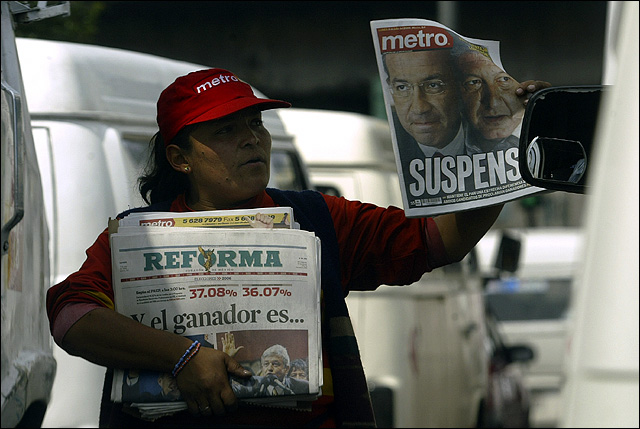
A woman sells newspapers with headlines reading: And
Lopez Obrador claimed there were “many irregularities” in the election, including badly reported results, the double counting of votes, and as many as 3 million votes that couldn’t be accounted for. He also asked how it was possible that his party won 155 of 300 electoral districts without winning the presidency. Later Monday, Democratic Revolution officials said they would ask for a ballot-by-ballot review of votes in some cases where they believe there were irregularities.
“The process can be reviewed without making anything up, and acting responsibly, and in that way we can find out the truth,” he said.
Calm prevails
Many had predicted violent street protests if the vote was too close to call, but Lopez Obrador supporters apparently were waiting for orders from the leader they revere with a near-messianic devotion. Lopez Obrador did not call for any demonstrations in his speech.
Financial markets rallied on preliminary results that showed Calderon, a fiscally conservative former energy secretary, in the lead. With 98.45 percent of polling stations reporting, Calderon of the National Action Party had 36.38 percent and Lopez Obrador of the Democratic Revolution Party had 35.34 percent – a difference of 402,700 votes.
The PRI’s Roberto Madrazo was a distant third with 21.57 percent, and minor candidates and write-ins accounted for the rest.
Appearing nearly giddy, Calderon said he clearly won and vowed to build a conciliatory government to mend rifts heightened by the angry campaign in which nearly two-thirds of the 37 million voters chose other candidates.
“It is time to put our divisions behind us,” he said.
Not like U.S. elections
Calderon brushed off comparisons to the electoral crisis that followed the U.S. 2000 election, in which George W. Bush narrowly defeated Al Gore. He joked the country’s northern neighbor could learn from Mexico.
“We have such advanced institutions that we can do what the United States couldn’t,” he said.
George Grayson, a Mexico expert at the College of William & Mary in Virginia and a former Virginia state legislator, said “the Mexican system is much more transparent” than the U.S. system.
Mexico has a single voter registry, a uniform photo identity card for voters and a national election law, he said, whereas “in the U.S., you have this crazy quilt of 50 state laws.”
Mexico’s Federal Electoral Institute is legally independent of the government, while in the U.S., partisan state officials tend to oversee the system – something that contributed to controversy over the 2000 presidential election in Florida.
The Institute also provides taxpayer financing for political campaigns based on their vote totals in past races, an effort to even the playing field. Mexico sharply limits private campaign contributions.