Bombings, kidnapping raise sectarian tensions
Baghdad, Iraq ? Bombs exploded for a second straight day Monday in the public market of a religiously mixed town south of Baghdad, killing five people, as Sunni lawmakers boycotted parliament to demand the release of a colleague they suspect was kidnapped by Shiite militiamen.
Two blasts ripped through the outdoor market in Mahmoudiya – the first about 12:30 p.m. and the second four hours later. Three people were killed and 22 wounded in the first blast, police Lt. Mohammed Khayoun said. The toll for the second was two dead and three injured, he added.
Late Sunday, three people were killed and 10 others wounded in a blast in the same market in Mahmoudiya, a flashpoint of sectarian conflict between Shiites who live inside the town and Sunnis who form the majority in surrounding farm communities.
At least 11 other people were killed Monday, including a U.S. Marine who died in fighting in Anbar province west of the capital, according to Iraqi and U.S. officials. The U.S. military also reported an American soldier died Sunday in a roadside bombing north of Baghdad.
Rising sectarian tensions threaten to undermine Prime Minister Nouri al-Maliki’s plan to restore stability in Iraq and stem the slide toward civil war.
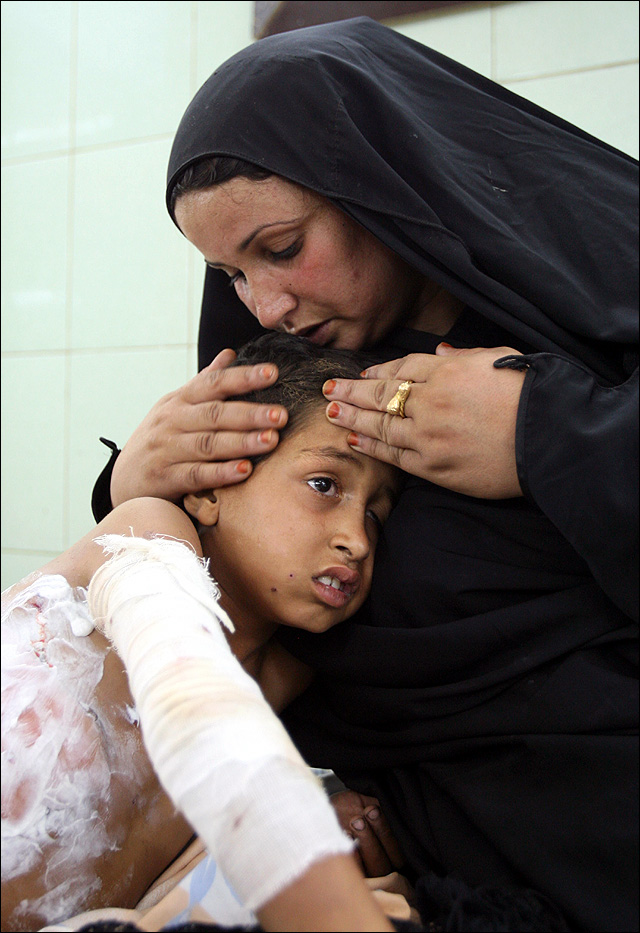
Cared for by his mother, Amir Ahmed, 10, suffers serious burns following a roadside bomb attack on a popular produce market. A roadside bomb exploded in the market in Mahmoudiya, just south of Baghdad, killing three and injuring 21.
U.S. officials hoped al-Maliki’s government of Shiites, Sunnis and Kurds, which took office in May, can win public confidence, reach out to Sunni insurgents and clamp down on sectarian militias.
But cracks have already begun to appear. The largest Sunni bloc in parliament boycotted a legislative session Monday to press their demands for the release of Sunni female legislator Tayseer al-Mashhadani, who was seized two days ago by gunmen in a mostly Shiite district of the capital.
Sunni politician Noureddine al-Hyali said al-Mashhadani was believed held somewhere near eastern Baghdad’s Ur neighborhood – a predominantly Shiite area controlled by the Mahdi militia of radical cleric Muqtada al-Sadr.
“We got this information from Iraqi security forces as well as the Americans,” al-Hyali said. There was no confirmation of his claim.
However, a Shiite official with close ties to al-Sadr, Ali al-Lami, insisted the Mahdi militia was not holding al-Mashhadani and had offered to help find her.
The Sunni boycott, if it lasts, threatens to undermine the U.S. strategy to lure Sunni Arabs away from the insurgency so U.S. and other international forces can begin heading home.
U.S. Deaths
As of Monday, at least 2,539 members of the U.S. military have died since the beginning of the Iraq war in March 2003, according to an Associated Press count.
With violence raging at home, top Iraqi officials have fanned out across the Middle East, seeking support from neighboring countries for the new government’s reconciliation plan.
Al-Maliki arrived Monday in the United Arab Emirates on the second stop of a three-nation Persian Gulf tour. The prime minister, a Shiite, held talks last weekend with officials in Saudi Arabia and will travel on to Kuwait before returning home.
Meanwhile, Foreign Minister Hoshyar Zebari, a Kurd, conferred Monday with Turkish officials in Ankara, and parliament speaker Mahmoud al-Mashhadani, a Sunni, journeyed to Iran.
National
Army finds systemic failures behind DC midair collision and calls for safety fixes
Pentagon says the firing squad execution of Fort Hood shooter Nidal Malik Hasan will be livestreamed

The long-deployed USS Lincoln returns home to San Diego Bay

Trump’s executive order on dyed diesel will offer little relief, farmers and truckers say

White House proposes a $70,000 fee for international students to work in the US