

Sri Lanka sliding into ‘low-intensity’ war
Batticaloa, Sri Lanka ? Gunfire echoes nearly every night across the lagoon that rings this fishing town. Bodies turn up nearly every day in the jungles beyond, some riddled with bullets, others bound and gagged with a single shot to the head.
A year ago they called it a “Shadow War.” Not anymore.
“Our war is again coming out in the open,” said Tevanayagam, a 44-year-old fisherman, who like many here uses only one name.
Four years after a cease-fire raised hopes for peace between the government and Tamil Tiger rebels, Sri Lanka is teetering on the brink.
The brink of what remains the question.
Naval battles, suicide bombings and jungle clashes have once again become the norm on this tropical island that for two decades has been largely known for the ferocious ethnic struggle between its Hindu Tamil minority and its Buddhist Sinhalese majority.
A “low-intensity war” is the description favored by analysts and diplomats.
The Tigers and government “are as far apart as they have been since the cease-fire,” said Jehan Perera of the independent National Peace Council. “The polarization is greater than it’s been in years.”
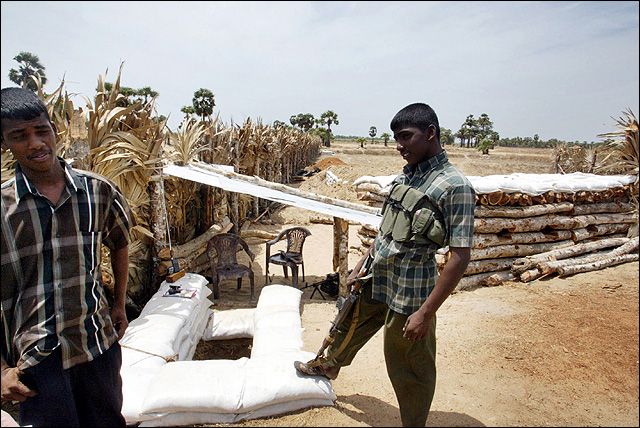
Tamil Tiger rebels stand guard at the forward defense lines of rebel-controlled Batticaloa, about 140 miles east of Colombo, Sri Lanka. Four years after a cease-fire raised hopes for peace between the government and Tamil Tiger rebels, Sri Lanka is heading back toward open conflict.
The roots of Sri Lanka’s conflict stretch back to the years after independence from Britain in 1948, when the government made Sinhala the official language, gave Buddhism a prominent role and Tamils faced widespread discrimination in schools and jobs.
In 1983, a spasm of anti-Tamil violence that killed hundreds sparked war. Each side fought viciously: the Tigers used suicide bombings and murdered rival Tamil militants; the government routinely tortured Tamil civilians. The death toll stood at more than 65,000 when the cease-fire was signed in 2002.
By then, the rebel Liberation Tigers of Tamil Eelam controlled wide swaths of the north and east where they have a country complete with border guards and traffic police.
But the Tigers still want to capture Tamil areas held by the government, like the northern port of Jaffna, capital of an ancient Tamil kingdom.
The inner workings of the Tiger leadership remain a mystery to outsiders, and there’s widespread speculation about their motives for attacks such as a June 15 bus bombing that killed 64 civilians, most Sinhalese.
Many say the Tigers are simply trying to push the government to grant broad autonomy over the territories they control. Others warn the rebels could be softening up government forces ahead of the rainy season, which starts in August, when the government’s armored vehicles would be bogged down in mud.
The government’s motives are clearer: It faces pressure from hard-line political allies, generals and Sinhalese nationalists to destroy the Tigers.
But all-out war could scare off much-needed foreign investment and tourist dollars, which helped push economic growth to 6 percent in the first quarter of the year. That’s no small feat in a country still recovering the war and the Indian Ocean tsunami, which killed 35,000 people here and displaced 1 million.
Perera warned that unless both sides start talking “undeclared war could very easily become declared war.”