

Mexico’s next president won’t be known for days
Election too close to call; Wednesday is earliest a winner will be named
Mexico City ? Mexico’s presidential election was too close to call Sunday, with voters bitterly divided between a leftist offering himself as a savior to the poor and a conservative warning that his rival’s free-spending proposals threaten the economy.
Officials said they wouldn’t be able to declare a winner until later in the week.
Electoral officials said they could not release the results of Sunday night’s quick count of the votes, which they previously said would happen only if the leading candidates were within 1 percentage point of each other. Luis Carlos Ugalde, president of the Federal Electoral Institute, said an official count would begin Wednesday, and a winner will be declared once it’s complete.
Felipe Calderon, 43, of outgoing President Vicente Fox’s National Action Party, had been running an exceedingly close race with Andres Manuel Lopez Obrador, 52, of the leftist Democratic Revolution Party. The Institutional Revolutionary Party’s Roberto Madrazo, 53, had been trailing in third place.
Fox appealed for calm amid fears that a close result would raise the potential for violence.
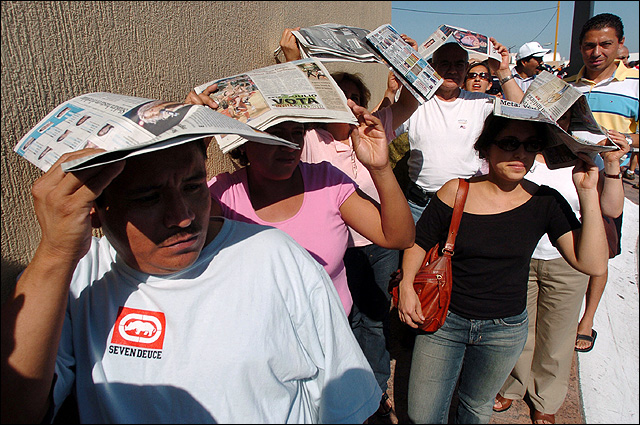
Voters use newspapers to protect themselves from the sun while waiting in line to vote at the Tijuana International Airport in Tijuana, Mexico. Delays were reported Sunday at many polling stations. The results of the presidential election were too close to call early this morning, and no winner is expected to be named until at least Wednesday.
Thousands of Lopez Obrador supporters, waiting for hours in the cold rain in Mexico City’s central plaza, began shouting “Fraud! Fraud!” when Ugalde came on live television to announce the delay. Lopez Obrador said late Sunday that he would respect the delay in declaring a winner, “but I want the Mexican people to know that our figures show we won.”
Calderon spoke minutes later, saying he too will respect the results – but that the official preliminary results, as well as the exit polls, show that he’s the winner.
“We have no doubt that we have won,” he said.
The race exposed deep divisions between Mexico’s rich and poor in a nation desperately trying to match the success of its northern neighbor, to which many Mexicans try to escape, legally or not.
The vote was the first since Fox’s stunning victory six years ago ended 71 years of rule by the Institutional Revolutionary Party, or PRI, and it could determine whether Mexico becomes the latest Latin American country to move to the left.
Electoral officials said voting was relatively peaceful, although many voters complained polls opened late or ran out of ballots.
Issues of interest in the United States
ImmigrationFelipe Calderon of the conservative, ruling National Action Party: Espouses temporary guest work programs and job creation in Mexico so people will not have to leave.
Andres Manuel Lopez Obrador of the leftist Democratic Revolution Party: Promises to use Mexican consulates to defend immigrants’ rights in the United States and wants the U.S. government to contribute to job creation in Mexico.
Roberto Madrazo of the Institutional Revolutionary Party: Promises to reduce migration by helping more Mexicans survive on their farms through subsidies and aid programs.
CrimeCalderon: Advocates U.S.-style trials, extraditing criminals to face charges abroad and life sentences for kidnappers.
Lopez Obrador: Says poverty is the root cause of crime, advocates more education and social programs for youths and favors using the army to fight drug traffickers.
Madrazo: Calls for tougher sentencing and more coordination and intelligence work among police agencies.
Trade and economyCalderon: Favors trade and economic stability and proposes reducing tax burdens to stimulate private investment.
Lopez Obrador: Favors protecting Mexican industries and agricultural sector and boosting Mexico’s oil and construction industries; says he will not obey North American Free Trade Agreement clause requiring Mexico to lift tariffs on U.S. corn and beans in 2008.
Madrazo: Takes a middle ground, proposing more private investment but also increased state support to farmers.