

Sudoku craze lands in Journal-World
Jeremy Martin, a self-proclaimed puzzle addict, has found a new vice.
“I sort of have this tendency to do one puzzle at a time and get really addicted,” the Kansas University associate professor says. “Recently, it’s been Sudoku.”
Sudoku is a puzzle craze that’s catching on around the world, and it’s growing increasingly popular in the United States.
Starting Monday, Journal-World readers can get a daily dose of Sudoku when the newspaper begins publishing the puzzle.
Sudoku replaces the Daily Crossword, the second crossword on the Journal-World’s Fun & Advice page. The Associated Press is discontinuing the crossword this month. The Universal Crossword will remain on the page.
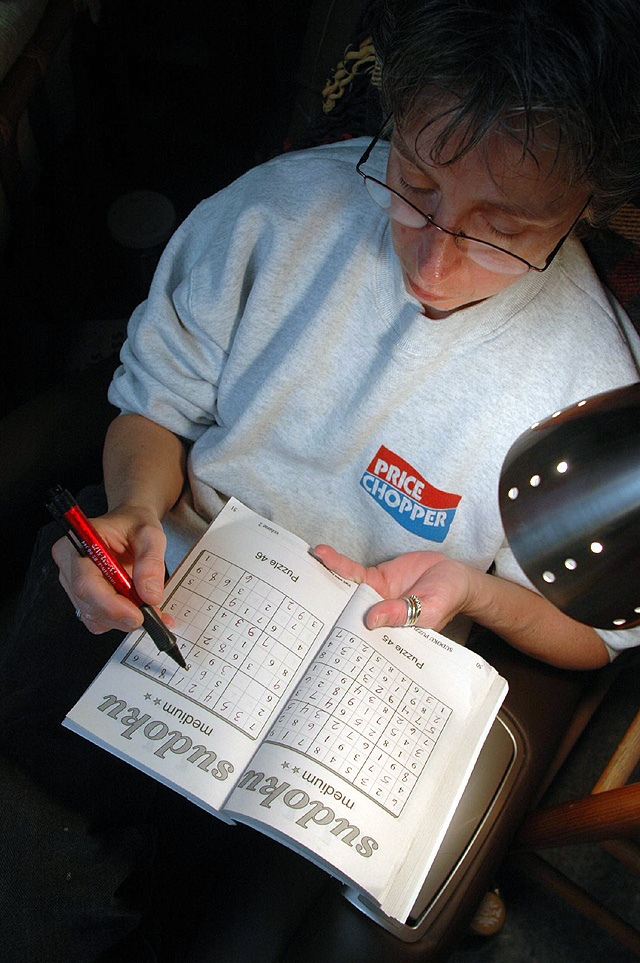
Lawrence resident Candy Davis has picked up on the recent craze surrounding the Sudoku puzzle. The game challenges players to arrange the numbers one through nine in grids. The Journal-World begins carrying the puzzle on Monday.
The Sudoku grid has 81 squares, divided into 3-by-3 subgrids. The goal is to fill in the grid so that every row, every column and every 3-by-3 subgrid contains the digits one through nine.
Solving time for the puzzles typically is 10 to 30 minutes, depending on skill and experience.
Wayne Gould says it’s the perfect puzzle for the masses. His company, Puzzles by Pappocom, uses computer software to generate puzzles for 271 magazines and newspapers – including the Journal-World – in 56 countries.
“As soon as I saw Sudoku, I knew it would be great,” Gould says. “It appeals to both sexes, all cultures, all languages, all educational, economic and social backgrounds.”
Gould, who was born in New Zealand, is a retired Hong Kong judge who splits his time between Hong Kong and New Hampshire.
He’s also editor of several collections of the puzzles and is credited with helping spread the game’s popularity in the United States.
Sudoku, also known as “number place,” originated in New York in the late 1970s but gained popularity in Japan. Gould says anyone from age 6 up can work the puzzles.
Try a Strategy
From Merl Reagle, author
of “Eraser-Free Sudoku”:
Pick an empty square that’s the crossing point of a row and a column that already contain as many different numbers as possible. Usually this will
narrow the “possibles” for that square down to just a few numbers.
“It’s different – it’s not a word game, like most puzzles in newspapers, and it’s not a math problem,” Gould says. “It’s a logic puzzle. It’s very easy to understand, and you can start playing at once. You don’t need a manual or a dictionary or a full library of reference books. And it gives you a good feeling when you solve it.”
Martin says he thinks people in Lawrence will soon catch the Sudoku fever.
“My impression is that a lot of puzzle-solvers – people who subscribe to Games magazine and things like that – are pretty open-minded,” he says. “If something comes up that’s new, it’s more about solving puzzles than what the puzzle is.”