

Massive crowd demands new government
Beirut, Lebanon ? Hundreds of thousands of Hezbollah members and their allies flooded central Beirut on Sunday demanding changes in the government’s makeup as soldiers strung more barbed wire around the offices of the Western-backed premier.
Buoyed by the big turnout after a week of street protests, the pro-Syria opposition gave Prime Minister Fuad Saniora an ultimatum of a “few days” to accept its demand to form a national unity government with a big role for Hezbollah or face an escalating campaign to oust him.
Saniora, who has been holed up in his fortified office downtown, rejected the demand and urged his foes to resume negotiations. The opposition should “return to the constitutional institutions to discuss differences and reach real solutions,” he said in a written statement.
Political unrest has split the country along sectarian lines, with most Sunni Muslims supporting the Sunni prime minister and Shiite Muslims backing the militant Hezbollah. Christian factions are split between the two camps.
Despite the heated rhetoric of the political confrontation, Sunday’s mass gathering remained peaceful and left the door open to the possibility of a settlement.
“Hopefully it won’t be long. At the end, there will be no winner, no vanquished. We should all be winners,” Saad Hariri, leader of parliament’s anti-Syria majority and a Saniora supporter, told The Associated Press.
Police had no immediate crowd estimate, but the horde that jammed downtown plazas and many neighborhoods appeared one of the biggest in a country that has seen a string of mammoth demonstrations by both sides in recent years. A Hezbollah anti-government rally Dec. 1 drew 800,000 of Lebanon’s 4 million people, according to police figures.
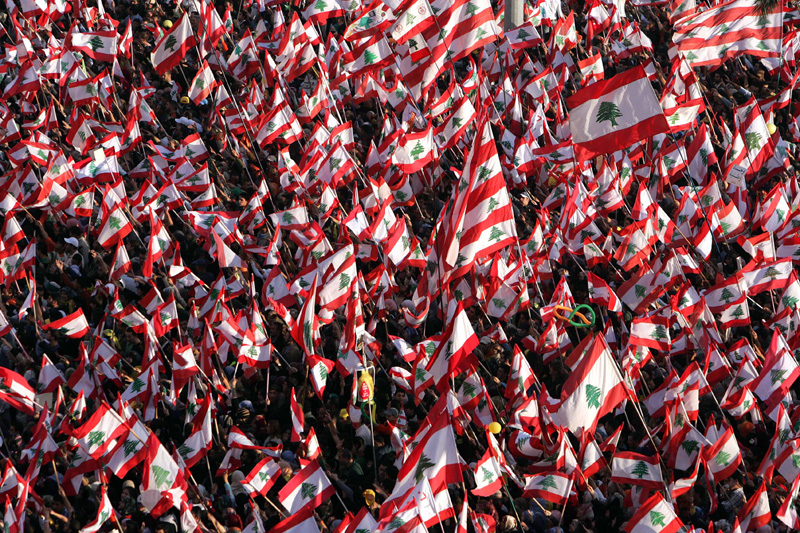
Opposition protesters wave Lebanese flag during the 10th day of an open-ended protest to force the resignation of Lebanese Prime Minister Fuad Saniora. Hundreds of thousands of Hezbollah-led protesters gathered Sunday in Beirut, demanding Saniora cede power to the opposition or step down.
Pro-government groups staged a rival demonstration that drew tens of thousands in the northern port city of Tripoli.
Hezbollah’s supporters streamed into downtown from all corners of Lebanon, waving Lebanese and Hezbollah flags as loudspeakers blasted anti-government speeches.
“We have come to show them how big our size really is,” said Reem al-Zein, a 20-year-old philosophy student. “I think this lying government will not be able to last much longer after today.”
Lebanese media have speculated the opposition’s next steps could include civil disobedience, disruptions of public services and resignations from parliament.
The political crisis began after talks on a national unity government collapsed and six pro-Hezbollah ministers resigned from the Cabinet. Hezbollah is demanding that it and its allies fill a third of the Cabinet posts, which would allow them to veto government decisions.
Relations between the two camps deteriorated after the Israel-Hezbollah war last summer and a U.N. push for an international tribunal to try suspects in the 2005 assassination of former Lebanese Premier Rafik Hariri, which many people blame on neighboring Syria.