

Lebanese prime minister rejects Bush’s cease-fire plan
Beirut, Lebanon ? Lebanon’s government rejected a U.N. cease-fire plan backed by President Bush on Monday, demanding Israel immediately withdraw even before a peacekeeping force arrives and promising to send 15,000 troops to take control of the Hezbollah stronghold along the border.
Prime Minister Fuad Saniora’s stand, delivered in a tearful speech to Arab foreign ministers, came on a day in which 49 Lebanese were killed – one of the deadliest days for Lebanese in nearly four weeks of fighting. The rejection, ratified by the Cabinet, complicated efforts to find a speedy diplomatic solution to the deadly conflict.
Saniora’s Cabinet, which includes two Hezbollah ministers, voted unanimously to send 15,000 troops to stand between Israel and Hezbollah should a cease-fire take hold and Israeli forces withdraw south of the border. The move was an attempt to show that Lebanon has the will and ability to assert control over its south, which is run by Hezbollah, the powerful Shiite Muslim militia backed by Syria and Iran.
In Texas, Bush said any cease-fire must prevent Hezbollah from strengthening its grip in southern Lebanon, asserting “it’s time to address root causes of problems.” He urged the United Nations to work quickly to approve the U.S.-French draft resolution to stop the hostilities.
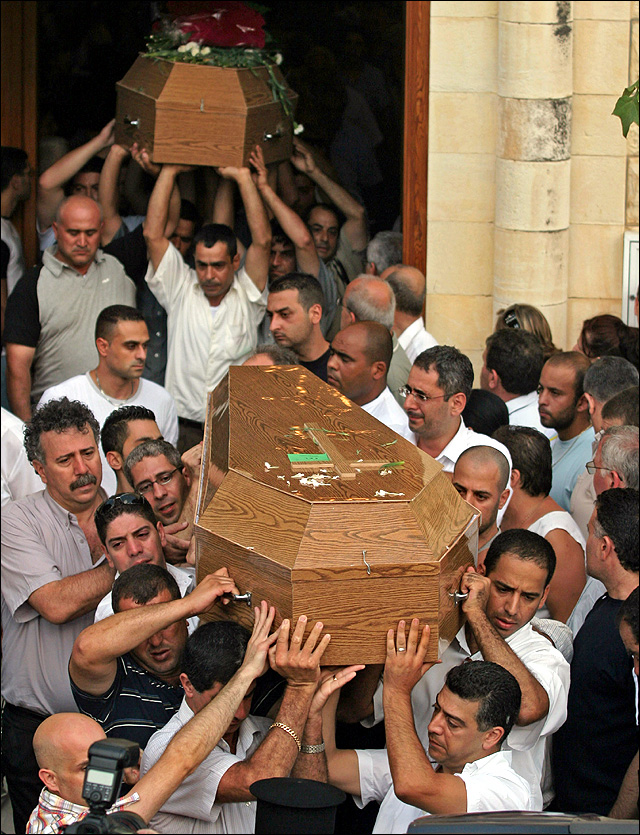
Mourners on Monday carry the coffins of Israeli Arabs Hanna Hamam, 62, and Ladida Mazzawi, 67, who were killed Sunday night in a Hezbollah rocket attack, in Haifa, northern Israel. Hezbollah fired its deadliest rocket barrage Sunday on Israel, killing 12 Israeli reservists and three civilians. That brought the Israeli death toll to 94.
No incentive to stop
Clashes between Israel and Hezbollah have sharply intensified in recent days as cease-fire diplomacy gains traction after nearly a month of unproductive talks. The cease-fire plan now under scrutiny at the United Nations has drawn only lukewarm support in Israel and vilification in the Arab world. Neither Israel nor Hezbollah has found an incentive to stop fighting, and both may be trying to gain advantage on the ground before a cease-fire.
At least 52 people died Monday on both sides. Hezbollah fired 160 rockets, wounding five Israelis, police and rescue services said. Three Israeli soldiers were killed in combat in south Lebanon, the first in an exchange of fire with Hezbollah fighters and the two others by an anti-tank missile, the Israeli army said.
With Arab League foreign ministers assembled around a horseshoe table, the embattled Lebanese leader repeatedly interrupted his opening address to gather his composure and wipe away tears. The foreign ministers cast their eyes downward in apparent embarrassment.
But Saniora’s impassioned appeal did not change minds in Israel, where hospitals in the war zone were working around the clock and under rocket fire to protect patients from harm – in some cases moving them into a basement. The defense minister threatened an expanded ground operation if diplomacy does not produce results soon.
“I gave an order that, if within the coming days the diplomatic process does not reach a conclusion, Israeli forces will carry out the operations necessary to take control of rocket launching sites wherever they are,” Israeli Defense Minister Amir Peretz said.
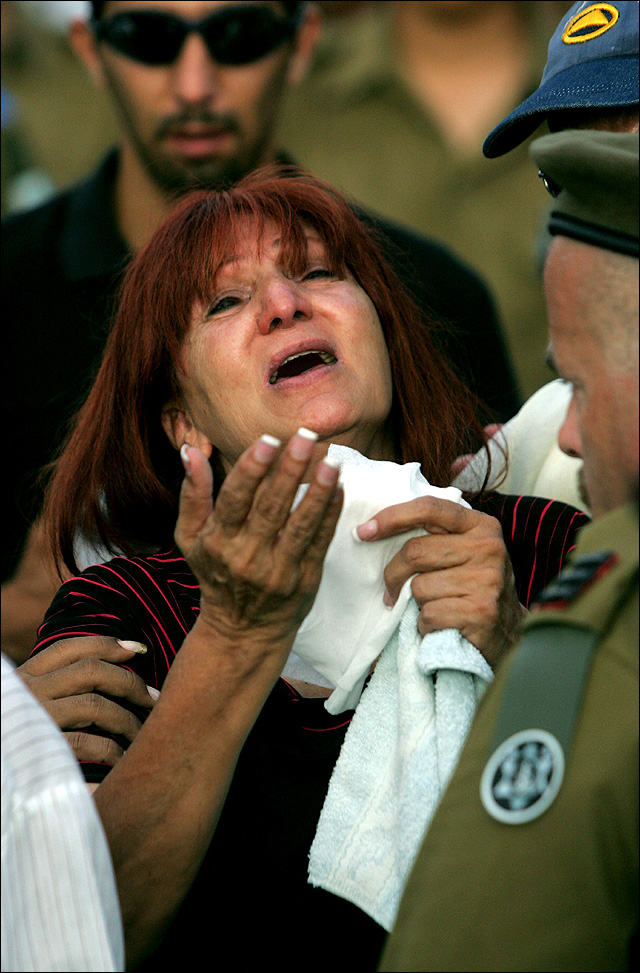
Ziona, the mother of Sgt. Major Roi Ya'ish, cries during his funeral at the military cemetery in the city of Herzeliya, north of Tel Aviv, Israel. Ya'ish, 27, was one of 12 reserve soldiers killed on Sunday by Hezbollah rockets in northern Israel as they were waiting to go into battle in south Lebanon.
Justice Minister Haim Ramon said Israel could not withdraw before the arrival of an international force. “The moment we leave, Hezbollah will return.”
Israeli Foreign Ministry spokesman Mark Regev told CNN a Lebanese army deployment in the south “in principle, is something, of course, we embrace and we support.”
But he said Israel wants to know “the rules of engagement” and whether this means the Lebanese army is finally going to start disarming Hezbollah.
Lebanon has been unable for nearly two years to implement a previous U.N. resolution calling for disarmament of the Shiite militants.
U.N. action
The new U.N. resolution under consideration calls for “a full cessation of hostilities” based on “the immediate cessation by Hezbollah of all attacks and the immediate cessation by Israel of all offensive military operations.”
But it makes no explicit mention of an Israeli withdrawal and implicitly allows Israeli defensive operations. Instead, it calls in the longer-term for a buffer zone in southern Lebanon – which Hezbollah controls and where Israeli troops are now fighting. Only Lebanese armed forces and U.N.-mandated international troops would be allowed in the zone.
France’s U.N. ambassador, Jean-Marc de La Sabliere, promised Monday to take into account Lebanon’s concerns that the resolution does not seek the withdrawal of Israeli troops. But he did not say whether France was prepared to add such language to the text.