

Romance writer dodges major ‘Complication’ with first novel
It took four years, two different manuscripts and several rejection letters, but Amy Knupp finally got her first book published.
“It was kind of surreal to actually hold it in my hands and read my name,” she says. “When I read the pages and saw my words there … it’s hard to find words to describe it.”
It’s easier to come up with words to describe the process of writing “Unexpected Complication,” a romance published by Harlequin. “Arduous,” “tedious” and “nerve-wracking” come to mind.
“I just soaked up as much information as I could,” the Lawrence resident says. “When I started out, I was very clueless.”
Long process
Knupp, 35, has been a fan of romances for a long time. But she set out in 2002, shortly after her second son was born, with the goal of writing a book herself.
When her first manuscript didn’t sell, she tried again, this time centering the book around minor characters from that first manuscript.
Knupp first submitted it to Harlequin in December 2003. She received two rejection letters from the publishing company, each one giving suggestions for revisions.
Harlequin finally purchased the book in July 2005 for its Superromance line, which publishes six books a month.
The Superromance line is especially known for breaking the mold of the previous generation of romance novels, which usually went something like this:
- Woman is in need of strong man.
- Strong man arrives.
- Others meddle in their relationship, or else circumstances make things tough for them.
- Love is made.
- Needy woman and strong man live happily ever after.
Knupp’s novel tells the story of Carey Langford, who learns she’s pregnant after ending a relationship. She seeks support from Devin Colyer, and the two eventually have feelings for each other. But the baby’s father is Devin’s cousin and a man he hates. He must balance his love for Carey and his concerns about the baby’s paternity.
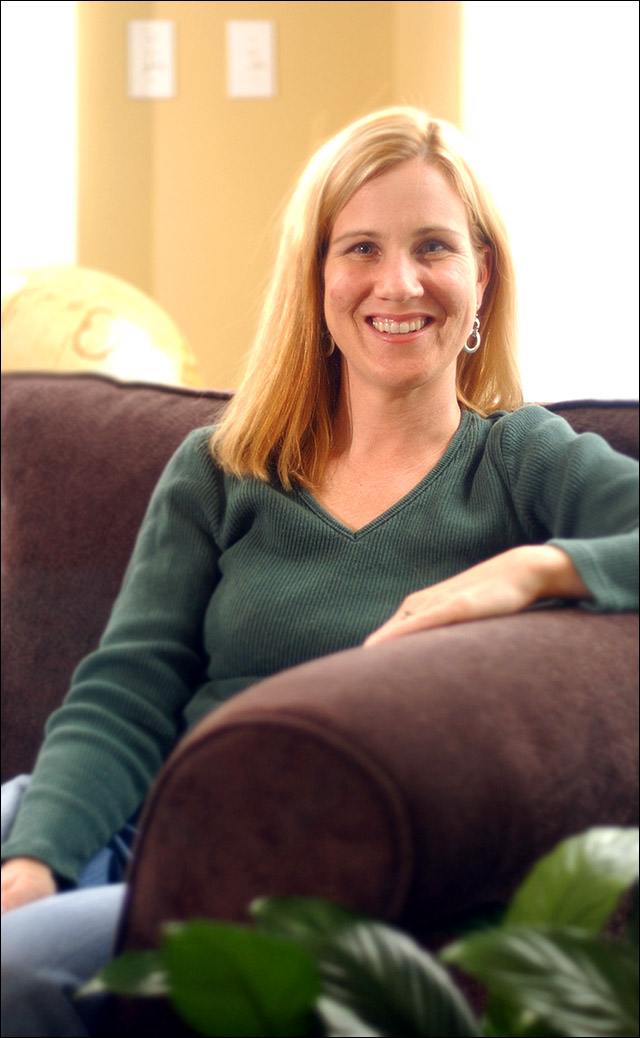
Lawrence author Amy Knupp has recently finished her first romance novel, Unexpected
“A lot of the story is really different from the first version,” Knupp says. “Some things are the same. The characters, generally, are the same – the main characters. But my subplots, I had to totally kill out some of those and start over, and a lot of the secondary characters got makeovers.”
Lessons learned
Flexibility and patience, Knupp says, were keys to getting the book published.
“I learned you need to be able to tear your story apart,” she says. “I see a lot of writers get totally married to their story the way it is or their characters the way they are. And I think the publishing process might be a little faster if you can take a piece of your story and totally get rid of it and redo it, because I did a lot of that.”
Through an online service of the Romance Writers of America, Knupp found two critique partners for her writing. One of them, Janette Kenny, lives just up the road in Leavenworth.
“Everybody, I think, has this misconception that writers just sit down and write the book, and, voilà , you have a book,” Kenny says. “And then, with a little tweaking, you have a best-seller. That first step of writing is more like giving birth to a baby.”
Kenny, who also recently got her first book purchased, says Knupp remained focused despite the long writing and revising process.
“She was very focused on it,” Kenny says. “We all go through internal doubts as you’re going through it.”
‘Gritty’ voice
Victoria Curran, Knupp’s editor at Harlequin, says first-time authors rarely break into the business on their first try.
Curran says Knupp’s writing voice separated her manuscript from others.
“I would say it was her characterization of her lead two characters,” Curran says. “The voice she brought to the story is a contemporary voice that is gritty at times and really, really modern. It’s relevant to today’s reader.”
Curran says once an author gets a book published, it’s much easier to get Harlequin’s attention on subsequent books. In fact, Knupp has a deadline next month for her second book with Harlequin.
She’s glad she stuck with her first book to get to this point.
“I had a door open,” she says. “I was going to do anything I could to use it.”