

Clocks subject to constant adjustments
Daylight-saving time starts the first Sunday in April. Time was measured by sundials until clocks were invented, and early clocks were set to sun time. In 1784, Benjamin Franklin thought it might be possible to productively use more daylight hours by adjusting the clock, but his idea was ignored until 1916. The Germans used daylight-saving time during World War I. It was introduced to save the energy used to light homes during the dark hours. The United States did not make it a law until March 1918, then repealed the law in 1919 and made time a local, not national, decision. During World War II, from 1942 to 1945, Americans lived year-round on daylight-saving time, called War Time. In 1966, the United States passed the Uniform Time Act and created eight time zones for U.S. states and territories. Clocks changed the last Sunday in April and the last Sunday in October. “Springing forward” to daylight-saving time the first Sunday in April began in 1986. Starting in 2007, daylight-saving time will begin on the second Sunday in March and end on the first Sunday in November. Digital clocks that use radio waves to keep time have made it possible for clocks to change time automatically.
I own a small, cylindrical container with a removable lid. Its body is made of thin wood with a metal ring at the bottom and around the lid. It’s 3 1/2 inches tall and 3 1/8 inches in diameter. The mark on the bottom reads “Patent Package Co., Newark, N.J., Pate. Aug. 31, 18–.” What is it?
The Patent Package Co. of Newark made lightweight wooden boxes for all sorts of products, including tobacco and spices. It also made hatboxes. Most boxes are marked with the patent date Aug. 31, 1858. Your small box was probably a spice box from a larger set.
Q: I bought a box of odds and ends at a show and found a cloth doll I would like to learn more about. Her tag reads “Honey Lou, 135491, 135492 pat. nos., Gund Mfg. Co., J. Swedlin Inc., 200 5th Ave., N.Y.C. 10 N.Y.”
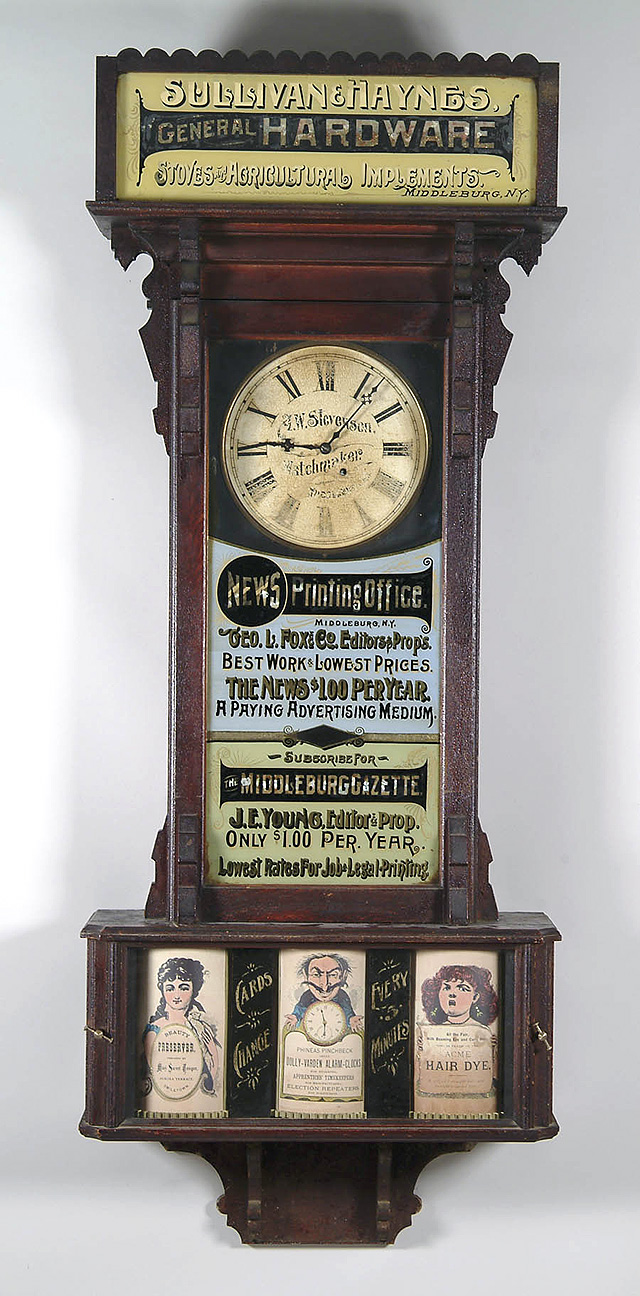
Time has always been important, especially for travelers. This clock not only tells time; it also advertises 13 different products. The lower ads revolve every five minutes while a bell rings. The clock hung in a New York hotel lobby from the 1880s until 2003. It sold last year at a James Julia auction in Fairfield, Maine, for 1,500.
A: There are two clues to the age of your doll – the postal code, 10, and the patent numbers, which refer to U.S. design patents. One- or two-digit U.S. postal codes were first used in 1943 and were replaced with ZIP codes in 1963. The design patent numbers on your doll’s tag were issued in 1943. So, your doll dates from the 1940s or possibly the ’50s. Adolph Gund, a German immigrant, founded his toy company in Norwalk, Conn., in 1898. He sold it to Jacob Swedlin in 1925 with the understanding that the company’s name would remain Gund. Gund is still in business and is best known for its plush animals and character toys.
Q: My husband has the clear glass nursing bottle he used when he was a baby. He was born 70 years ago in Sheffield, England. The banana-shaped bottle is 7 3/4 inches long with one flattened side. Both ends of the bottle are narrow and open. The logo on the bottle reads “Boots the Chemists.” What can you tell us about the bottle? Why are both ends open?
A: John Boot opened an apothecary shop in Nottingham, England, about 150 years ago. Your husband’s baby bottle dates from around the turn of the 20th century. It originally had a rubber nipple at one end and a release valve at the other to let air into the bottle as the baby sucked milk out. Old Boots banana-shaped bottles with two openings sell for about $30. Boots is still in business and still headquartered in Nottingham. Its products are sold at some Target and CVS stores in the United States.
Q: I recently purchased a vase that’s in perfect condition in upstate New York. It has a black-and-gold sticker on it that reads “California Originals – Torrance, Calif.” Any information?
A: California Originals, which made many types of ceramics, was the successor to a company called Heirlooms of Tomorrow. Heirlooms was founded in the mid-1940s by William Bailey, who changed the company’s name in the 1950s and moved it from Manhattan Beach to Torrance. California Originals, in business until about 1980, is probably best known for its cookie jars and ashtrays. But it also manufactured figurines, planters and vases. Don’t remove the sticker from your vase. Many California Originals pieces are not marked.
Q: About 30 years ago, I bought a combination table-chair decorated allover with hand-painted wood-burned flowers. The top of the table tilts up to form the chair back. The dealer told me it was a pyrography project made from a kit almost 100 years ago. Is there anything I can do to repair water damage on the legs and paint staining on the top? Should I have the chair refinished?
A: Refinishing the chair top would damage the original wood-burned decoration. However, you can do a simple cleaning with soap and a little water. The legs, if undecorated, can be refinished.
Tip
Always change your old clocks by turning the minute hand clockwise, never counterclockwise. If you are resetting a clock with a chime, be sure the clock rings each hour as you turn the hands.
Current prices
Current prices are recorded from antiques shows, flea markets, sales and auctions throughout the United States. Prices vary in different locations because of local economic conditions.
Hill’s Cascara Quinine Bromide pills calendar, “Cures Coughs and Colds in 24 hours, Cures LaGrippe in 3 Days,” 1903, 5 x 9 inches, $145.
“Gone With the Wind” Scarlett talc container, purple ground, image of Scarlett, Flirt Perfumed Talc by Pinard, 4 oz., $250.
Schoenhut Miss Dolly doll, open-closed mouth, brown decal eyes, blond mohair wig, 20 inches, $265.
1960 “John F. Kennedy for President” license plate, white ground, green letters, $310.
Silver-plated napkin ring, child feeding dog, Meriden Britannia Co., No. 199, $505.
Mickey Mouse adult-size tea set, ceramic, Mickey and Minnie decals, silver handles and ring design, France, 1930s, service for 12, $1,650.