

Former warlord says he is not guilty of war crimes
FREETOWN, Sierra Leone ? The man who was once Africa’s most feared warlord listened impassively to a litany of horrors couched in dispassionate legal language – cutting off of limbs and other body parts; rape, abduction and sexual slavery; pillaging; conscription of boys and girls.
Then Charles Taylor, whose war to rule Liberia dragged in nations across West Africa, firmly told a war tribunal, “I did not and could not have committed these acts.”
The judge accepted that as a not-guilty plea, and with that the first African president to be brought before such a court had been arraigned. As the hour-long hearing ended, Taylor, who is known for his flamboyance, stood and smiled and blew kisses to relatives.
Taylor’s appearance – three years after he was indicted and a week after he tried to escape being handed over to the court where he had been indicted for supporting Sierra Leonean rebels- forced him “to face the people of Sierra Leone, against whom he is accused of committing heinous atrocities,” the court’s chief prosecutor, Desmond de Silva, said in a statement Monday.
De Silva added a precedent had been set, “Those who commit atrocities and violate international humanitarian law will be held accountable, no matter how rich, powerful or feared people may be – no one is above the law.”
At the arraignment, Taylor’s defense attorney also asked that the case remain in Sierra Leone at the international court established to try those responsible for atrocities during the country’s 1991-2002 civil war.

Former Liberian President Charles Taylor, right, makes his first appearance at the Special Court in Freetown, Monday, April 3, 2006. Former Liberian President Charles Taylor pleaded not guilty Monday to war crimes and crimes against humanity, including sexual slavery, mutilation and sending children into combat.
Court officials have asked that the trial be moved to an international tribunal in The Hague, Netherlands, because of fears the 58-year-old Taylor could still destabilize West Africa.
Taylor said through his attorney that he feared for his safety in Sierra Leone but wanted to be tried in the region, in part because it would be easier for defense witnesses to testify. The court’s chief prosecutor has said Taylor has no reason to fear for his safety.
After accepting Taylor’s plea, Justice Richard Lussick instructed aides to set a date for the trial to begin. No date was immediately set, and Lussick said nothing about where the next hearing might be held.
De Silva has said the defense could be given months to prepare. He noted prosecutors took two years to compile their evidence, which defense lawyers will now have to review.
While most reporters watched on closed circuit TV from elsewhere in the complex, the audience area in the court chamber was filled with more than 100 people – among them Liberia’s ambassador and members of Taylor’s family. The courtroom was largely quiet, but there was a murmur when Taylor’s attorney said he wanted to be tried in Sierra Leone.
Taylor showed little emotion during the hearing, though at one point he shook his head as the indictment was read.
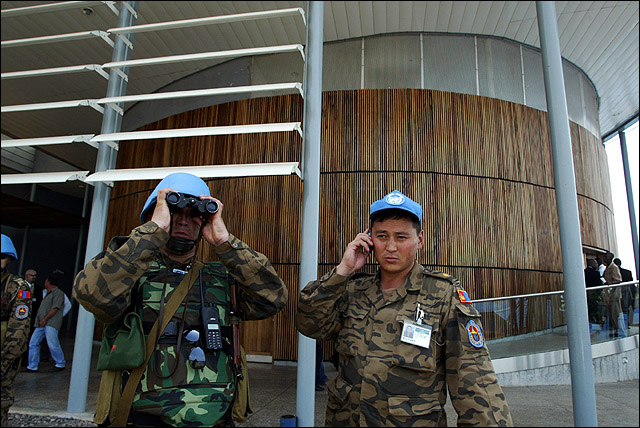
UN troops observe the area after the arrival of former Liberian President Charles Taylor at the Special Court in Freetown, Sierra Leone, Monday, April 3, 2006.Former Liberian President Charles Taylor pleaded not guilty Monday to war crimes and crimes against humanity, including sexual slavery, mutilation and sending children into combat.
Security was tight. Taylor – and court officials who have received death threats – were protected by bulletproof glass and by dozens of U.N. peacekeepers from Mongolia and Ireland.
A Liberian lawyer had said the defense strategy would be to argue that the Sierra Leone court has no jurisdiction over Liberia or its head of state and so no right to try Taylor, who was president when he was indicted in 2003.
Taylor appeared to allude to that Monday. The court’s appeals chamber had rejected a similar argument made soon after the indictment was filed.
Liberian President Ellen Johnson Sirleaf has expressed fear that Taylor’s supporters could use a trial in the region as an excuse to mount another insurgency in her country, one that could, like Liberia’s last war, spill across the region.