

Strong quakes kill dozens, destroy villages in Iran
Tehran, Iran ? Three strong earthquakes and several aftershocks early Friday reduced villages to rubble in western Iran, killing at least 66 people and injuring about 1,200 others, officials said.
At least 13 tremors jolted the mountainous region throughout the night, Tehran University’s Geophysics Institute said.
The U.S. Geological Survey reported a 5.7 magnitude quake shortly before 5 a.m. local time., followed by a 4.7 magnitude aftershock about 15 minutes later. The area had been hit by a 4.7-magnitude quake the day before, according to the USGS, which monitors earthquakes around the world.
The quakes were centered near Boroujerd and Doroud, two industrial cities about 210 miles southwest of Tehran, the official Islamic Republic News Agency reported.
The regional head of emergency response, Ali Barani, said about 200 villages were damaged, some flattened. Barani said hospitals in Doroud and Boroujerd were full to their capacity.
State-run television said a total of 66 bodies had been recovered from houses destroyed in Silakhor, a region north of Doroud. The broadcast said 1,200 people were injured.
Most people had been sleeping. They ran into the streets in panic and refused to return to their homes.
“We are afraid to get back home. I spent the night with my family and guests in open space last night,” Doroud resident Mahmoud Chaharmiri said by telephone.
Television showed survivors standing next to their destroyed houses in villages north of Doroud. The ground was strewn with the carcasses of sheep and goats killed by the quake.
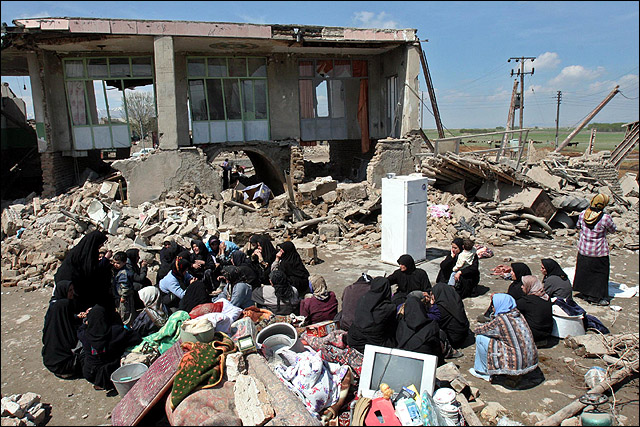
Iranian women mourn for the victims of the earthqauke which devastated their village of Khalegh Ali, 300 miles (500 kilometers) southwest of the capital Tehran, Iran, Friday, March 31, 2006. Three strong earthquakes followed by several aftershocks have jolted western Iran, killing at least 50 people and injuring at least 850, state media reported on Friday.
Such quakes have killed thousands of Iranians in the past, especially in the countryside where construction is often flimsy with many houses built of mud bricks. But initial reports suggested the devastation was not so widespread this time.
Officials called on doctors and nurses on leave to get back to work. Iranians are celebrating Nowruz, or new year, and most government offices are closed and their staff on holiday.
In February 2005, a 6.4-magnitude quake in southern Iran killed 612 people and injured more than 1,400.
A magnitude 6.6 quake flattened the historic southeastern city of Bam in the same region in December 2003, killing 26,000 people.
Iran is located on seismic fault lines and is prone to earthquakes.
On average, it experiences at least one slight earthquake every day.