

Barware makes festive collection
Martinis and fancy mixed cocktails have become popular again, so barware is needed to make the drinks. There are vintage examples of shakers, stir sticks, swizzle sticks, ice crushers, serving trays, ice buckets, cocktail napkins, pitchers and martini mixers. Drinking glasses of appropriate sizes and shapes – like old-fashioned tumblers (6 to 10 ounces), highball glasses (8 to 12 ounces), wine and martini glasses – were made in the 1920s and ’30s. Some say the cocktail shaker was an original American invention. Patents for drink mixers were registered in the United States as early as 1872, but it is the 1920s art deco shakers that are now collected.
A shaker could resemble an airplane, woman’s leg, bowling pin, zeppelin, golf bag, rooster or penguin. The 1920s shaker was probably made of sterling silver or silver plate. After the repeal of Prohibition in 1933, shakers were made of chrome-plated stainless steel, often with Bakelite trim. The major glass companies produced shakers of clear or colored glass decorated with silk-screened designs. There were also pottery shakers.
Some interesting sets of glass cocktail items were made by Hazel Atlas Glass Co. in the 1930s. The Sportsman series included a set with a cocktail shaker, ice bucket and tumblers. The glass was either clear or blue. The five different white silk-screened designs are Angelfish, Windmill, Tally Ho (a fox hunt), Ships (a sailboat) and Dancing Sailor. The designs were made in sets.
Q: For years, I have had a stuffed toy horse whose yellow blanket is stenciled with the name “Spark Plug.” What can you tell me about it?
A: Spark Plug is Barney Google’s rather pitiful racehorse. Barney Google was introduced to American comic-strip readers in 1919. The strip’s creator, Billy DeBeck, added Spark Plug to the strip in 1924. The horse was an immediate hit with readers. Today the strip is drawn by John Rose and is titled “Barney Google and Snuffy Smith.” Several versions of stuffed Spark Plugs were made. The value of yours depends on its age, condition, size and manufacturer. Look for a tag on the toy. It might tell you who made it and could also include a copyright date. A 1920s stuffed Spark Plug, in excellent condition, sells for about $125.
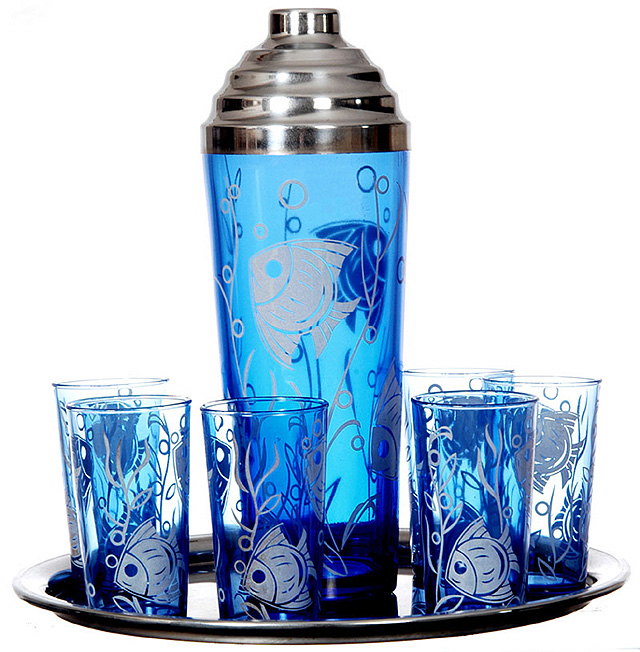
The blue glass Angelfish cocktail set was made in the 1930s by the Hazel Atlas Glass Co. of Washington, Pa. It sells for about 5
Q: At a Black Hills ranch auction several years ago, we bought a wooden rocking chair with a closely woven rush seat and back. It has never been refinished or repaired, and is in excellent condition. The family who owned it said their great-grandfather brought it from the East Coast in the late 1800s. The bottom of one of the chair’s arms is impressed with the printed mark “Manufactured by L.J. Colony, Keene, N.H.”
A: Wicker, including willow, rattan and reed, was widely used for furniture in the United States after the Civil War. But until 1900, the most popular wicker furniture was very elaborate, with fancy curlicues and open weavings. Your chair was most likely made around 1900, when the public’s taste moved toward simple, straight lines and tighter weavings. Colony is a well-known and historic name in Keene. Presumably, L.J. Colony was one of the members of that family; he is listed as the father of a 24-year-old woman who died in Keene in 1887. Other rocking chairs marked with his name are known.
Q: For the past 50 years, we have owned two small vases marked on their white bottoms with a double-A logo and the words “Van Briggle, Colo. Spgs.” They are both glazed in a pinkish maroon with a slightly blue cast. Can you date and price them?
A: Van Briggle Pottery was founded in Colorado Springs, Colo., in 1902 and is still in business. The “AA” logo stands for the pottery’s founders, Artus and Anne Van Briggle. Some designs and colors have been produced for decades. Van Briggle used white clay from 1930 to 1969, and the light-maroon glaze you describe is probably Persian Rose, produced from 1946 to 1968. Your vases are not as valuable as the older art pottery made at Van Briggle. In general, small Van Briggle vases the age of yours sell for about $50 each.
Q: My velvety Mickey Mouse scatter rug was given to me in the 1940s. It pictures Mickey in front of a music stand directing Minnie Mouse and Pluto as they sing. It’s 20 inches by 38 inches and is stamped “Italy” on the back. Is it worth much?
A: Disney throw rugs were imported from Italy and Belgium from 1935 until World War II. Today, an early rug like yours could sell for $150 to $350.
Tip
Do not use light bulbs over 25 watts to light a cabinet filled with glass. Stronger bulbs generate too much heat. There are some new types of bulbs that are brighter and give off less heat.
Current Prices
Current prices are recorded from antiques shows, flea markets, sales and auctions throughout the United States. Prices vary in different locations because of local economic conditions.
¢ Pinky Lee Xylophone toy, 1950s, Pinky on cover, Emenee, 14 inches, $45.
¢ Ex-Lax laxatives thermometer, porcelain, blue, black and red ground, “Keep Regular,” 36 x 8 1/4 inches, $210.
¢ Kleenex Sneezing Bear toy, eyes light, sneezes and wipes nose with Kleenex, original tin Kleenex box, battery, Linemar, $365.
¢ Staffordshire ironstone soup tureen, medium blue transfer, Corinth pattern, 1834-1848, 11 x 15 1/2 inches, $500.
¢ Stevens & Williams glass vase, oval, scalloped rim, yellow with pink interior, gold aventurine, applied vaseline glass handles and prints, 5 inches, $610.
¢ Carved shell cameo portrait of Samuel Atkins Eliot, 1798-1862, mayor of Boston, Whig to 31st Congress, treasurer of Harvard College, 1 1/2 x 1 1/2 inches, $700.
¢ Rocking chair, mahogany, curved and padded backrest, deeply scrolled arms, saber legs, haircloth damask upholstery, c. 1840, 25 inches, $940.
¢ English silver trifid-handle spoon, William III, Britannia standard, Francis Archbold, c. 1698-99, 7 1/2 inches, $1,100.
¢ Rosemeade ceramic ashtray, Fin & Feather pattern, $1,885.