

Blind faith
Brian Nelson picks up his 12-string guitar, rests it on his lap and feels for the frets.
His eyes point toward the ceiling. He can’t cheat by looking at the strings.
Nelson finds the proper hand position and begins strumming, belting out “Michael, Row Your Boat Ashore” in a deep base voice. He’s memorized the second and third verses, too – the ones most people don’t know.
This is a singalong, though not everybody wants to sing. Some of the 15 or so people in the room are sitting silently. Others know the words by heart, or at least some of them. And still others are following along with their hands, learning the words by Braille.
It wasn’t too long ago that Nelson and the others there didn’t have a church group designed exclusively for them – one that catered to the needs of the blind and visually impaired.
But now they’ve found a place to belong – at Immanuel Lutheran Church, which has started a once-a-month get-together for the blind.
“I think blind people are one of the populations that are the most lonely and most isolated,” says Nelson, who has been blind most of his life. “I think this can get them out and around people and doing things. That will help with the loneliness.”
Filling a void
The blind ministry group, which started meeting in July, is a mix of socialization and biblical teaching for a group that often finds it difficult to get to church, in part because most transportation services don’t operate on Sunday mornings.
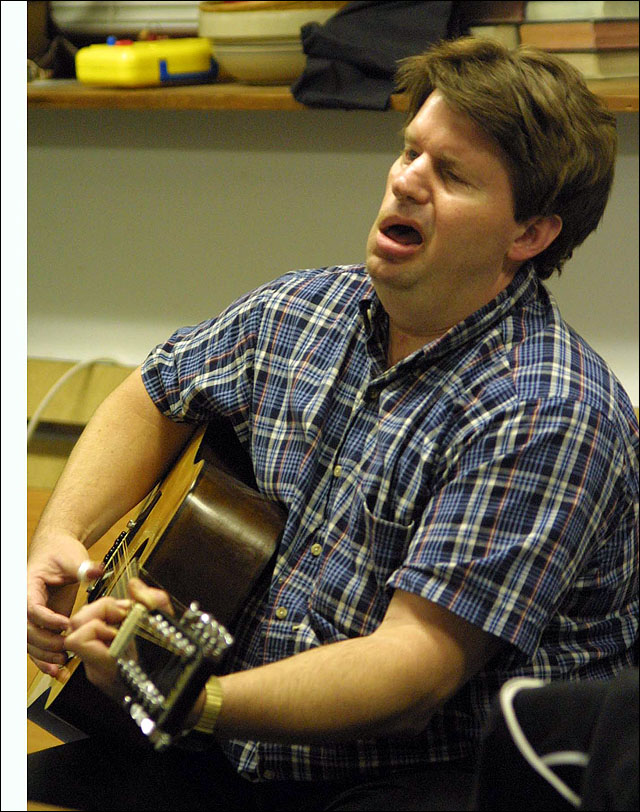
Brian Nelson, an organizer of the Blind Ministry at Immanuel Lutheran Church, leads hymn-singing at a recent gathering at the church. Nelson, who is blind, said many barriers often stand between the visually impaired and attending church.
“We’re just trying to fill that void,” says David Loomis, chairman of the blind ministry committee.
The group meets once a month, usually on the third Friday, at the church, 2104 Bob Billings Parkway.
It usually includes a meal, songs, brief Bible readings and plenty of time for the members to chat. Between 12 and 20 people have been coming, and Loomis hopes the numbers grow as word spreads.
“We try to make it a social gathering for all people,” he says. “We do have devotions and some church music, but it’s not all church music.”
As to whether the church hopes the blind ministry attendees become church members, Loomis says it’s a no-pressure approach.
“If it happens, it happens,” he says.
Lutheran history
The group continues a long tradition of Lutherans helping the visually impaired.
The Lutheran Blind Mission in St. Louis has North America’s largest Christian library serving the visually impaired, with Braille materials and books on tape. It also has 22 outreach centers across the country that provide resources, classes and other services.
Don Signor, a longtime Immanuel Lutheran Church member, said an article about the Lutheran Blind Mission in a church magazine prompted members to start thinking about starting their own blind ministry.
Signor, who is volunteering with the project, said he and others consulted with other churches in designing the blind ministry. They’re trying to get the word out about the group through social service organizations, ophthalmologists and optometrists, and other routes.
Signor says he hopes church members can identify specific needs for those who attend the blind ministry group. Some may need help around the house, he says, or rides to the store.
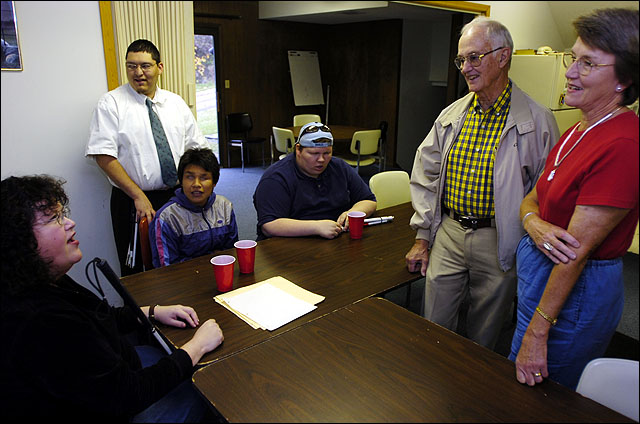
Church volunteers Don and Caroline Signor visit with participants in the blind ministry at Immanuel Lutheran Church, 15th and Iowa.
“We still have a lot of work to do,” he says.
‘Very accepting’
For Nelson, 44, the meetings are a highlight each month. He’s blind because of a pea-sized tumor in his brain that he’s had since he was a child.
“It’s still here,” he says, tapping lightly on the top of his skull.
He lives alone in an apartment, can see just enough to watch some TV and walks for exercise on the sidewalk that snakes around his apartment complex.
“There was nothing here (in Lawrence) for the blind people,” he says. “I think that’s not right. They’re a lost population, it seems like.”
The gatherings are a welcome event for Johnna Godinez, too. The 34-year-old has been losing her vision for 10 years because of retinitis pigmentosa, a condition that consumes eyesight starting with peripheral vision and working its way inward.
Godinez attends services on Sunday mornings at Grace Evangelical Presbyterian Church, 3312 Calvin Drive, when she can find a friend to give her a ride. But she likes being around other people with visual impairments in an informal, Christian setting.
“This is a group similar to other church groups that have like speaking to like,” she says. “We have church groups that are men’s Bible studies, women’s Bible studies, young mothers’ Bible studies. This is a chance for people with visual disabilities or blindness to eat and socialize.”
Godinez says it’s nice to know a church thought it was important enough to specifically reach out to the blind.
“It’s well-needed,” she says. “This is a pretty loving and free environment. It’s very kind and very accepting.”