

Reflecting on Greenspan
Longtime Fed chair to leave legacy
Washington ? Was Alan Greenspan just lucky? Was it just a matter of being in the right place at the right time? Or was there something about Greenspan’s abilities, judgments and hunches that set him apart as one of the most successful policymakers of his age?
The answers to these questions are important for investors as they face life after Greenspan.
As chairman of the Federal Reserve for the past 18 years, Greenspan conquered inflation and presided during the longest economic expansion in the post-war era. Under Greenspan, recessions were rare and mild, but the recoveries were frustratingly weak and jobless.
He made the Fed and himself in particular the center of Washington’s economic policymaking universe, pushing aside such centers of power as the White House and the Treasury.
He cemented his own reputation as the maestro of the markets, able to defuse a looming financial crisis with his bare hands.
He presided over one of the century’s great bull markets in stocks and bonds, but may have enabled a couple of the greatest speculative bubbles in history.
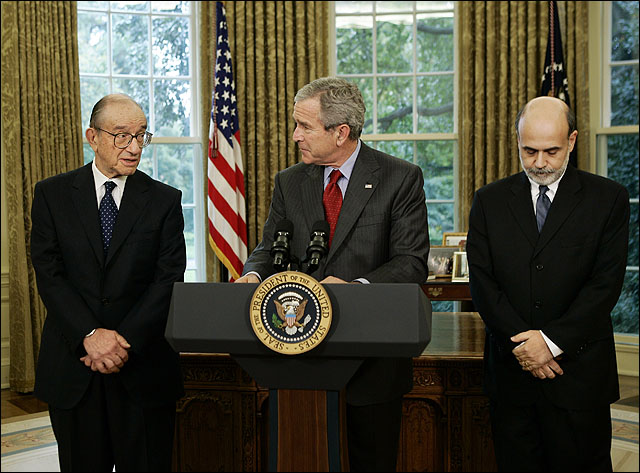
President Bush on Monday nominates his top economic adviser, Ben Bernanke, right, to become the new chairman of the Federal Reserve Board. Bernanke will replace Alan Greenspan, left, who became Fed chairman in 1987 and will complete his current term Jan. 31, 2006.
Greenspan steered the Fed toward more transparency about its policies and goals, but also entangled the central bank in side issues that might compromise its independence.
Who was the real Alan Greenspan?
Steadying influence
“He has almost single-handedly fostered an environment which allowed the economy to thrive,” said Gilbert Metcalf, a professor at Tufts University.
Tom Schlesinger, the executive director of the Financial Market Center, a think tank devoted to Fed policy, noted in a recent speech that during the past 20 years, recessions have occurred much less frequently than they did in the first 40 years following World War II.
At the same time, inflation and national unemployment have both dropped far below the levels people became accustomed to in the ’70s and ’80s, he said.
Of course, some of Greenspan’s critics don’t attribute this stability to his reign as Fed chief.
James Galbraith, a professor at the University of Texas, says that economic cycles are less violent now because the volatile manufacturing sector is no longer a key factor of economic growth.
Others say that Paul Volcker, Greenspan’s predecessor at the Fed, set the stage for his success in the battle against inflation.
But most economists say Greenspan will get credit for the economic conditions under his watch.
“Maybe he is lucky, but he is going to get credit,” said Oliver Ireland, a partner in the Washington law firm of Morrison & Foerster, who worked at the Fed in the ’70s and ’80s.
How did he do it?
Fed focus
The secret to Greenspan’s success was to keep the Fed’s primary focus on price stability even as inflation faded, economists said. Having won a few battles against inflation, Greenspan’s Fed kept at it to make sure the war was won.
“Volcker brought inflation down to about 4 percent – Greenspan took it the rest of the way,” said Alan Meltzer, a professor of economics at Carnegie Mellon who has written a book on the history of the Fed. “It was very hard to bring it down to 4 percent, but it was also very hard to bring it down from 4 percent because at that point people weren’t terribly concerned about inflation.”
The Greenspan Fed also proved that low unemployment and low inflation can coexist in the economy. One of Greenspan’s largest triumphs was resisting the economic consensus that rate hikes were needed in the late 1990s as the unemployment rate fell below 5 percent and then 4 percent.
This stability is even more remarkable considering the major economic crises during his tenure, including the 508-point drop in the Dow Industrial Average in October 1987, the Asian financial crisis in July 1997, the Russian debt default in August 1998, the dot-com bubble’s collapse in March 2000 and the terror attacks on Sept. 11, 2001.
Crisis management
And this is due to Greenspan’s second great legacy – a confidence that the Fed can handle crises. Financial markets have come to trust in this calm confidence from the central bank, limiting the wild swings in prices that often did more damage than the actual crisis.
“I think the Fed in the last decade has been a real model on how to deal with crises,” said Ann Owen, an economics professor at Hamilton College.
Greenspan will stand as one of the greatest Fed chairman, Fed historian Meltzer said.
But because central bankers spend most of their time out of the public eye, it is difficult to say precisely who Greenspan is.
When he did appear in public, investors were bemused by his Woody Allen-like appearance and his convoluted method of speaking.
“He is a little man, slightly stooped, balding, large nose, wide lips, wry smile. He wears thick glasses,” said Robert Reich, a Labor Department secretary under President Clinton, in his priceless description of a one-on-one lunch with Greenspan at the Fed in his 1997 book, “Locked in the Cabinet.”
“How did a shy little Jewish guy like you get to be the most powerful man in America?” Reich asked.
Born in New York City in 1926, Greenspan made a name for himself in the 1950s as an economic consultant to big businesses.
Greenspan entered politics as an adviser to President Nixon and first came to Washington in 1974 to chair the Council of Economic Advisors under President Ford, where he worked with many Republicans who are still on the scene, including Dick Cheney and Donald Rumsfeld.
Showing his political dexterity, Greenspan became an adviser to Ford’s political rival, Ronald Reagan, who as president appointed him as chairman of the National Commission on Social Security Reform in 1981.
The bipartisan panel proposed a mix of higher taxes and benefit cuts to shore up the system. More importantly, it got Reagan out of a political jam. He later repaid the favor by appointing Greenspan to be chairman of the Federal Reserve in 1987, replacing two-term chief Volcker, who had run afoul of Reagan aides including former Treasury Secretary James Baker.
As Fed chairman, Greenspan become a master at the Washington power game, skilled in winning over members of Congress, the executive branch and the press.
Mark Zandi, economist at Economy.com, said Greenspan had contacts within corporate America, Wall Street and the government and could call on those contacts and relationships when he needed to.
At the core, people who worked with Greenspan credit his absolute mastery of economic statistics for his success in winning over the Fed establishment.
“His mastery of the arcana of economic statistics, I think, was important in giving him confidence in what he wanted to do,” said Martin Mayer, author of a book on the Fed.