

Brazil’s forests shrinking faster than first thought
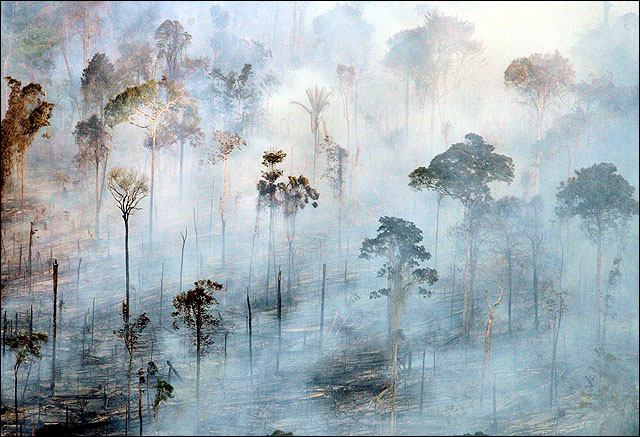
A forest burns near the city of Santarem in the Brazilian state of Para, in this Dec. 2, 2004, file photo. The Amazon rain forest, the world's largest is thought to contain at least 30 percent of all plant and animal species on the planet, most of them uncatalogued. A more detailed satellite observation of the area has detected increased selective logging.
Washington ? The damage to Brazil’s rain forest is much worse than had been thought, a new study shows.
The findings show much more widespread timber harvests than had been previously estimated, according to a report in Friday’s issue of the journal Science.
Losses in clear-cut areas where all trees are removed have been monitored by satellite observations, but those were not able to detect the cutting of individual trees in areas where others are left behind.
Now, a more detailed satellite observation system is able to detect selective logging.
Annually, selective logging disturbs an area totaling about the size of Connecticut, according to lead author Gregory Asner of the Carnegie Institution of Washington and Stanford University.
“Selective logging negatively impacts many plants and animals and increases erosion and fires. Additionally, up to 25 percent more carbon dioxide is released to the atmosphere each year, above that from deforestation, from the decomposition of what the loggers leave behind,” Asner said in a statement.
Illegal logging was even discovered in some protected national reserves, parks and indigenous lands, the researchers found.