

Recycled heirlooms treasured
Recycling is nothing new. Fabrics – usually hand-woven – were valuable in the 18th and early 19th centuries, and every little piece was saved and reused. Homemade and manufactured cloth was recycled in several ways. Strips of cloth were used for both woven and braided rugs and carpets. Later, strips were shirred for early pictorial rugs. The first hooked rugs – made by pulling a strip through a piece of loosely woven burlap – appeared about 1840. Many hooked rugs were designed and made by housewives. Today, collectors treasure these pieces of folk art. A number of these rugs picture a building or perhaps the maker’s own house. The style of the house can sometimes help to date the rug. Look for rugs with unusual designs and sturdy backing. A rug that has been kept in a damp place might have rotting burlap. This type of damage is almost impossible to repair.
Q: My aunt left me some sculpted Oriental figurines that she described as “mud figures.” Each one is in the form of a man wearing a green or yellow robe and sitting on a stool. One is holding a bottle, and another a tool of some kind. What can you tell me about mud figures?
A: Mud figures are small pieces of pottery made in China during the 20th century. Many were used to liven up fish bowls or planters. Some were made in the shape of trees or houses. Others, like yours, represent people. The faces and hands of the figures are unglazed, but their clothing is glazed. Until the 1980s, mud figures were of little interest to American collectors; then they caught on here. Now the figures can sell for more than $100 each. But collectors have to beware of reproductions.
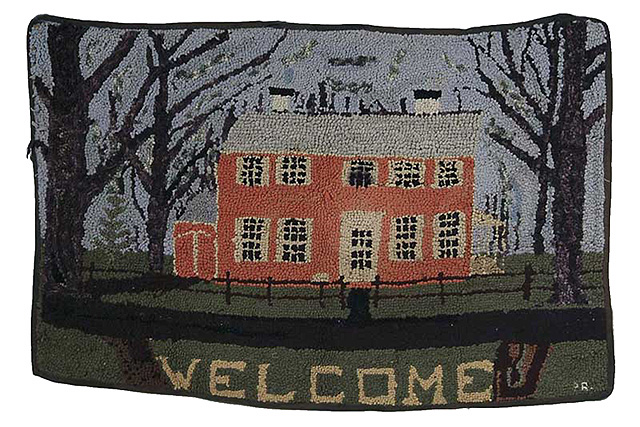
this hooked rug shows a large, red Colonial home and trees. The rug is 28 1/2 by 43 inches.
Q: I have a 15-pound bronze figure of a boy straddling a fence. He’s looking down at a large goose with its head up near the boy’s knee. The boy is wearing shorts, a jacket and a small, pointed hat. The figure is 11 inches high and 10 inches long, and is incised “Hummel” in capital letters on the back. I thought Hummels were made of pottery.
A: Your large bronze figure is a copy of the small ceramic Hummel figurine called “Retreat to Safety.” That figurine, introduced in 1948 and designed by Reinhold Unger, shows a small frog at the base, not a goose. “Retreat to Safety” has been made in two sizes – 4 inches high and 5 1/2 inches high. The W. Goebel porcelain factory in Rodental, Germany, has produced Hummel figurines since 1935. None are marked the way yours is marked. Whoever made your figure was copying the Hummel figurine, probably without authorization.
Q: My great-great-grandmother’s electric table lamp has been passed down to me. Both the lampshade and the base are made of textured glass that’s reverse-painted with a rural scene. Can you give me any information?
A: Reverse-painted shades for electric lamps were popular from about 1900 to 1930. Look for a mark on your lamp to identify the maker. However, many lamps were unmarked, and it’s difficult to figure out who made them. But even unmarked lamps are valuable if they’re in excellent condition.
Tip
Every few years, check the hooks that are holding your paintings on the wall. Eventually, nails and hooks can loosen and paintings will fall. Also check the wires on the backs of your paintings.
Current prices
Current prices are recorded from antiques shows, flea markets, sales and auctions throughout the United States. Prices vary by location.
¢ Cracker Jack puzzle, parrot, paper, 1946, 2 1/4 x 3 1/4 inches, $20.
¢ Boy Scout patch, National Jamboree, Irvine Ranch, California, 1953, 3 inches, $45.
¢ Cabinet card set, views of Santa Barbara (Calif.) earthquake damage, 1925, set of 10, $160.
¢ Baccarat glass paperweight, multicolored garland, white lace and vaseline ground, 1971, 3 3/8 inches, $225.
¢ Planters Peanuts ceramic mug, peanut-textured design featuring Mr. Peanut in green pants, peanut-shell handle, c. 1930, 4 3/4 inches, $500.
¢ Our Gang Tipple-Topple game, cardboard fence, figures of Fatty, Wheezer, Pete, Farine and Mary Ann, All Fair Inc., 1930, Hal Roach Studios, box, $310.
¢ Navajo rug, central diamond, black, white, gray, tan and cream, wool, c. 1940, 45 x 69 inches, $670.
¢ Clarice Cliff Bizarre Ware vase, cream ground, landscape in Patina Country pattern, c. 1930, 9 3/4 inches, $1,295.