

Guatemala’s Indians refuse soldiers’ help, deal with dead
Santiago Atitlan, Guatemala ? A Guatemalan Indian community, haunted by a government-sponsored massacre during the country’s brutal civil war, refused soldiers’ help Monday in recovering those killed in a week of flooding and mudslides and conducted its own searches instead.
Guatemalan officials were likely to give up searching for 384 missing throughout the region. They will likely be added to the 652 people already declared dead across Guatemala from rains last week associated with Hurricane Stan, raising the total number killed to more than 1,000. Another 133 people were killed in El Salvador, Mexico, Costa Rica, Nicaragua and Honduras.
In Guatemala’s isolated western township of Tacana, near the Mexico border, rescue workers on Sunday recovered more than 130 bodies from a mudslide that buried a shelter where people had taken refuge.
In Panabaj, a community on the outskirts of Santiago Atitlan buried by a mudflow a half-mile wide and up to 20 feet thick, residents on Sunday blocked troops who had come to help dig out victims.
“The people don’t want soldiers to come in here. They won’t accept it,” said Panabaj Mayor Diego Esquina, who said memories are still too vivid of a 1990 army massacre of 13 villagers. In all, tens of thousands died at the hands of soldiers and death squads in the 1960-96 civil war.
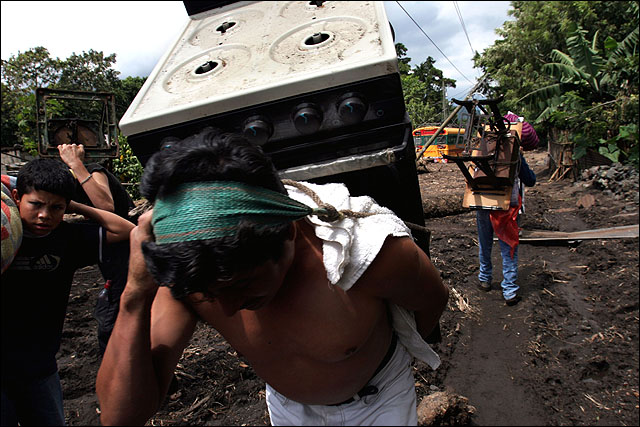
A Mayan Indian mudslide victim carries a stove from the wreckage of his home Monday in Santiago Atitlan, a town where hundreds are believed to have died in last week's mudslides in Guatemala.
“There is a very strong resistance in the name of maintaining their culture,” said Rodolfo Pocop, 35, a Santiago Atitlan resident who represents a national Indian rights group.
All the mudslide victims were Sutujil Indians. There are only about 100,000 Sutujil Indians in the country, and all live in communities on the shores of Lake Atitlan, Pocop said.
The Indians struggled Monday to reconcile the demands of tradition – which require that bodies be recovered and buried exactly 24 hours after dying – with the shifting fields of mud and rotting corpses.
Experts “have advised us not to dig anymore because there is a great danger” that the still-soaked earth may collapse again, said Uvaldo Najera, a Tacana municipal employee.
Hundreds of Mayan villagers who had dug for victims in previous days gave up their efforts Sunday.
Guatemalan Vice President Eduardo Stein said steps were being taken to give towns “legal permission to declare the buried areas cemeteries.”
Indian residents of Santiago Atitlan, dressed in embroidered shirts and cotton, knee-length shorts with sashes, performed incense- and herb-laden rituals both to pacify the spirits of the dead and to ask to be spared from further disasters.