

ElBaradei, IAEA share 2005 Nobel Peace Prize
Vienna, Austria ? Mohamed ElBaradei prides himself on remaining cool under pressure, but he showed unusual flashes of emotion on learning Friday that he and his International Atomic Energy Agency had won the 2005 Nobel Peace Prize.
His eyes misted up several times behind his glasses as he spoke with reporters about the delight – and surprise – he felt when he heard on television that he and the U.N. nuclear watchdog had been picked to share the world’s most prestigious award.
“This came as an absolute surprise to me,” the austere, 63-year-old IAEA director general told reporters. “I was just on my feet with my wife, hugging and kissing and full of joy and full of pride.”
Because he stayed home Friday instead of coming into his office, he missed the Nobel committee’s phone call to IAEA’s Vienna headquarters, as well as a visit from Norwegian diplomats bearing a floral bouquet.
ElBaradei figured someone else had been honored – until he heard his name on TV.
The Nobel endorsement has particular resonance for ElBaradei, strengthening him in a job he nearly lost over a dispute with the United States over Iran and Iraq. His winning, he suggested, vindicated his methods and goals – using diplomacy rather than confrontation and defusing tensions in multilateral negotiations that strive for consensus.
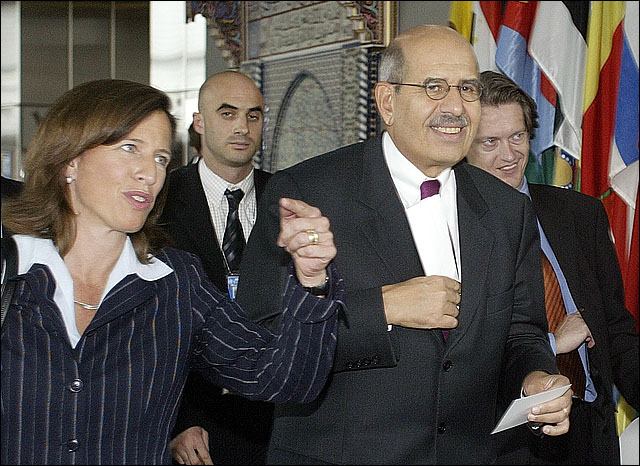
International Atomic Energy Agency Director General Mohamed ElBaradei and his spokeswoman, Melissa Fleming, left, head to a news conference Friday after the announcement that ElBaradei and the IAEA will share the 2005 Nobel Peace Prize.
He also suggested the conflict with Washington was past, saying Secretary of State Condoleezza Rice “wished me well” in a congratulatory phone call.
The Bush administration has bristled at ElBaradei’s positions on the nuclear threat posed by Iran and Iraq and unsuccessfully lobbied to block his appointment to a third and final four-year term this year. The Nobel was viewed as a major boost to the Egyptian diplomat and his mandate to curb nuclear proliferation.
ElBaradei and the IAEA locked horns with Washington in the run-up to the 2003 Iraq war by challenging U.S. claims that Saddam Hussein possessed weapons of mass destruction. More recently, ElBaradei’s refusal to back U.S. assertions that Iran has a covert nuclear weapons program has hardened opposition to him within the Bush administration.
A ‘message’
After the award was announced, ElBaradei refrained from criticizing the United States in comments to Associated Press Television News and two other media outlets.
“I don’t see it as a critique of the U.S.” he said Friday. “We had disagreement before the Iraq war, honest disagreement.”
Instead, ElBaradei said, the honor was “a message – ‘Hey guys, you need to get your act together; you need to work together in multinational institutions.”‘
The award also was a signal “going to the Arab world, going to the Western world that we … have a lot in common and we need to work together to survive,” ElBaradei said.
Describing his phone conversation with Rice, he said they both “agreed that we will have to continue to work together” on issues including dispelling suspicions about Iran’s nuclear ambitions and getting North Korea to return to the nonproliferation fold.
“The award sends a very strong message: ‘Keep doing what you are doing,”‘ he said. “We continue to believe that in all of our activities we have to be impartial, objective and work with integrity.”
In Washington, Rice reaffirmed in a statement that the Bush administration was “committed to working with the IAEA to prevent the spread of nuclear weapons technology.”
The Nobel Committee recognized ElBaradei and the U.N. nuclear agency “for their efforts to prevent nuclear energy from being used for military purposes and to ensure that nuclear energy for peaceful purposes is used in the safest possible way.”
“At a time when disarmament efforts appear deadlocked, when there is a danger that nuclear arms will spread to states and to terrorist groups, and when nuclear power again appears to be playing an increasingly significant role, IAEA’s work is of incalculable importance,” it said.
ElBaradei and the agency were among the favorites to win as speculation mounted the Nobel Committee would seek to honor the victims of nuclear weapons and those who try to contain their use.