

Tribal reparations discussed at First Nations summit
Kelowna, British Columbia ? Indian chiefs and Inuit leaders came to this former frontier town Thursday to hash out with Canadian officials a multibillion-dollar plan to fight poverty and disease on native reserves and settle damage claims for mistreatment.
Prime Minister Paul Martin, participating in the two-day summit along with the premiers of Canada’s 13 provinces and territories, got a jump on talks Wednesday by proposing a $1.7 billion payment for aboriginal victims of sexual and psychological abuse during forced Christian schooling.
Some 100,000 children were required to attend such residential schools during the past century, and the sad history of their abuse has long been cited by Indian leaders as the root cause of epidemic rates of alcoholism and drug addiction on reserves.
Native reserves also are short 20,000 to 35,000 housing units, their high school graduation rate is just over half the national average, and life expectancy for Indians is five to seven years lower than for non-aboriginals.
Leaders of Inuit groups and the First Nations – the term used in Canada for Indian tribes – came from around the country for the unprecedented gathering.
“Without question, the summit is historically significant,” Stewart Phillip, chief of the Penticton Indian band and president of the Union of British Columbia Indian Chiefs, said just before the summit opened with tribal ceremonies and traditional prayers.
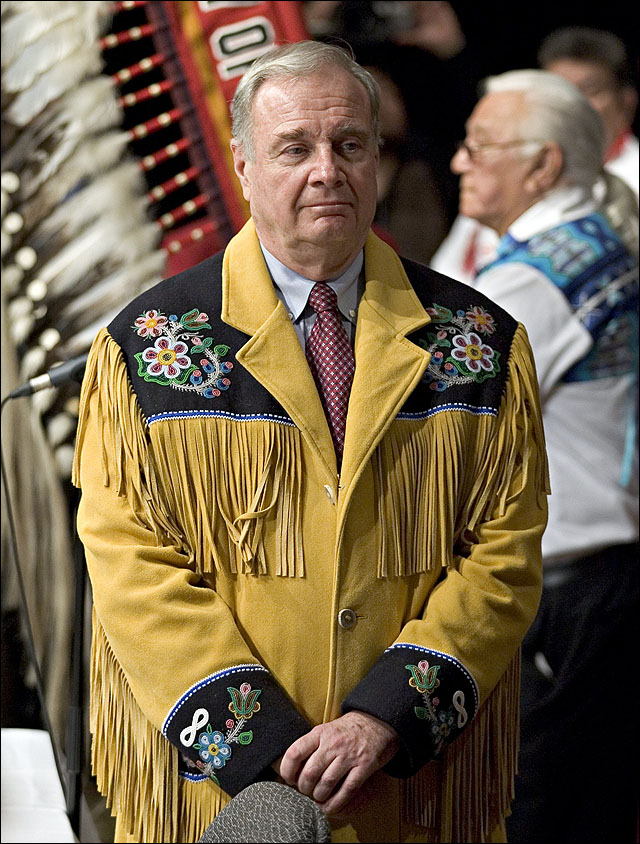
Canadian Prime Minister Paul Martin stands in a traditional coat he was presented with before a meeting between government officials and aboriginal leaders in Kelowna, British Columbia. Summit participants will discuss how the government should fund programs to fight poverty and disease among native people, and settle damage claims for past grievances.
“In many respects, the First Nations meeting represents a symbolic beginning to a 10-year process toward irradiating the deplorable and disgraceful social and economic conditions for First Nations communities in Canada,” Phillip said.
The federal government currently spends upward of $6.8 billion a year for aboriginal groups, but problems abound.
Government sources said Martin was expected to announce today a plan to spend as much as $3.4 billion over the next five years to improve housing on native reserves and to boost health care, education and economic development for Canada’s estimated 700,000 Indians and 45,000 Inuit.
“Canada has a Third World in its front yard and back alleys,” Phil Fontaine, national chief of the Assembly of First Nations and one of the key negotiators at the summit, wrote in the Canadian edition of Time magazine this week. “That is a national tragedy and an international embarrassment.”
Still, Fontaine hailed Martin’s proposal to set aside $1.7 billion for compensation payments and healing programs to atone for decades of abuse aboriginal children suffered when they were forced to attend residential schools meant to Christianize them. The proposal must be approved in court to cover more than 21 class-action lawsuits against the federal government.