

China’s leader says he’ll reduce trade imbalance
Bush uses visit to push for religious freedom
Beijing ? President Bush called on China on Sunday to expand religious, political and social freedoms and urged steps to reduce Beijing’s huge trade surplus with the United States. President Hu Jintao promised steps to resolve economic frictions.
The two leaders conferred at the Great Hall of the People on the edge of Tiananmen Square, and Hu said they both sought an outcome of “mutual benefit and win-win results.”
There appeared to be no breakthroughs about U.S. demands for currency reforms in China and no concrete announcement about how China would cut its trade surplus with the United States, on track to hit $200 billion this year.
Hu promised Bush that China would take steps to reduce its trade imbalance with the United States, but he did not discuss any specific steps. He said China was willing to step up protection for intellectual property rights and would “unswervingly” press ahead with currency reform – an area where the United States says Beijing has not lived up to its promise for improvement.
“The two sides also expressed their willingness to join hands together to gradually achieve a balance of trade between China and the United States,” Hu said through a translator. “The frictions and problems that may arise in this rapid development of the two-way trade may be properly addressed through consultations.”
Regional issues
The two leaders met amid tensions about China’s rising economy and military might. They readily acknowledged differences but stressed areas of cooperation, from preventing and controlling bird flu to persuading North Korea to abandon its nuclear ambitions in exchange for aid, diplomatic recognition and security guarantees.
“Our two nations seek a Korean peninsula that is stable, at peace and free of nuclear weapons,” Bush said as he thanked China for leading the six-country talks about North Korea’s nuclear program.
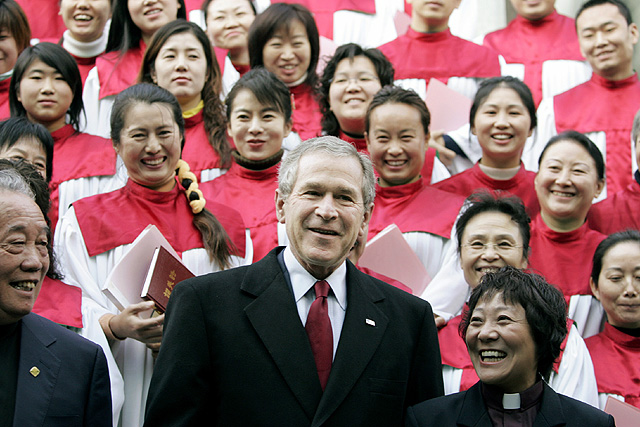
U.S. President George W. Bush, center, is pictured with the Rev. Du Fengying, right, and the Rev. Yu Xin Li after attending morning services at Gangwashi Church in Beijing. Bush arrived Saturday evening in the Chinese capital.
Bush noted that the latest round of negotiations in September ended with a joint statement in which North Korea committed to abandoning all nuclear weapons and all existing nuclear programs.
“The United States expects them to honor that commitment,” Bush said.
Bush briefly mentioned U.S. concerns about China’s growing thirst for oil – which has driven up gasoline prices in the United States.
“We had a good talk about energy,” Bush said. “China is a growing economy and China recognizes, like the United States recognizes, in order to keep our economies growing in the years to come, we’ve got to share technology and diversify away from hyrdocarbons.”
Bush said the relationship with China was important for the United States and “this trip will make it stronger.”
He invited Hu to come to the United States next year, a makeup for a visit that was postponed in September because of Hurricane Katrina. Hu accepted, and the official Xinhua News Agency said the Chinese president would make the trip early next year.
Faith-related business
Bush, however, chose to make a worship service his first public event during a two-day state visit to China. The significance of Bush’s visit to the church, a modest marble-and-brick building tucked off an alley, was clear to the congregation of about 400.
Bush received a standing ovation when he entered the sanctuary, which looked much like a classroom with wooden movie theater seats. There was more applause when the pastor announced his presence, and members of the choir assembled outside to see Bush off afterward.
“The spirit of the Lord is very strong inside your church,” Bush said.
The service at Gangwashi Church, one of five officially recognized Protestant churches in Beijing, was in Chinese, but its structure and content would have be familiar to any Protestant parishioner in the United States. Bush and other guests listened to a translation over headphones.
In the church’s guest book, Bush wrote “May God bless the Christians of China.”
Under the president’s inscription, the first lady wrote: “And with love and respect, Laura Bush.”
This month, the State Department cited China, a land of 1.3 billion people, as one of eight countries of “particular concern” for denying religious freedom.