

Have a relatively stress-free holiday
Don't let family dynamics bend you out of shape this season
The temperature’s dropping, and your blood pressure’s rising.
The mere thought of planning meals, picking out gifts, dodging traffic and, most of all, dealing with relatives might be enough to make you want to hop a plane to the tropics and skip holidays with the family altogether.
Some people do just that.
But for the vast majority, the winter holidays bring us together with friends and family we may not see any other time of year. And with the amped-up stress inherent in the season, your brother’s jab about how “Mom’s gravy never had lumps,” your grandma’s comments about your weight and your Uncle Mort’s tendency to get drunk at family get-togethers may hit you harder than usual.
But there are ways to cope. One strategy involves choosing your battles.
“In terms of defensiveness and anger management, it’s always a good idea, when you feel that twinge in your stomach – or wherever you feel it in your body when it stings – to take a step back and ask yourself whether it’s worth addressing,” says Christy Blanchard, an adult outpatient services psychologist at Bert Nash Community Mental Health Center.
“It could be something just as simple as taking a deep breath and changing the subject.”
To the brother who dislikes your gravy, “I’ll never make it as well as mother” might be an effective response to move the conversation away from the topic without acknowledging the negativity.
It’s also important going into the holiday season that you understand your expectations and those of your family. The best way to ensure you’re all on the same page, Blanchard says, it to engage in open, honest communication.
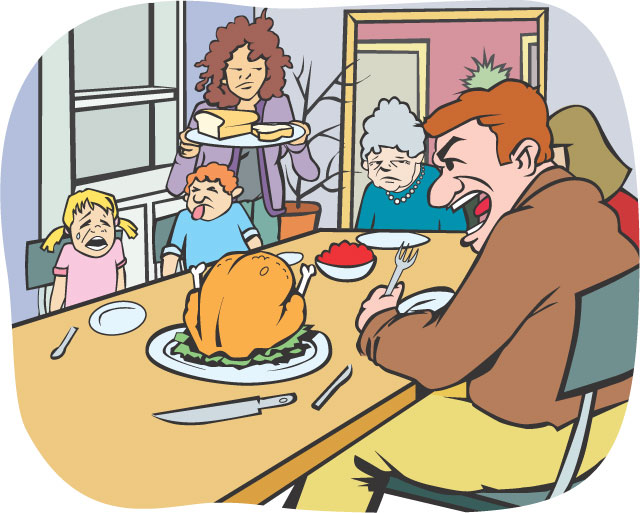
Maybe it’s become a family tradition for everyone to watch you slave over the stove from 5 in the morning on Thanksgiving until the 14-dish feast is served. Perhaps this year you can ask whether your guests expect turkey and all the fixings or if a nice pot of chili would do the trick. If they can’t live without the elaborate fare, offer to open your home for the festivities and watch the kids while the rest of the family takes a turn cooking.
“Start to share responsibility,” Blanchard says. “That also can open up new family traditions.”
Returning home
Of course, breaking routine can be alarming for some family members. College students returning after their first semester away have been going through a lot of changes at school, and they expect constancy at home. Altering their room, the Thanksgiving menu or the annual evening around the Monopoly board may send them into mild shock.
Parents should be sensitive to that possibility, says Kathryn Nemeth Tuttle, associate vice provost for student success at Kansas University, and include their children in decisions about change.
Students also should be prepared for family members to notice the way they’ve changed while away from home – and be ready to deal with their reactions.
They may not like your new tattoo, your new major or your new eating habits.
“Don’t be dogmatic about your changes,” Tuttle says. “I don’t think you have to make a big point when grandmother has prepared turkey dinner to give a small lecture about why it’s important to be vegan. Hopefully you’ve matured enough that you can say, ‘These are some changes that seem important to me, but I’m not going to impose them on you.’
“Or just eat the vegetables and shut up.”
On the flip side, parents should ease off their children.
“They’re the ones, hopefully, that are the mature ones,” Tuttle says. “My hope would be that the parents would be the ones to be understanding and give the student a little space to grow.”
Take a break
Despite your best attempts at achieving family harmony during the holidays, occasional squabbles, misunderstandings and hurt feelings are inevitable. Those aren’t the times to raid the liquor cabinet or polish your Ginsu knives. Taking breaks and maintaining your health can go a long way toward helping you manage stress and anxiety.
“If you’re feeling overstimulated, take a walk,” Blanchard suggests. “I think we often get started with the holiday train and we just feel like everything is required, and in doing so we don’t give ourselves permission to step back and take a break.”
If you exercise regularly, don’t stop during the holidays. Take your running shoes or your yoga mat to Grandma’s house. Don’t overeat. Get plenty of sleep. And avoid alcohol.
“If you’ve had more than a drink or two, you’ll notice the next morning you don’t feel very well-rested, even though you may have passed out,” Blanchard says.
In the end, setting boundaries in a way that’s sensitive to other family members may save you a lot of undue stress and heartache.
“Not everyone should have to celebrate the holidays in the same way,” writes Karen Beery in Bert Nash’s e-newsletter for November. “In fact, it should be all right NOT to celebrate, to slow down and simplify the season.”
Ten tips for parents of college students: How to keep the holidays happy
Kansas University offers 10 tips for students and parents dealing with the holiday stress, especially those in situations where the student is returning home for the first time since experiencing a new independent life at college.
1. Talk with your student about your expectations for the visit in advance so there are no surprises.
2. Discuss the house rules and how they might differ from what the student has experienced the past four months.
3. Give students time to catch up with high school friends, and establish family time. Students may also need time to be alone, take walks or go to another room and read. Give yourself and your student space.
4. Understand that disagreements between students and parents can be discussed and not just swept under the rug.
5. Accept your differences. The relationships you have with your family are far more important than winning an argument.
6. Keep a sense of humor while your student is at home. Try to laugh off the small conflicts.
7. Cultivate a mutual respect across generational lines for different values and needs.
8. Encourage your student to be a considerate guest and not tie up the telephone or computer lines or hog the television.
9. Have realistic expectations about the visit. Look forward to it, but do not expect a magical visit simply because your student has been away at college.
10. Having a good visit home involves planning and a willingness to adapt behaviors to the situation. While your student has been changing, you and other family members have, too. Share what has changed and enjoy what is new.
Kathryn Nemeth Tuttle, associate vice provost for student success and former director of KU’s Freshman-Sophomore Advising Center, recommends that parents ask questions and offer encouragement during the holidays.
“Talk with your student about what went well in the fall semester, what they found challenging and what adjustments they plan to make for the spring semester,” she says. “It is vital that college students learn to navigate the academic system at KU on their own. But parents can maintain an active role by asking questions, keeping the communication lines open and talking with them about their current and future classes.”
Parents should also encourage their students to talk with their academic advisers, instructors or faculty members and to take advantage of the many student assistance offices at KU, Tuttle says.